By Sinéad Carew and Sophie Kiderlin
NEW YORK/ LONDON, Feb 6 (Reuters) – MSCI’s global equities gauge rallied 1.5% on Friday for its strongest advance in months, after falling in five of the prior six sessions, while bitcoin also bounced from a sharp selloff and spot gold and silver prices regained some lost ground.
Oil prices settled slightly higher as investors monitored talks between the United States and Iran and assessed the possibility of a supply-disrupting Middle East conflict.
An equities rally on Wall Street boosted the global index as investors crept back into U.S. technology stocks, particularly semiconductors. Tech shares sold off massively in the prior three sessions on concerns about spending and competition disruption related to the artificial intelligence boom.
AMAZON SPENDING PLAN INFLATES AI TOTAL
Amazon.com shares finished down 5.6% after it announced huge spending plans late on Thursday, upping the total for a combined 2026 AI spending spree by Amazon, Microsoft, Alphabet and Meta Platforms to an estimated $600 billion. The tech sector was also hit this week by worries about AI disruption in the software and data services sectors.
Regarding the S&P 500’s bounce on Friday, Robert Pavlik, senior portfolio manager at Dakota Wealth in Fairfield, Connecticut, pointed to technical buying after the benchmark lost ground in six of the last seven sessions and the index hit its 100-day moving average. This added support, along with bitcoin’s turnaround and investor reconsideration of AI fears.
“The market looks like it was getting a bit overdone to the downside so you’re seeing a rebound in technology and some industrials and financials stocks. It was a healthy selloff,” said Pavlik, also suggesting that investors had recalculated when AI disruption to the software industry would materialize.
“The realization that this is not something that’s happening today brought a little bit cooler heads to the market,” he said.
The biggest gains were concentrated in chipmakers, with the Philadelphia semiconductor index rallying 5.7% after three straight daily losses. The S&P 500’s software and services index ended up 2.4% after losing more than 17% in the last seven sessions.
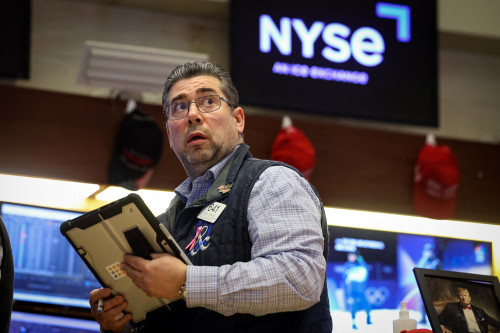
On Wall Street, the Dow Jones Industrial Average rose 1,206.95 points, or 2.47%, to 50,115.67, for a record closing high and its first above the 50,000 mark.
The S&P 500 climbed 133.90 points, or 1.97%, to 6,932.30, with its industrials, staples and energy sectors marking record closes. The economically sensitive Dow Jones Transportation Average index also notched a record-high finish.
The Nasdaq Composite finished up 490.63 points, or 2.18%, at 23,031.21, for its biggest one-day gain since late November.
For the week, the Nasdaq sank 1.84% while the S&P 500 eased 0.1%, but the Dow climbed 2.5%.
MSCI’s gauge of global stocks rose 15.74 points, or 1.53%, to 1,042.98, tracking its biggest one-day gain since May. But the index of stocks from 47 countries was still showing a small loss for the week.
Earlier, the pan-European STOXX 600 index finished up 0.89%, but it fell slightly for the week.
CRYPTO, PRECIOUS BOUNCE
Cryptocurrencies managed a strong rally to staunch a bruising selloff for now after a wipeout on Thursday, which was part of a larger decline that has knocked $2 trillion in value from the market since October.
Bitcoin gained 10.79% to $69,909.01. Ethereum rose 10.88% to $2,047.77.
“Whether or not this bounce continues is questionable. It’s brought some questions into bitcoin as a store of value and the relative safety that it brings but, when it bounces, you don’t get the margin calls like you would probably be getting when it’s selling off,” said Pavlik.
In precious metals, gold advanced with help from bargain-hunting, a slightly weaker dollar and lingering concerns over U.S.-Iran talks in Oman. Silver recovered from a 1-1/2-month low.
Spot gold rose 3.93% to $4,957.39 an ounce. U.S. gold futures gained 2% to $4,958.50 an ounce. Spot silver rose 8.6% to $77.36 an ounce.
SURVEY SHOWS IMPROVEMENT IN U.S. CONSUMER SENTIMENT
In currencies, the safe-haven dollar index was lower as risk assets rebounded. Earlier, the greenback pared some losses after a U.S. survey showed that consumer sentiment improved marginally in early February amid lingering worries about the labor market and the rising cost of living.
The dollar index, which measures the greenback against a basket of currencies including the yen and the euro, fell 0.36% to 97.61, with the euro up 0.41% at $1.1823.
Sterling strengthened 0.67% to $1.3616 after falling in the previous session.
But against the Japanese yen, the dollar strengthened 0.04% to 157.1, as investors monitor Sunday’s election, in which Prime Minister Sanae Takaichi aims to strengthen her majority in parliament.
In U.S. Treasuries, two-year U.S. Treasury yields bounced back from a more than three-month low ahead of January’s delayed payrolls report, which will provide clues on the strength of the labor market next week.
On the U.S. monetary policy front, traders were still betting that the next U.S. Federal Reserve rate cut would be in June, according to the CME Group’s FedWatch tool.
The two-year note yield, which typically moves in step with interest rate expectations for the Fed, rose 1.3 basis points to 3.496%, from 3.483% late on Thursday.
The yield on benchmark U.S. 10-year notes fell 0.4 basis points to 4.206%, while the 30-year bond yield fell 1 basis point to 4.853%.
Oil prices settled slightly higher. Iran’s top diplomat said the nuclear talks with the U.S., mediated by Oman, were off to a good start and set to continue.
U.S. crude settled up 0.41%, or 26 cents, at $63.55 a barrel, and Brent settled at $68.05 per barrel, up 0.74%, or 50 cents.
(Reporting by Sinéad Carew, Sophie Kiderlin, Gregor Stuart Hunter, Rae Wee and Tom Westbrook; Additional reporting by Dhara Ranasinghe; Editing by Jacqueline Wong, Andrew Heavens Gareth Jones, David Holmes, Edmund Klamann, Rod Nickel)