By Promit Mukherjee
OTTAWA, Dec 15 (Reuters) – Canada’s annual inflation rate was 2.2% in November, unchanged from the previous month, and driven primarily by food prices rising at their fastest pace in more than two years, Statistics Canada said on Monday.
A year-on-year drop in the costs of gasoline and shelter partially offset the rise in food prices, the statistics agency said.
It was the first month since March that core measures of inflation, which strip out volatile items like food and gasoline, came in below 3%, the upper end of the Bank of Canada’s control range.
Analysts polled by Reuters had forecast annual inflation of 2.3%.
November’s monthly inflation matched analysts’ estimates of 0.1%, down from 0.2% in October, StatsCan said.
Canada’s annual inflation has been subdued since April due to the removal of a carbon levy on the sale of gasoline. This has kept the price of the fuel low on a year-on-year basis.
StatsCan’s data showed that the price of gasoline was up 1.8% in November when compared with October, but on an annual basis it was 7.8% lower.
Without the effect of gasoline, November’s CPI was 2.6%.
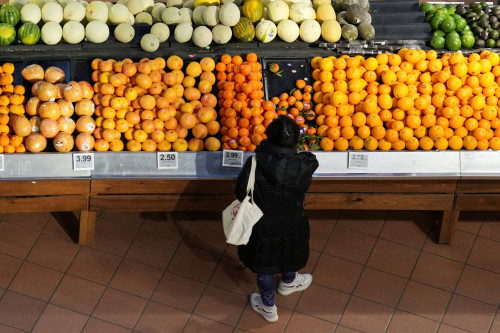
Food prices overall rose by 4.2% on a yearly basis in November, the biggest increase since December 2023, spurred by a 4.7% rise in grocery prices and a 3.3% increase in the cost of food purchased from restaurants, StatsCan said.
Adverse weather conditions in growing regions and President Donald Trump’s import tariffs are considered to be driving up food prices, StatsCan said. Coffee, in particular, is imported to the United States and then shipped on to Canada. Beef prices in North America are high due to a small cattle herd in North America.
But most other components largely cooled from the previous month in signs that prices were not heating up amid tariffs.
“Central bankers can take comfort that a stagflationary environment is not emerging,” Royce Mendes, Managing Director & Head of Macro Strategy at Desjardins, wrote in a note.
The Bank of Canada’s preferred measures of core inflation – CPI-median and CPI-trim – had hovered around 3% since April when Trump’s tariffs started to take effect.
CPI-median, the centermost component of the CPI basket, edged down to 2.8% in November from 3% in the prior month. CPI-trim, which excludes the most extreme price changes, was also at 2.8% last month from 3% in October.
The Canadian dollar firmed slightly after the data, trading up 0.07% to 1.3761 to the U.S. dollar, or 72.67 U.S. cents. Yields on Canada’s two-year government bonds were down 2.3 basis points at 2.486%.
(Reporting by Promit Mukherjee; Editing by Dale Smith, Kirsten Donovan and Nick Zieminski)