May 19, 2026
Ford (NYSE: F) — Someone Just Bought the Whole Factory
Ford Energy, EDF Power Solutions, and what the first real commercial commitment means for the thesis
Ford (NYSE: F) — Someone Just Bought the Whole Factory
Here’s the part that keeps pulling me back in.
Ford Energy – a subsidiary that didn’t exist in any commercial form until early May – just signed a deal that would fill its entire projected annual production capacity from the moment the Kentucky facility goes live. Not a portion of it. Not a pilot allocation. All of it. EDF Power Solutions North America agreed to a five-year framework under which it can procure up to 4 GWh per year of Ford Energy’s DC Block battery storage systems – totaling 20 GWh of potential volume over the contract term, with first deliveries scheduled for 2028.
Ford’s Kentucky 1 production site is targeting at least 20 GWh of annual capacity by late 2027. Do the math. The first commercial customer just ordered the whole thing.
That is not how speculative energy subsidiaries typically launch. That is how you signal that the demand was already there before the press release went out.
To understand why this matters structurally, you have to go back to December 2025. That’s when Ford announced it would fully acquire the Kentucky plants following the dissolution of the BlueOval SK joint venture with SK On – a venture originally designed to produce EV batteries at scale. When EV demand didn’t materialize at the pace that justified the investment, Ford didn’t write off the real estate and move on. It pivoted the entire operation toward grid-scale battery energy storage and built a new subsidiary around it.
Ford Energy was unveiled commercially on May 11, 2026. Twelve days later, it had a customer.
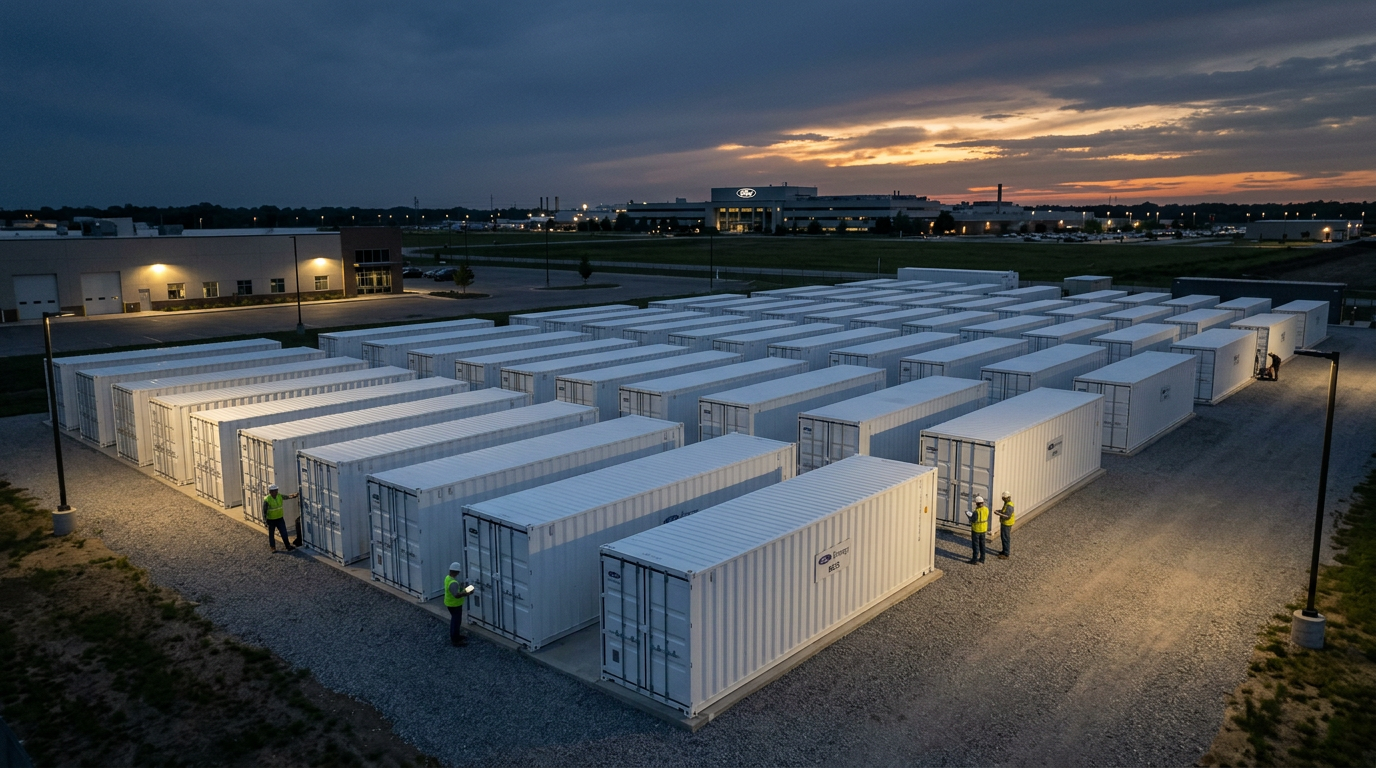
The product at the center of the deal is the Ford Energy DC Block – a 20-foot containerized BESS unit built around 512 Ah LFP prismatic cells, purpose-built for utility-scale deployment across grid, data center, and large C&I applications. Assembled in the United States. That last detail matters more than it usually would. In a tariff environment where imported hardware carries real cost risk and FEOC compliance is a live procurement consideration, domestic assembly is a competitive differentiator – not a marketing point.
Brief tangent worth noting: EDF Power Solutions isn’t a startup chasing cheap components. It’s the entity formed by combining EDF Renewables and EDF Group International Division across North America – part of the broader EDF Group, which develops, builds, and operates low-carbon generation, flexible power assets, and electricity transmission infrastructure across the continent. When an operator of that scale commits to a supplier framework, procurement decisions within that portfolio tend to follow. This is not a one-time transaction. It is a preferred-supplier relationship being set from day one of commercial operations.
In at 9:35 AM. Out by 10.
I call it the “Opening Bell Breakout.” It’s the same setup I used to catch moves like 113% on GOOGL and 240% on META. I trade one simple 15-minute window each morning – and I’m usually done by 10 AM.
What the Parent Company Actually Looks Like Right Now
Context matters for positioning, so let’s not skip the financials.
Ford’s full-year 2025 revenue came in at a record $187.3 billion, up roughly 1% from $185 billion in 2024. Top line, it looks fine. Under the surface, the company absorbed one of its worst unadjusted loss years since the financial crisis – a GAAP net loss of $8.2 billion, compared to net income of $5.9 billion in 2024. The bulk of that swing came from approximately $17.4 billion in pre-tax special items: the BlueOval SK write-down, program cancellations, and the broader EV strategy reset. Full-year adjusted EBIT landed at $6.8 billion, down sharply from $10.2 billion in 2024, dragged by a $2 billion net tariff hit and a $1.5–$2 billion disruption from the Novelis aluminum supplier fire that took chunks out of high-margin truck and SUV production in Q4. Adjusted Q4 EPS came in at $0.13 against a $0.19 consensus – a 32% miss.
The segment breakdown tells a cleaner story than the headline number:
- Ford Pro (fleet & commercial): the undisputed earnings engine – more than $66 billion in revenue, $6.8 billion EBIT, double-digit margins; paid software subscriptions up 30% year-over-year
- Ford Blue (ICE): $101 billion in revenue (flat), $3.0 billion EBIT; higher pricing offset a 5% decline in wholesale volumes
- Model e (EV): full-year EBIT loss of $4.8 billion – a $300 million improvement from 2024; 2026 loss guidance set at $4.0–$4.5 billion as cost reductions continue
- Ford Credit: full-year EBT of $2.6 billion, up 55% year-over-year
- Liquidity: $3.5 billion in adjusted free cash flow; $21.3 billion in operating cash flow; approximately $29 billion in cash and $50 billion in total liquidity at year-end
- CapEx: $8.8 billion actual in 2025; 2026 guidance of $9.5–$10.5 billion includes approximately $1.5 billion earmarked for Ford Energy’s initial production ramp
For 2026, management is guiding for adjusted EBIT of $8–$10 billion and adjusted free cash flow of $5–$6 billion. Segment targets: Ford Pro EBIT of $6.5–$7.5 billion, Ford Blue EBIT of $4.0–$4.5 billion, Model e loss of $4.0–$4.5 billion, Ford Credit EBT of approximately $2.5 billion. The analyst consensus sits at a Hold with an average price target in the $13.29–$13.56 range (low end $10, high end $16 across 13 analysts). 2026 EPS consensus is approximately $1.55.
The stock’s P/E is sitting well below 6 at current levels. That’s not a growth multiple. That’s a market saying: show me you can execute something new. Ford Energy’s EDF deal is the first concrete answer to that question.
“Top Gun” Energy Is Entering the Space Economy
In Top Gun, Maverick’s need for speed wasn’t about thrills – it was about survival.
That same dynamic is emerging in the space economy.
As satellites and hypersonic systems move from research into real-world use, speed is starting to determine who stays relevant.
Testing delays, launch bottlenecks, and crowded schedules are slowing everything down.
The next advantage isn’t just bigger rockets. It’s faster access and faster validation.
A small, operational aerospace company is positioning right at that pressure point – where speed, testing, and access come together.
The Market Ford Energy Is Walking Into
Grid-scale battery energy storage is one of the few infrastructure categories where demand is outpacing supply chain readiness right now. AI data center construction is the loudest driver – hyperscale facilities are drawing power at load profiles that swing rapidly and unpredictably, and grid interconnection queues in most U.S. regions are running 3–5 years deep. BESS isn’t optional for that buildout. It is what allows variable power procurement to match continuous operational demand.
C&I and utility-scale BESS deployment is projected to grow significantly through 2030 and into the mid-2030s, driven by AI infrastructure, 5G densification, and industrial electrification. The segment Ford Energy is targeting – domestic, utility-grade, IRA-compliant – is specifically the slice that enterprise procurement teams and utilities can actually bankroll without tariff exposure or FEOC risk. Chinese-assembled hardware is running into both. Ford’s Kentucky footprint avoids both.
Fluence and Tesla Energy are established in this market. Better capitalized, longer track records, deeper utility relationships. That’s real. But neither of them is standing up a domestic LFP assembly operation at the scale Ford is targeting – and neither has the manufacturing infrastructure Ford has spent a century building. Whether that institutional discipline translates into BESS execution is the open question. It’s also the reason the stock isn’t pricing any of this in yet.
Options Setup
F options have historically tracked a 90-day implied volatility range of 30–35%, consistent with a large-cap industrial mid-transformation. The put/call skew has not been pricing extreme tail-risk hedging – directional uncertainty is elevated, but the market isn’t loading up on downside protection. That could shift if the Ford Energy narrative fails to produce additional catalysts before Q3 earnings.
Recent tape behavior suggests support clustering near $12.70. Post-announcement resistance sits at the intraday highs. Next hard catalyst: Q3 earnings, expected late July 2026. That’s the window where the Ford Energy narrative either picks up commercial momentum or stalls out – and the options market will price accordingly in the weeks ahead.
One thing worth sitting with: elevated near-term IV after a catalyst event tends to make directional calls expensive. Premium sellers find covered structures attractive in this environment. Traders who want exposure to the Ford Energy thesis without overpaying for near-term noise are better served by longer-dated structures – September or October expiry gives the narrative time to develop without buying into an IV spike that deflates over the next few weeks.
The NEXT Trillion Dollar Company?
It just signed a deal to get its tech in Apple’s iPhone until 2040! Online commenters are debating if this brand-new company will be the 7th trillion dollar stock.
Three Ways to Think About Positioning
Analysis only. Three frameworks based on how different traders interpret the setup. All defined-risk. None of this is advice.
- If you believe this deal is the first of several: The production line is committed before it goes live. A second framework agreement before Q3 earnings would materially accelerate the re-rating conversation. Defined-risk long structures – call spreads targeting $14–$15 with September or October expiry – capture that scenario. Anchor stop logic near $12.70. The tape has already moved; a pullback into the low $12s would offer better entry than chasing today’s close.
- If you believe the execution gap is underpriced: First deliveries are 2028. Ford Energy has no revenue, no production track record in this segment, and sits inside a parent company carrying $4.0–$4.5 billion in Model e losses and $9.5–$10.5 billion in CapEx commitments for 2026. If Q3 adds nothing new on the Ford Energy front, the stock likely drifts back toward $10–$11. A put spread – long $12 put, short $10 put – is a defined-risk expression of that view.
- If you believe the story is real but the clock is slow: Ford’s dividend yield at current prices provides an income layer while the thesis develops. A covered call overlay – selling $14–$15 calls against a long equity position – generates premium while preserving exposure to a partial re-rating. Patient capital structure. Long the pivot, short the hype cycle’s timeline.
Where the Risks Actually Live
Worth being direct about what could go wrong here, because the bull case is easy to construct and the bear case deserves the same analytical space.
- The framework is not a binding offtake. EDF has the right to purchase up to 4 GWh per year. They are not obligated to. Actual volumes depend on their project pipeline and Ford Energy’s delivery performance. Shortfall below the cap is a realistic outcome.
- Zero production track record. Ford Energy has never manufactured a BESS unit at commercial scale. The 20 GWh capacity target requires a full $2 billion deployment by late 2027. Any production ramp delay, supply chain friction, or cell supply disruption pushes deliveries and revenue further out.
- Policy risk is real. The IRA domestic content incentives that underpin Ford Energy’s cost competitiveness are subject to legislative change. A restructured incentive regime materially alters the competitive equation.
- The parent is not in a position to absorb large misses. Ford Pro is carrying the company right now. If Pro margins compress – tariff pressure, fleet pricing softness, or another supply chain disruption – capital allocation toward Ford Energy faces internal competition.
- Fluence and Tesla Energy are not standing still. Ford Energy has a window. It is not unlimited. Better-capitalized competitors with established utility procurement relationships will not wait for Ford to figure out production.
The re-rating question is simple to frame and genuinely hard to answer. Does this deal catalyze a new narrative around Ford, or does it fade into the quarterly noise while the market waits for 2028 deliveries to actually happen?
What I keep coming back to: the market opportunity is not speculative. The BESS buildout is happening. Data center demand is not slowing. Domestic supply chain constraints are real. Ford built the right product in the right location at a moment when procurement teams are actively looking for alternatives to imported hardware. The EDF deal is the first hard evidence that Ford Energy can close commercial customers – not conceptually, but on paper, at volume.
Execution is still unproven. The clock starts now. And the tape just moved before the factory has produced a single unit.
Tactical Summary
- ✦ The deal: 5-year framework with EDF Power Solutions North America – up to 4 GWh/year, 20 GWh total potential volume; first deliveries 2028; Ford Energy’s first publicly disclosed commercial commitment
- ✦ The product: Ford Energy DC Block – 20-ft containerized, 512 Ah LFP prismatic cells, utility-scale BESS; U.S.-assembled at BlueOval Battery Park (Kentucky 1), Glendale, KY
- ✦ Production target: At least 20 GWh annual capacity by late 2027; ~$2B total CapEx commitment; ~$1.5B earmarked in 2026
- ✦ FY2025 financials: $187.3B revenue (+1% YoY, record); $6.8B adj. EBIT; –$8.2B GAAP net loss (~$17.4B pre-tax special items); $3.5B adj. FCF; $8.8B CapEx; $50B total liquidity
- ✦ Segment snapshot: Ford Pro – $6.8B EBIT, $66B+ revenue; Ford Blue – $3.0B EBIT, $101B revenue; Model e – $4.8B EBIT loss; Ford Credit – $2.6B EBT (+55%)
- ✦ 2026 guidance: Adj. EBIT $8–$10B; adj. FCF $5–$6B; CapEx $9.5–$10.5B; Model e loss $4.0–$4.5B; Ford Credit EBT ~$2.5B
- ✦ Analyst consensus: Hold; avg. price target $13.29–$13.56 (range $10–$16, 13 analysts); 2026 EPS est. ~$1.55
- ✦ Options: 90-day IV historically 30–35%; post-catalyst IV elevated; longer-dated structures (Sep/Oct) preferred over near-term; next hard catalyst Q3 earnings late July 2026
- ✦ Primary risk: Framework agreement, not binding offtake; no production track record; 2028 first delivery; competition from Fluence and Tesla Energy; IRA policy exposure
This editorial is for informational and analytical purposes only. Nothing contained herein constitutes financial, investment, or trading advice. All trade structures referenced are illustrative frameworks only. Past performance is not indicative of future results. Options trading involves substantial risk of loss. Always conduct your own due diligence and consult a qualified financial professional before making any investment decision.
– The Editorial Desk