
The capital-markets recovery thesis took a public hit on Monday, and the verdict on how far the damage spreads arrives this afternoon.
Brian Moynihan projected investment banking revenue of between $1.6 billion and $1.8 billion in the third quarter, down from $2 billion in the same period a year earlier, landing $200 to $400 million below where Wall Street had modeled the number. That compares to a second quarter in which Bank of America posted a 50% jump in investment banking fees and a 33% jump in sales and trading revenue. The reversal is abrupt enough that investors have a genuine question: was Q2 the peak, or just a breather before a longer up-cycle?
Shares of BofA extended losses after his comments, dropping a little over 5% by late afternoon trading. Goldman Sachs, Citigroup, and Wells Fargo also fell on Moynihan’s comments. The sector move matters because it signals that institutional investors are treating BofA’s warning as an industry read, not a company-specific miss.
The Bull Case Still Has a Pulse
Moynihan did not walk away empty-handed on the longer view. He pointed to a robust deal pipeline, particularly in middle-market investment banking. “Right now we’re seeing it solid, and the pipelines are staying full,” Moynihan said. Bulls will read that as a timing problem, not a structural one: deals are in process, not cancelled, and a congested Q3 calendar can spill into Q4 volume.
There is also a base-effects argument. Moynihan noted that Q3 2025 was an unusually strong quarter and that flat performance against that benchmark is still solid by historical standards. On trading specifically, Moynihan said he expects sales and trading revenue to be relatively flat versus $5.4 billion in the third quarter of 2025.
The Bear Case Is About the Thesis, Not the Quarter
Here is where the debate gets harder to dismiss. The recovery thesis that lifted bank stocks through the first half of 2026 rested on a specific chain of logic: deregulation unlocks M&A, M&A unlocks advisory fees, advisory fees lift earnings estimates, earnings estimates re-rate multiples. The muted outlook from the country’s second-largest bank by assets could be an early signal that Wall Street’s AI-fueled advisory and trading boom might have hit turbulence.
That leaves open the question of whether the third-quarter slowdown is a temporary lull in deal timing or a more durable shift. If it is the latter, banks that have re-rated on capital-markets optimism, Goldman Sachs and Morgan Stanley in particular, are carrying expectations that the current environment cannot support.
What Petno Says Changes the Calculus
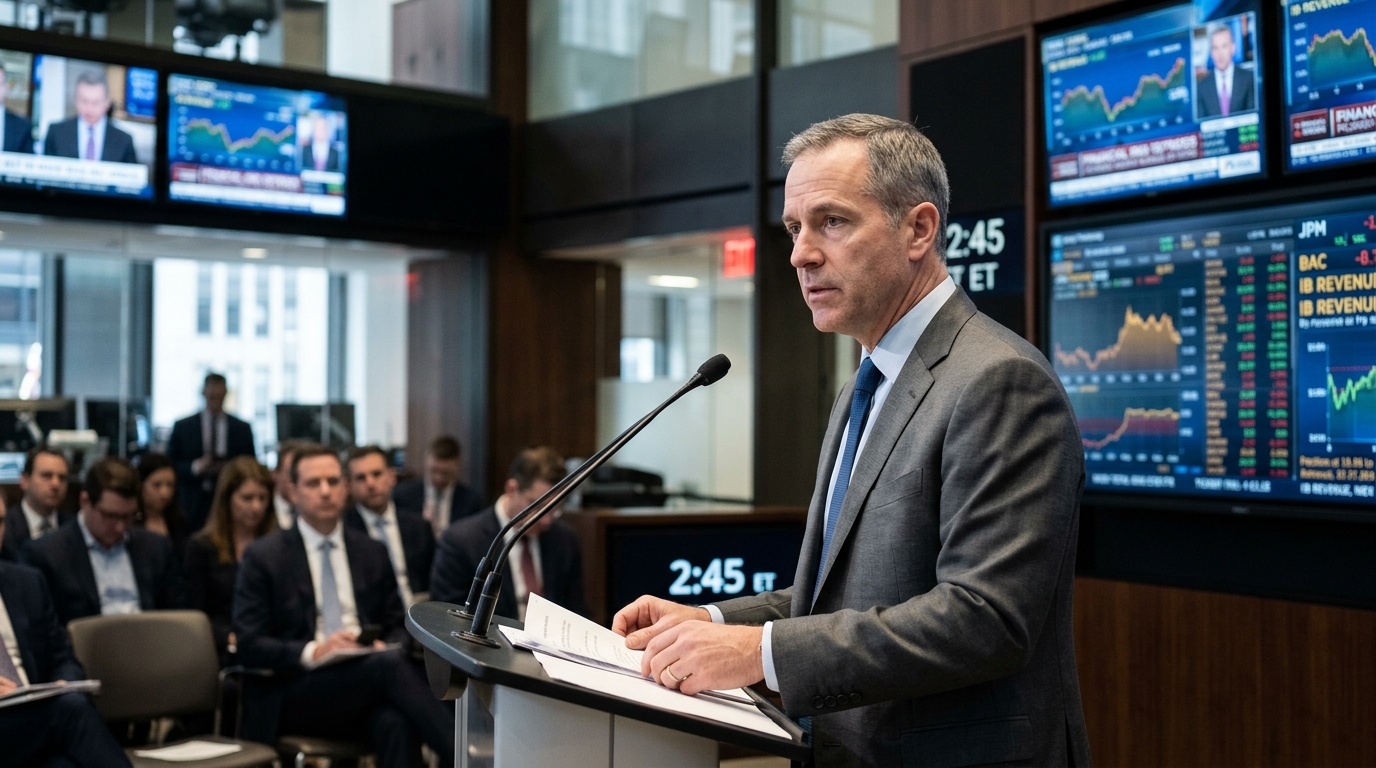
Doug Petno, Co-President of JPMorganChase and CEO of the Commercial & Investment Bank, will present at the Barclays Global Financial Services Conference in New York City today at 2:45 p.m. Eastern. JPMorgan ran the strongest capital-markets franchise in Q2, which means Petno’s read on Q3 fee trends carries more weight than any other voice the conference could put on stage today. If he echoes Moynihan’s caution, the sector de-rating accelerates. If he pushes back, with different deal mix or client activity data, the one-day selloff in JPM, GS, and C starts to look like an overreaction.
That asymmetry is exactly what sophisticated investors are positioning around before 2:45 ET.
Stocks to Watch
- BAC: The source of the warning and the most direct read. Full Q3 results are due Wednesday, October 14, which sets a five-week window before confirmation or reversal.
- JPM: Petno’s comments this afternoon are a live catalyst. The stock fell with the sector Monday despite no company-specific guidance change.
- GS: More levered to investment banking fee cycles than any other large bank. Advisory and underwriting mix makes it the highest-sensitivity name if Moynihan’s read proves correct.
- MS: Similar exposure to GS, with wealth management providing a partial offset if capital-markets revenue disappoints.
- C: Cheapest on price-to-book among the large banks and therefore offers the most downside cushion if the sector continues to price fee expectations lower.