
Here is the question worth sitting with: Alphabet is on track to spend between $195 billion and $205 billion on capital expenditures in 2026 alone, quarterly free cash flow turned negative for the first time since its 2004 IPO in Q2 2026, and the stock is still up roughly 2.5% on a day when the broader market is in the red. What does the market know that the skeptics don’t?
The answer lives in two developments that landed within days of each other.
The Finland Commitment
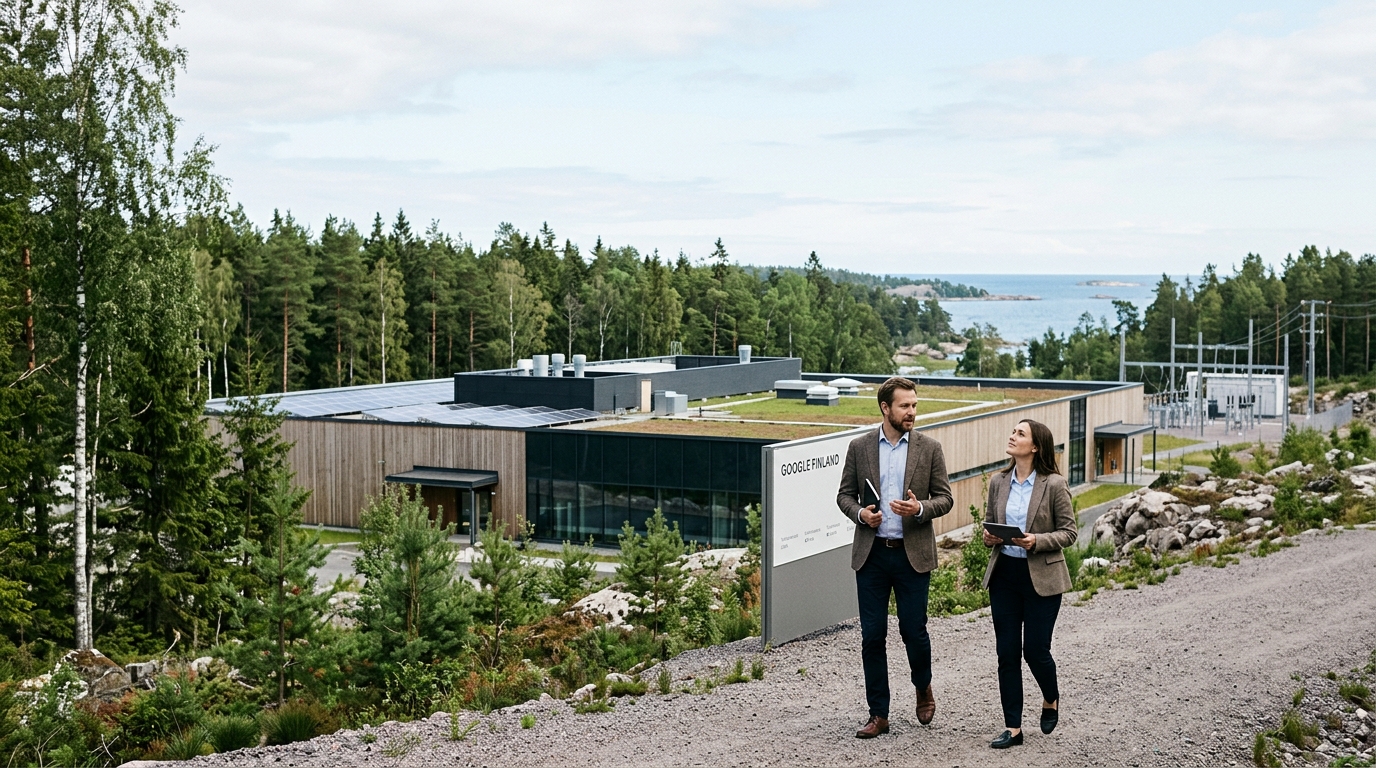
Alphabet is spending at least €13 billion ($15.1 billion) on AI infrastructure in Finland over the next two years (2027 to 2028), calling it its largest single investment in Europe, drawn to the Nordic country by its cold climate and carbon-free power. The build-out covers new data centers in Kajaani, Muhos, and Vaala, plus an expansion of the existing Hamina site, along with grid upgrades and clean-energy projects projected to contribute an annual average of €3.6 billion (about $4.2 billion) to Finland’s GDP during the initial construction phase.
Alongside the capex, Google signed a power purchase agreement with Fortum tied to the Loviisa nuclear plant. The agreement starts in 2028 at a smaller capacity and reaches 50% of the plant’s capacity during 2030 to 2049, tied to Fortum’s life-extension program through 2050. It is billed as Google’s first nuclear power agreement outside the United States. That detail matters. Energy scarcity is the binding constraint on AI capacity right now, and Alphabet just locked in long-duration clean baseload power in a jurisdiction with favorable regulation.
Gemini 3.8 Live: The Revenue Side of the Equation
Infrastructure spending is a bet. Revenue is proof. That is why the September 15 release of Gemini 3.8 Live carries as much weight as the Finland announcement for investors trying to model returns.
Google launched Gemini 3.8 Live and Gemini 3.8 Live Extended Thinking on September 15, rolling the models out across the Gemini API and Google AI Studio, with product rollouts spanning Gemini Live and Search Live as well. Gemini 3.8 Live is positioned for scale and cost efficiency, while Gemini 3.8 Live Extended Thinking targets high-complexity tasks requiring multi-step reasoning. Google says the Extended Thinking model scored 82.6 on Artificial Analysis’ Speech to Speech Quality Index, narrowly ahead of OpenAI’s GPT-Live-1 Astra at 81.5.
Salesforce, Genspark, and Lumeris are already integrating these models into production agents and tools, meaning paying enterprise customers are using Alphabet’s models in real workflows. That is early commercial traction, not a research preview.
What Wall Street Is Pricing In
Evercore ISI raised its GOOGL price target from $420 to $450, citing survey data showing Google holding and strengthening search leadership while Gemini gains share against ChatGPT. Tigress Financial raised its target to a Street-high $485 from $415.
Oppenheimer is modeling roughly $170 billion in cumulative incremental revenue through 2028 from external TPU sales, which it argues would push Google Cloud revenue 15% above current Street expectations in 2027 and 30% above in 2028. That is a large number, but it has a foundation: Alphabet has said it began recognizing revenue from TPU system sales in Q2 2026, and earlier guidance indicated the vast majority of revenue from those agreements would be realized in 2027.
The Risk That Doesn’t Go Away
The bear case is not complicated. Alphabet raised full-year 2026 capital expenditure guidance to $195 billion to $205 billion while free cash flow turned negative in Q2 2026. Every dollar committed to Finnish data centers is a dollar that has to come back as Cloud revenue, ad revenue, or TPU licensing before shareholders see a return. Evercore’s survey data shows 78% of respondents named Google their primary search engine in August 2026, which is encouraging, but the margin for error at this spending level is thin.
What to Watch
The critical metric over the next two quarters is Google Cloud revenue growth and whether the TPU backlog converts on schedule. Alphabet reported $519.5 billion in revenue backlog in Q2 2026, including $513.9 billion tied to Google Cloud, and said it expects to recognize just over half of total backlog as revenue over the next 24 months. If that conversion accelerates alongside Gemini 3.8 Live enterprise adoption, the Finland capex starts to look like a calculated land grab rather than a spending problem. If it stalls, the capex overhang will dominate the conversation heading into 2027.
Alphabet is not a company with an infrastructure story. It is a company with an infrastructure bet, and right now the evidence tilts toward the bet paying off.