

When news broke overnight about China’s Moonshot AI unveiling its new model…

The market gapped down 1% before most traders even poured their morning coffee…
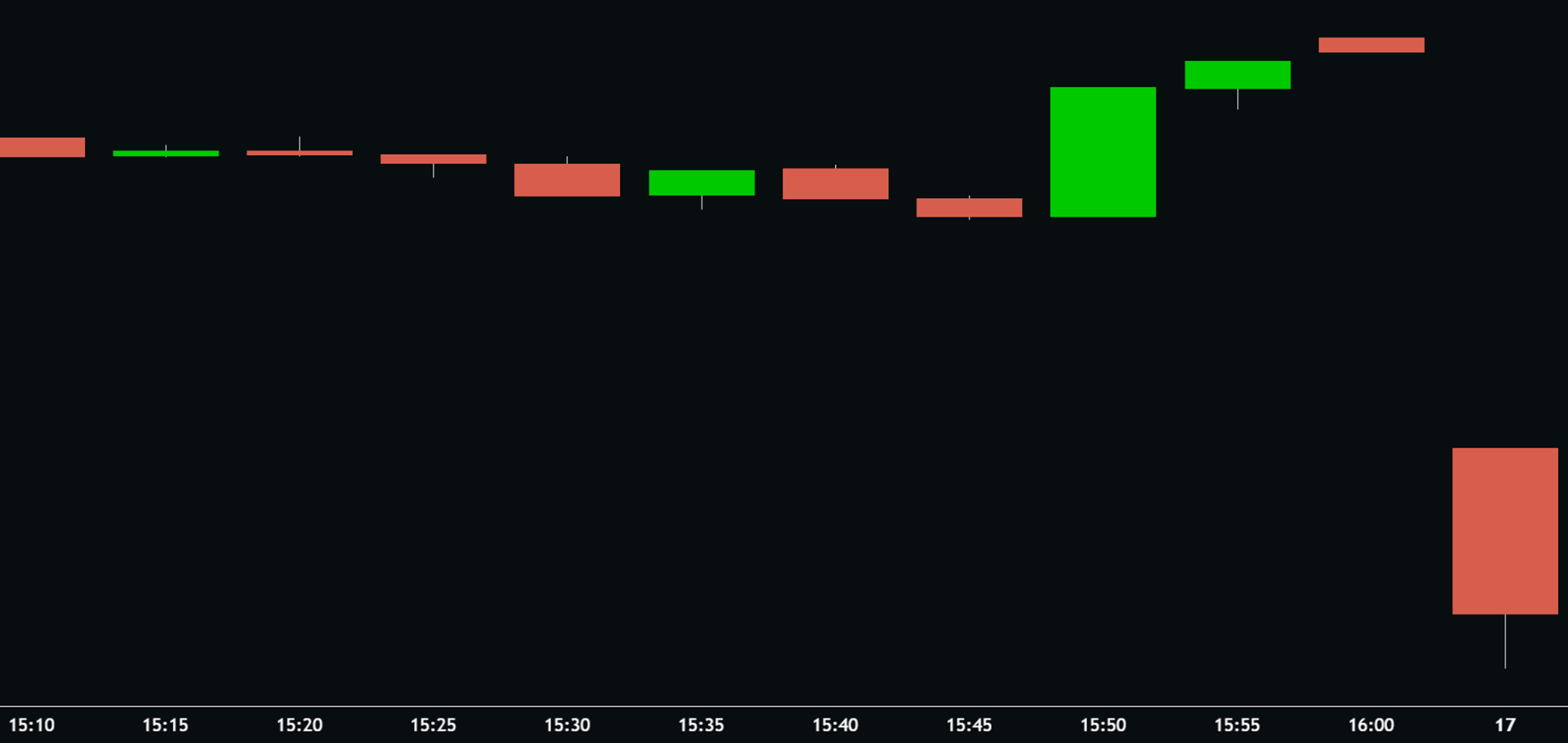
For standard portfolios, it looked like the start of another stressful day…
And over the next two hours, the market barely crawled higher… moving a tiny 0.2%…
To traditional buy-and-hold investors, a 0.2% move is practically useless…
Yet, according to our research, anyone who ignored the overnight headlines and waited until exactly 9:50 AM Eastern could have locked in a $529 payout before lunchtime… on a simple $1,000 starting stake…
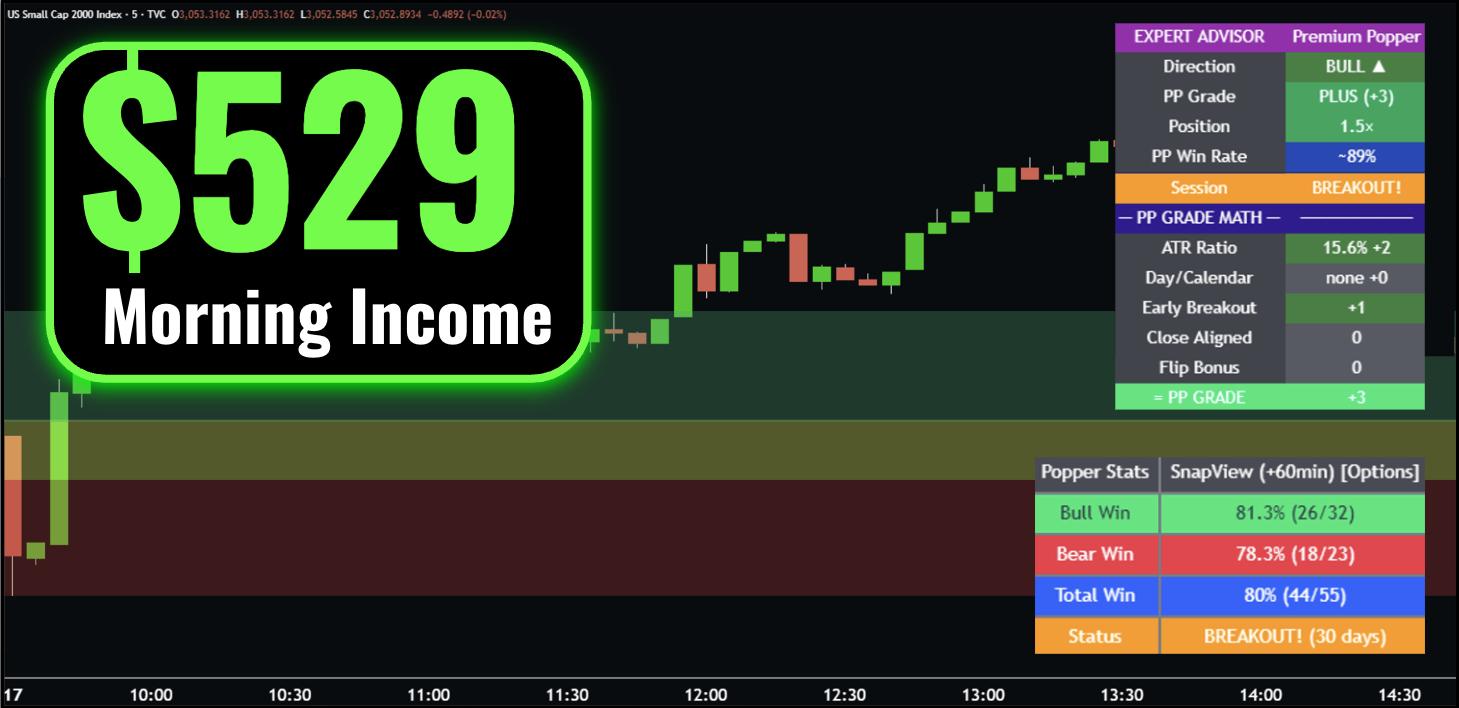
That would not have been an isolated fluke either…
Back on June 25th, when inflation surged past 4%…
And panicked investors expected a massive market beatdown… the market moved just 0.3% after the open… yet that exact same morning setup yielded another $526 payday before lunch…
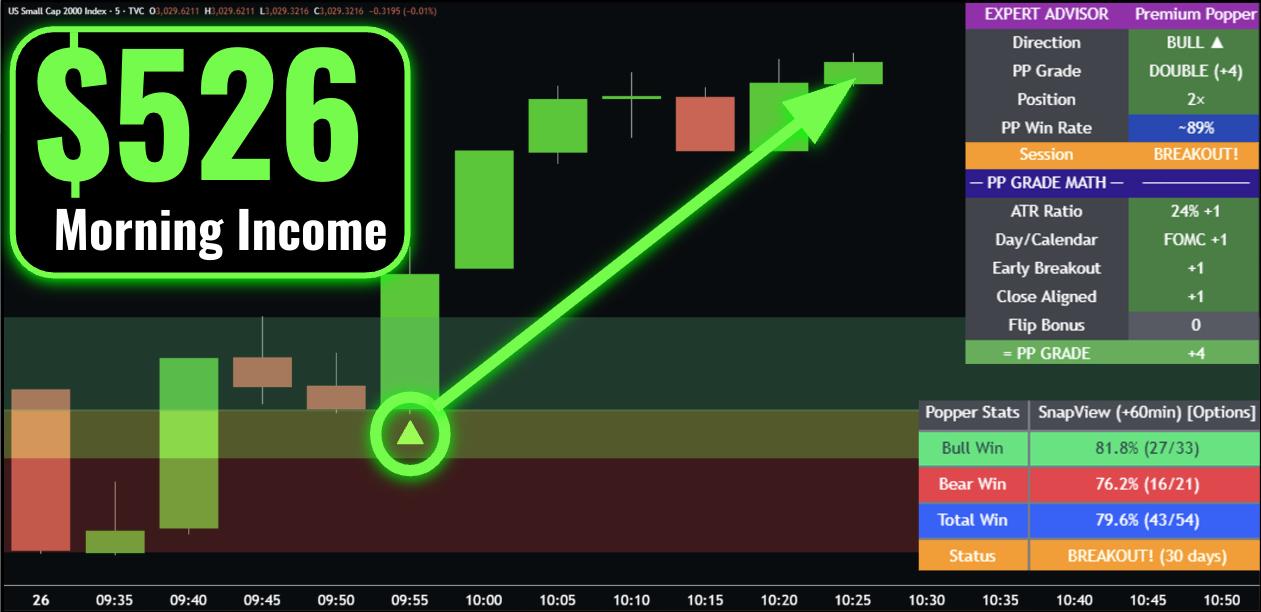
Of course, there would have been smaller gains and some that did not work out, but…
How would it have been possible to pull $500+ out of the market on a tiny fraction-of-a-percent crawl… while traditional traders are getting chopped to pieces?
It all comes down to an institutional phenomenon that happens during the first 20 minutes of every trading day…
Between 9:30 AM and 9:50 AM, Wall Street heavyweights enter a massive brawl to settle block orders… pushing nearly 25% of the entire day’s volume into a brief 20-minute window…
Right around 9:50 AM, the brawl ends… the dust settles… and the market literally hands us its direction for the rest of the morning…
By placing just one simple trade on one ticker right as that direction becomes clear…
You give yourself a shot to walk away with $500 in hand before lunch, leaving you completely free for the rest of your day…
While I cannot make any guarantees in the market…
Recently, I sat down live on camera with a former money manager to lay out the floor data behind this 9:50 AM morning phenomenon…
And how anyone with a normal brokerage account can take advantage of this step-by-step…
Tap here to watch the complete video breakdown before access is taken down.
See you there,
Silas Peters
Fortinet Beat Every Number. The Stock Lost a Quarter of Its Value.

The results were unambiguous. Fortinet reported non-GAAP (adjusted) earnings per share of $0.91 for Q3 2026, exceeding the $0.86 consensus estimate, while revenue grew 20% year over year to $2.08 billion, slightly above the $2.06 billion forecast. Billings rose 29% from a year earlier to $2.34 billion. Product revenue jumped 37% to $765 million, while service revenue increased 13% to $1.31 billion. Management said it raised full-year billings guidance for the third time this year.
The stock dropped roughly 25% anyway.
Despite beating analyst estimates and raising full-year billings guidance for the third consecutive time, the company’s shares fell about 25.7% in after-hours trading to around $129, after closing Wednesday at $174.08 (down 5.9% in the regular session). The prior session’s trading range was $173.02 to $185.13. That is an all-in collapse of roughly 33% from its October 13 intraday high of $197.13 in a little over two weeks.
Two forces drove the after-hours move simultaneously. Fortinet stock plunged in after-hours trading after the cybersecurity giant delivered a Q3 2026 earnings report that beat analyst estimates on every headline metric, yet triggered a severe sell-off driven by a combination of a “sell the news” dynamic and reports tied to “FortiBleed 2.0.” The “FortiBleed 2.0” figures circulating widely were not in a Fortinet filing or statement, and appear to come from third-party reporting and social posts, so treat them as unconfirmed.
The sharp selloff also highlighted investor concerns about service revenue timing and the sustainability of the company’s growth mix, even as management emphasized strong demand across enterprise, AI security, and operational technology segments. The company’s own commentary framed part of the service-growth pressure as activation timing and enterprise agreement consolidation.
The valuation problem was not new. Heading into the earnings release, JPMorgan maintained an Underweight rating with a $140 price target. Analyst-rating tallies vary by data vendor and change daily, so any precise count of “hold or sell” ratings should be treated cautiously unless sourced to a specific snapshot.
That is the context traders need to read into the rest of the cybersecurity group right now. Fortinet’s collapse is not idiosyncratic. It is the clearest data point yet that the market will not pay today’s multiples for in-line security growth, regardless of headline beats.
The pressure is not limited to the platform vendors carrying the highest multiples. Identity security names like Okta have been re-rated higher on AI agent demand, making them equally exposed to a group-level multiple reset.
The group’s positioning into the next two months of earnings is uncomfortable. Palo Alto Networks’ next earnings date is not the November 18 date cited here; market calendars currently point to Thursday, November 12, 2026, for its next report, and the options market is pricing an earnings move around the low teens. CrowdStrike’s next earnings date is widely listed as Tuesday, December 1, 2026, but the company has not confirmed that date yet. Both stocks carried stretched multiples before Fortinet reported. CrowdStrike’s trailing price-to-earnings ratio has been cited in the several-thousand range in late October, depending on the data provider and methodology. Zscaler, which closed at $260.45 on October 26, sits about 22.7% below its 52-week high (roughly $336.99), and traded lower after hours in the broader cybersecurity downdraft.
The trade here is not to buy Fortinet’s dip. The company’s service revenue deceleration is structural, the breach headline will linger, and the stock still trades above JPMorgan’s $140 target. The real opportunity is to position for the same earnings-day reset in PANW and CRWD. Both names have delivered consistent beats on similar forward multiples. If Fortinet just showed the market’s appetite for rewarding that pattern, the smart move is to reduce exposure ahead of their reports rather than chase a dead-cat bounce in the name that already broke.
CRWD and PANW have already fallen meaningfully from their early-October record closes, but the exact “more than 13% from October 6” figure depends on the specific comparison dates and closing prints used. Fortinet’s session confirms that those pullbacks were not random volatility. They were the beginning of a group-level reassessment. The question now is whether PANW at a forward price-to-earnings ratio near 96 and CRWD’s roughly $274 billion market cap can survive their own earnings catalysts intact, or whether November and December deliver two more versions of last night.