
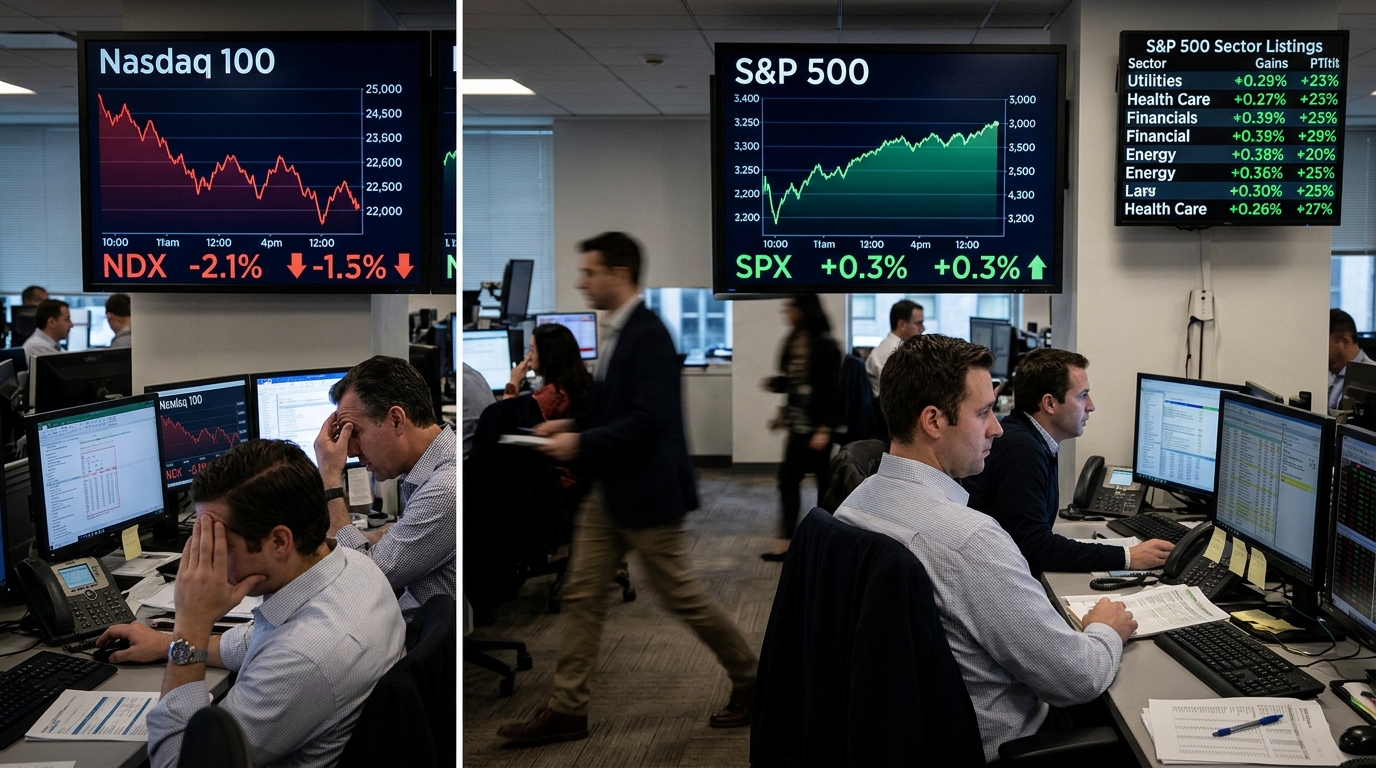
Two mornings in a row now, the opening bell has arrived carrying a fresh casualty list. Nasdaq 100 futures slid about 2% overnight after earnings from Amazon and Intel raised fresh concerns about capital expenditure, with Amazon down about 6% to 7% in extended trading and Intel down about 23%. That follows Alphabet’s worst session since 2004 on Thursday. The question worth asking before treating this as a definitive market judgment is whether it actually is one.
Look past the index-level damage and the picture gets more complicated. On October 22, 324 of the 500 S&P 500 companies gained, with the median stock up 1.09%, yet the index itself fell 1.36% as technology plunged 3.3% and the Goldman Sachs Broad AI Index dropped about 6%. The equal-weight S&P 500 and large-cap value both gained more than 3% during that same stretch. That is rotation, not a broad liquidation.
Bonds are confirming the same read. The yield on the 10-year Treasury eased to about 4.92% on October 30, down from about 5.05% just two sessions earlier. Investors are driving money toward haven assets such as Treasuries as the rotation out of the AI trade accelerates. TLT, the long-duration Treasury ETF, has now posted back-to-back gains while the Nasdaq fell. That is not the bond market calling AI a fraud; it is portfolio managers cutting their biggest winners to fund fixed-income allocations before quarter-end accounting closes the books.
Month-end mechanics matter here. Roughly 47% of S&P 500 index weight and one-third of expected earnings growth will report during the five sessions from October 28 through November 3. Fund managers rebalancing into that event cluster, combined with four days remaining before Tuesday’s midterm elections, creates a mechanical reason to reduce concentrated technology positions regardless of what any individual earnings report actually said.
Amazon reported heavier spending and a cautious outlook, and signaled another increase in capital expenditures next year. Amazon and Intel are together poised to lose roughly $300 billion in market value if premarket losses hold. Those are real numbers. But Microsoft, which also reported this week, told a different story: Microsoft topped analysts’ expectations for both earnings per share and revenue, and Azure revenue growth was about 48% for the September quarter with Microsoft projecting about 49% to 50% growth for the current quarter. The market can still sell Microsoft anyway, because in a forced-rebalancing environment the question is not which stock beat but which position needs trimming first.
On a monthly basis, the Nasdaq is set for a decline after two consecutive monthly gains, while the S&P 500 and the Dow are headed for a positive month. That divergence is the tell. When the broad index holds while its biggest sector corrects, you are watching a reallocation, not a collapse.
For long-term investors, the lesson here is structural rather than tactical. Technology alone is about 38% to 40% of the S&P 500, and a broader AI proxy can exceed half the index once you add several mega-cap growth names outside the tech sector. A portfolio that mirrors that concentration has been rewarded for years, but it has also meant that any institutional decision to rotate creates outsized personal damage. Tuesday’s election results could reverse the bond bid and send capital back into growth names quickly. Or they may not. Either way, the selloff was partly manufactured by the calendar.