
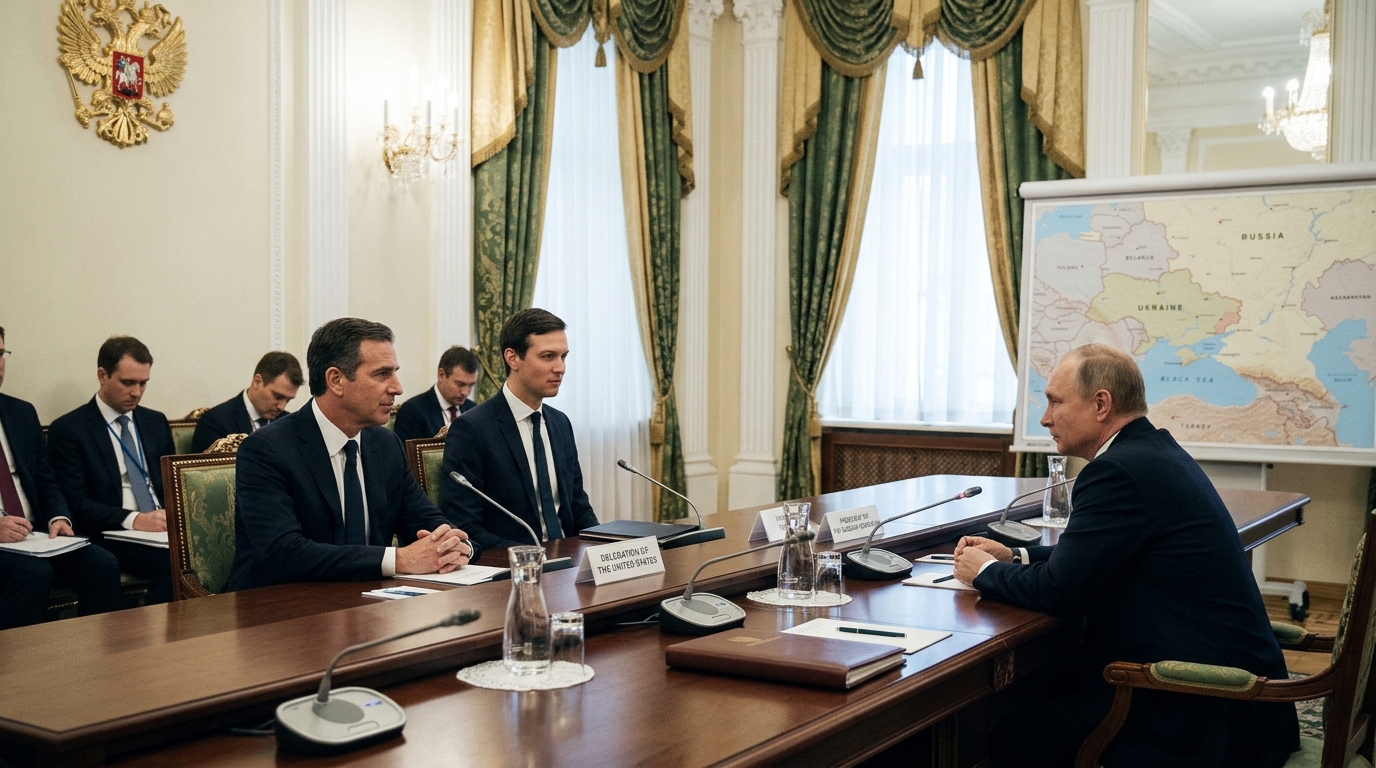
US envoys Steve Witkoff and Jared Kushner met Russian President Vladimir Putin in the Kremlin on Thursday to discuss Ukraine, after two days of US-brokered talks between Russian and Ukrainian delegations in Abu Dhabi yielded no major breakthroughs. The meeting landed on a European defence sector already in the middle of a painful repricing.
Rheinmetall shares closed about 16% lower in Frankfurt on November 5, leaving them down roughly 50% year-to-date. That compression happened before Witkoff boarded a plane to Moscow. Now the question for portfolio managers holding the sector is sharper: does current pricing already assume a ceasefire, or is there a second leg of selling still to come?
What the Guidance Cut Actually Said
This was the second time the defence group has cut its sales forecast this year, following a similar move in August after Germany cancelled the F126 frigate programme. On November 5, the company lowered its 2026 revenue forecast to approximately €13.2 billion, from €13.7-14.2 billion, citing delays tied to Germany’s Arminius project and slower acceptance tests for artillery ammunition. The principal problem is execution, rather than a collapse in defence demand.
Sales increased 38% in the first nine months of 2026, operating profit rose 68%, and backlog reached €78 billion, including signed framework agreements. Bank of America stripped the stock of its Buy rating, moving to Neutral and cutting its price target from €1,300 to €900. Berenberg cut its own target from €1,020 to €900 while keeping a Hold stance. Both reacted to the same concern: a backlog is only worth what you can deliver on schedule.
The Bull Case Is Still There. It Is Just Less Comfortable.
Europe’s need to strengthen its defences has hardly disappeared. Military budgets continue to rise, and governments remain committed to rebuilding capabilities after years of underinvestment. The Democratic sweep in the US midterm elections has raised questions about future American defence spending, but European governments have shown little inclination to slow their own programmes. The rearmament commitment predates Washington’s domestic politics and survives a change of congressional control.
The peace process introduces a different problem. Kushner has said that significant differences remain. Putin also reiterated his opposition to foreign troops being stationed in Ukraine after any ceasefire, calling the idea unacceptable and warning it would be treated as a security threat that could restart the war. That is not the posture of a side about to make concessions. And yet market sentiment treats each diplomatic headline as a sell trigger.
What Investors Are Missing
The sector is being priced as if peace is imminent when the diplomatic evidence suggests something much messier: a process that could drag for months, generate regular ceasefire headlines, and still not produce a durable settlement. Through 2025, European defence stocks periodically softened as markets flirted with the idea of a ceasefire, particularly into the summer and ahead of the Alaska summit. When those expectations failed to translate into a durable shift on the ground, the sector regained support. The current selling fits a pattern that has repeatedly reversed.
The company-specific risk at Rheinmetall is real and separate from geopolitics. Execution on the Arminius Boxer programme and ammunition contracts will determine whether the €78 billion backlog becomes 2027 revenue or 2028 revenue. On the company’s Q3 call, management indicated it is unlikely to reach a €100 billion year-end backlog target for 2026 without the Arminius contract. That is a timing problem, not a demand problem. Conflating the two is where the market appears to be making its error.
Stocks to Watch
Rheinmetall (RHM): The obvious centrepiece. Shares changed hands around €770.80 on Thursday, a price that captures a debate now running through the entire European defence sector. The backlog is large; the execution is the test.
Leonardo (Milan): The relative bright spot. Italy’s Leonardo manufactures helicopters, military aircraft and defence electronics. Following strong nine-month results, the company raised its 2026 new-order outlook to €29.5 billion from €28.2 billion. Less exposed to German procurement delays and less correlated to the Abu Dhabi headlines.
BAE Systems (BA.): The British defence contractor has fared better than much of its competition. Democratic control of Congress could bring greater scrutiny of Washington’s ambitious defence spending plans, particularly affecting BAE given its substantial US exposure. That risk bears watching.
Hensoldt and Renk: Hensoldt has been particularly successful in electronic warfare and sensor systems, a segment that has received elevated funding given the modern combat environment’s emphasis on electromagnetic spectrum capability. Both are smaller and more volatile proxies on the same German rearmament bet as Rheinmetall, without the execution baggage of the Arminius delay.