Dear reader,
During my years advising senior intelligence officials at the Pentagon and the CIA…
And senior members of the Trump administration…
I learned that the most dangerous events in Washington are never the ones splashed across the news.
The real turning points happen quietly…
When Washington swamp creatures get together behind closed doors.
I believe one of those turning points is set to take place by November 30th.
Click here and I’ll give you all the details…
And show you why I believe this move will unleash one of the most chaotic environments in America’s history.
I predict those who know what to do will make a fortune in the next 12 – 18 months…
At the same time…
Those who don’t understand what’s happening could suffer devastating losses…
And might never be able to retire on their own terms.
Which side will you be on?
Only you can decide.
Click here and I’ll show you the five steps I’m recommending.
Regards,
Jim Rickards
Former advisor to the CIA, the Pentagon, and the White House
Editor, Rickards’ Paradigm Press
A 5.15% Treasury Is Pulling Capital Out of Brazil. Argentina’s Banks Are Betting It Won’t Last.
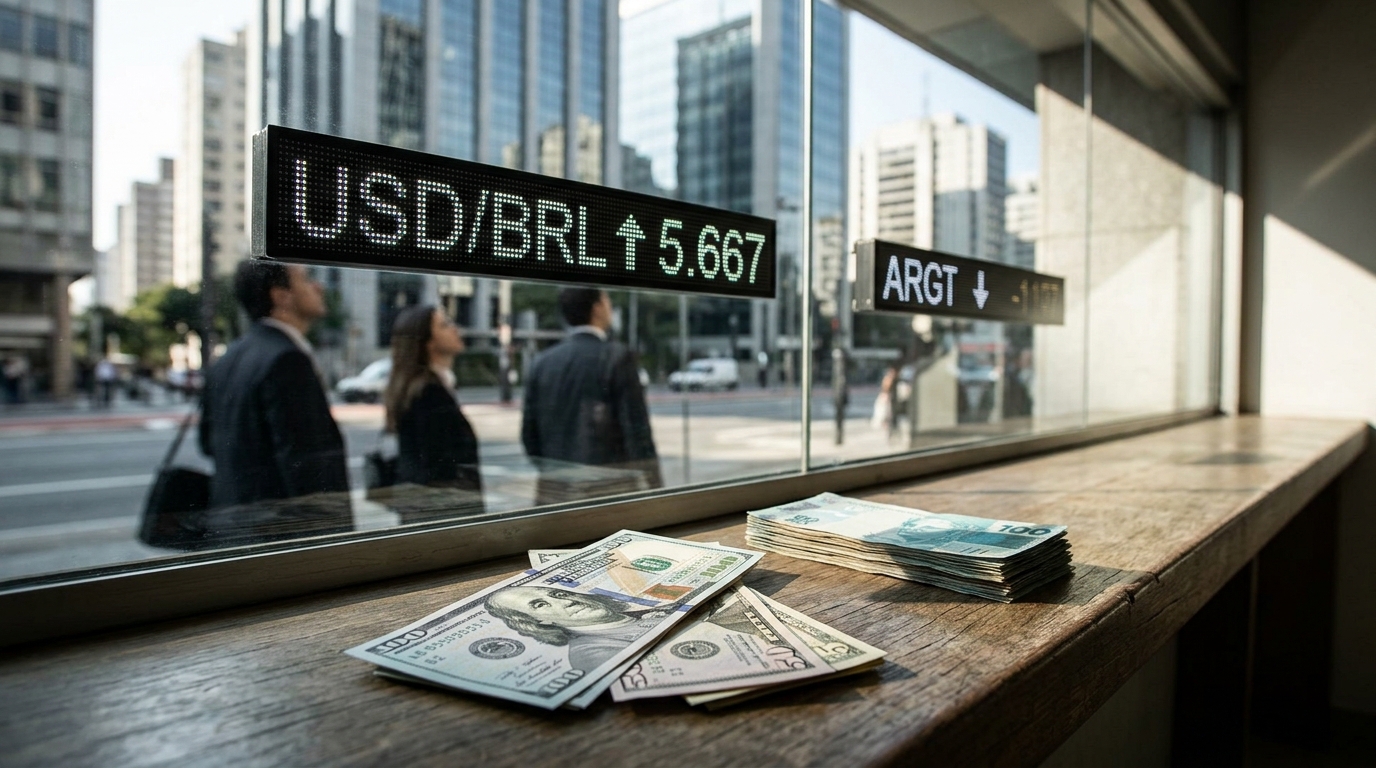
Not all emerging markets respond to a surging dollar the same way. Friday’s close made that point with unusual clarity: the Brazilian real sank to 5.667 per dollar, its weakest in at least 12 months, while Argentina’s Merval jumped 2.68% to 84,704 on a sharp rally in banks and power companies. Same region, same day, opposite directions. The divergence is the trade.
What the Dollar Is Doing to Brazil
The 10-year Treasury note yield was 5.15% as of November 13, up 5 basis points on the day. That comes on top of a 14-basis-point surge the prior session, leaving the benchmark rate roughly 30 basis points higher on the week. The dollar index held above 103 and closed around 103.41, its highest level since April 2025, supported by rising expectations of a more aggressive Federal Reserve tightening cycle.
The real weakened to 5.667 per US dollar, a 0.46% slide on the day, its weakest close in at least 12 months and about 11.9% weaker than 20 sessions ago. Brazil’s gross general government debt was about 82.9% of GDP as of September, and domestic fiscal anxiety is compounding the external dollar pull. The Ibovespa managed a 0.66% gain to 172,458, but that is a stock market still sitting 17.5% below its October 9 peak of 209,067. The index is rising in a falling currency, which means dollar-denominated returns are deteriorating fast. EWZ traders need to hold both numbers in mind simultaneously.
Argentina’s Counter-Move
Argentina’s Merval jumped 2.68% on Friday as banks and power firms rallied, while the peso held near 1,544 per US dollar. Country risk, the extra yield investors demand to hold Argentine dollar bonds, eased to about 830 points, down from a 2026 high of 925 reached on November 5. That spread compression is what drove the banks. When sovereign risk falls, the lenders most exposed to Argentine government paper are the first to rerate higher.
The peso’s relative calm matters here. At 1,544 per dollar, it sits just below its 12-month high of 1,551 set on November 3. Unlike the real, which broke to a fresh low, the peso has been drifting rather than collapsing. A hotter-than-expected consumer price index reading has investors anticipating more Fed rate increases, and Goldman Sachs added another hike to its forecast, now expecting an additional quarter-point increase in March 2027. That is the global backdrop both markets share. The difference is local: Brazil’s fiscal overhang gives capital a reason to exit, while Argentina’s shrinking country-risk premium gives it a reason to stay.
The Cross-Asset Positioning Call
This is not a story about one country. It is a cross-asset positioning decision framed by a 5.15% Treasury. When US yields rise at this pace, dollar-denominated capital revalues risk globally, but it does not punish all emerging markets equally. It hits hardest where fiscal credibility is weakest and where the currency acts as the pressure valve.
Brazil is not the only emerging market where the currency is absorbing the pressure that fiscal policy cannot. India’s central bank faced the same dollar-driven squeeze, raising rates to defend the rupee rather than to cool domestic prices.
Brazil fits that description precisely right now. The real is the release valve for fiscal worry, and 5.667 per dollar is the highest reading in over a year. EWZ carries the currency drag directly. ARGT, by contrast, reflects a market where the sovereign spread is narrowing rather than widening, and where the domestic catalyst on Friday was bank-led buying on reduced risk perception.
Levels and Risks to Watch
For the real, 5.67 per dollar is the line to watch, since it is the highest close in at least 12 months. A sustained hold above that level keeps pressure on Brazilian assets priced in dollars. For Argentina, country risk staying well below the 925 peak of November 5 is the signal to monitor, as a re-widening would hit banks first.
The primary risk to this divergence thesis is a rapid reversal in US yields. The 10-year Treasury yield is expected to trade at 4.83% by end of quarter, according to Trading Economics models. Any softening in that direction reduces the dollar’s pull and narrows the gap between EWZ and ARGT. Watch next week’s Fed speakers and the next inflation print before sizing into either side of this trade with conviction.
The Fed path is the variable that resets this entire trade. Ten Fed officials speaking in a single week showed how divided the committee remains on whether another hike follows the last one.