Hong Kong’s technology complex did something unusual on Friday. The Hang Seng Tech Index closed up 6.45% and the Hang Seng Index itself rose 2.11%. The catalyst was not a product launch, not a quarterly earnings beat, and not a government subsidy announcement. It was, in large part, a founder’s public statement that his AI company would buy fewer Nvidia chips.
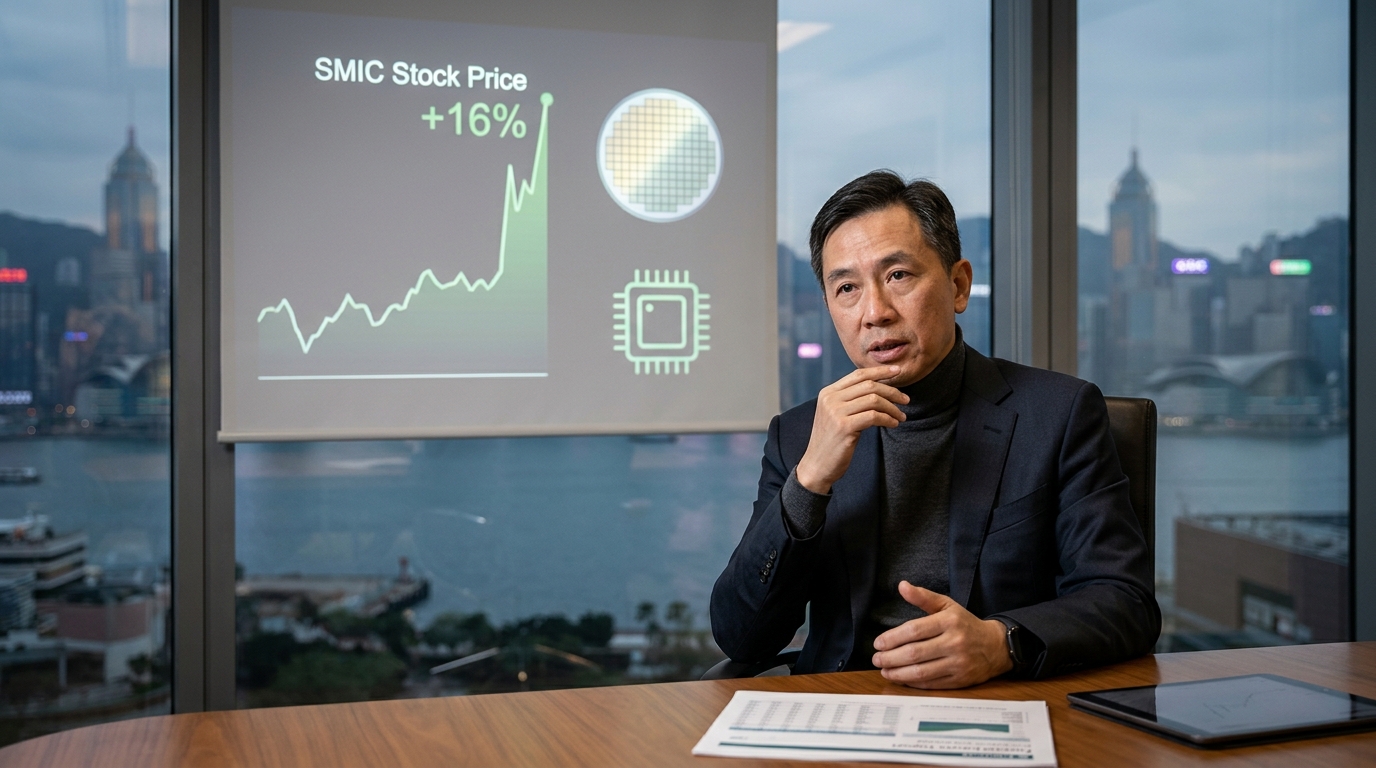
MiniMax gained more than 17% after founder and chief executive Yan Junjie said the company would accelerate adoption of Huawei and Alibaba AI chips to reduce reliance on Nvidia. Z.AI, the other listed large-model builder in Hong Kong, matched it. MiniMax closed at HK$110.1, up 17.19%, with an intraday surge of over 20%; Z.AI closed at HK$347.4, up 18.57%, with an intraday rise of over 20% in the afternoon. The chip makers joined in. Semiconductor and optical-communication shares led gains, with Hua Hong up more than 20%, SMIC more than 16%, and domestic GPU developer Iluvatar CoreX more than 26%.
Two stories in one session
The market was doing two things simultaneously and pricing them as one. The first was a genuine policy catalyst. Reuters reported Friday that Premier Li Qiang chaired a cabinet meeting that called for a greater role by state-backed “national team” investors to steady the stock market, the clearest signal yet that Beijing will step in to stem a slide near 16-month lows. In the State Council’s readout, sovereign wealth fund Central Huijin Investment was told to optimize its function as a quasi-stabilization fund to provide sufficient liquidity at times of turmoil.
That alone would have moved markets. The tech complex amplified it because Yan Junjie’s comment arrived alongside Nvidia’s difficulties elsewhere. The Financial Times reported that Nvidia has ordered the companies that assemble its servers to stop deliveries to Indonesia, Malaysia, Singapore, and Thailand. The report said the move followed new US curbs that took effect last week, requiring export licenses for shipments of advanced chips to several Southeast Asian countries, part of efforts by Washington to shut down routes that Chinese firms are believed to use to obtain advanced AI chips. Two constraints on Nvidia’s reach in one week framed the Chinese chip independence story as more urgent than it may actually be.
What the chip math says
The question the session raised but did not answer is whether domestic chips can actually do what MiniMax needs them to do. The honest answer is: for inference, probably yes; for large-scale training, not yet at competitive cost. Analysts and policy researchers have noted that Chinese AI companies have used domestic chips, including Huawei’s, mainly for inference, which requires less computing power, while relying largely on Nvidia’s advanced chips for large-scale model training. A Council on Foreign Relations analysis has argued that SMIC is stuck at 7nm and that high-bandwidth memory remains a key bottleneck, and that even in a Huawei-favorable scenario domestic output would amount to only a small fraction of Nvidia’s aggregate AI computing power by 2026.
Domestic compute lowers supply-cut risks but near-term migration entails adaptation costs. Goldman Sachs, after a research visit to MiniMax on November 25, was not deterred. According to a summary of that note carried by local financial media, Goldman said that while channels to acquire new high-end computing power have recently tightened, the company’s existing training compute reserves remain undamaged. Goldman maintained its Buy rating with a HK$760 target price; following its July financing, the company holds approximately $3 billion in cash, with Goldman forecasting revenues of $400 million and $1.753 billion for fiscal 2026 and 2027, respectively. Citibank took the opposite view, sharply lowering its target price from HK$576 to HK$171, citing intensified domestic competition, continued pressure on computing power and chip supply, and revenue forecasts for 2026 to 2028 cut by 18% to 31%.
Context the rally glossed over
The 17% and 19% closes look decisive until you zoom out. Including Friday’s gain, MiniMax has still dropped about 37% over the past month. Huachuang Securities put Z.AI’s August annualised revenue at about US$1.6 billion and MiniMax’s at more than US$800 million, meaning investors were also resetting expectations for the commercialisation curve, not just a chip supply story. The rally rewarded both firms equally, despite different business scales and different chip-transition risks.
SMIC’s 16% gain was the most telling signal of the session precisely because SMIC’s real constraint is manufacturing yield, not political sentiment. Everbright Securities said the second half of 2026 marks an inflection point for domestic AI-chip demand, supply readiness, and commercialisation, adding that the domestic AI chain may enter a phase of earnings delivery and valuation re-rating through 2026 and 2027. That is a plausible multi-year thesis. Whether one founder’s announcement deserved to accelerate the whole clock by 16% in a single afternoon is a different question.
What to watch next
The key test arrives Monday. If the Hang Seng Tech Index cannot hold Friday’s gains, it counts as a one-day wonder; MiniMax must hold above HK$110 to be considered a real rebound. Beyond price levels, watch for any MiniMax disclosure of which specific Huawei or Alibaba chip generations it is migrating to, and at what training scale. Without that detail, Friday’s move was the market pricing a direction, not a delivery.