By Doyinsola Oladipo
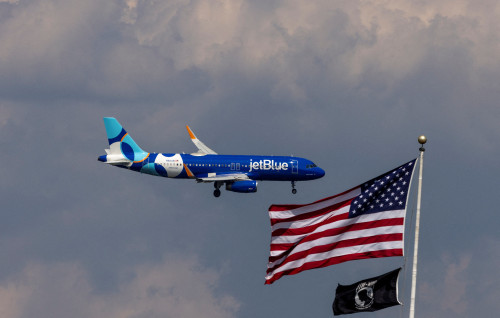
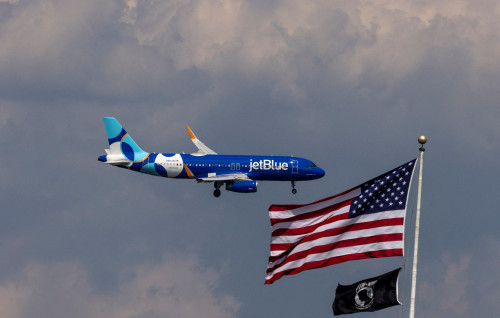
NEW YORK, April 27 (Reuters) – Just as JetBlue Airways was nearing its first profitable year since the pandemic, a spike in fuel prices has revived questions about its turnaround, forcing the airline to raise more debt and quash bankruptcy speculation.
The New York-based low-cost carrier started the year projecting confidence that a multiyear restructuring launched in 2024 was working, as cost pressures eased and travel demand remained buoyant. But fuel prices have soared since war erupted in the Middle East, and a potential U.S. bailout of Spirit Airlines may undermine JetBlue’s fragile recovery.
Wall Street is asking whether the carrier can survive what is turning out to be the worst jet fuel supply crisis the airline industry has faced, an unintended consequence of the Iran war launched by Washington. While U.S. airlines are still reporting strong demand, the war is torching profits.
INVESTORS AWAIT QUARTERLY RESULTS
JetBlue is scheduled to report quarterly results on Tuesday, and Wall Street will scrutinize how much sky-high jet fuel prices have eaten into the carrier’s already negative margins. The company has recorded annual net losses since 2019 and promised to break even on a net basis this year.
Its turnaround efforts – termed Jet Forward – netted it some $300 million in earnings before interest and taxes in 2025, and its forecast for 2026 included a similar sum, assuming an average fuel price of $2.27 per gallon. But last month, the carrier revised its first-quarter fuel estimate to between $3.01 and $3.06 per gallon.
According to Reuters calculations, if JetBlue consumes 826 million gallons of fuel in 2026 as it did in 2025, at the midpoint price of $3.04 a gallon, the airline would spend about $2.5 billion – roughly $450 million, or 21%, more than it did in 2025. These costs would wipe out savings from the lower fuel consumption the company had touted last year, which would have helped it pay down some of its roughly $9.5 billion in debt and lease obligations.
Daniel McKenzie, equity analyst at Seaport Research, expects JetBlue’s fuel expense to rise 40% year-on-year to $2.9 billion. He models JetBlue offsetting about 30% of those costs with higher revenue, incurring a pre-tax loss of roughly $1.1 billion in 2026.
JetBlue declined to comment on this story.
LIQUIDITY NOT AN IMMEDIATE CONCERN
JetBlue concerns go beyond jet fuel prices. A government rescue of Spirit Airlines could revive competition for overlapping low-fare routes from leisure travelers, JetBlue’s mainstay.
The budget carrier, though, is taking steps to course-correct.
JetBlue CEO Joanna Geraghty told employees last week the carrier was not considering bankruptcy this year, after the low-budget carrier secured a $500 million debt financing commitment backed by up to 22 aircraft. While its debt load is high for its size, JetBlue ended the year with $2.3 billion in cash.
It also has significant assets it could borrow against, and Joseph Rohlena, North American airlines analyst at Fitch, said liquidity was not an immediate concern for JetBlue. Earlier this month, Fitch downgraded the airline’s credit rating to CCC+, saying it was concerned about the company’s ability to cover its fixed expenses using its earnings.
“If either fuel stays very high or if demand starts to falter, and (they) start burning more cash, they may have to go back to the markets,” Rohlena said, referring to raising capital.
Unlike bigger carriers, JetBlue has fewer international flights and premium seating options that are in high demand from affluent travelers.
Even those carriers have reported significant pressure from rising fuel prices.
Delta said it expects to recover only 40 to 50 cents of every extra dollar it spends on fuel this quarter, with United seeing a similar gap before improving later in the year. Alaska Airlines is recovering only about one-third of the increase, forcing it to withdraw its forecast.
(Reporting by Doyinsola Oladipo in New York; Editing by Sayantani Ghosh and Rod Nickel)