
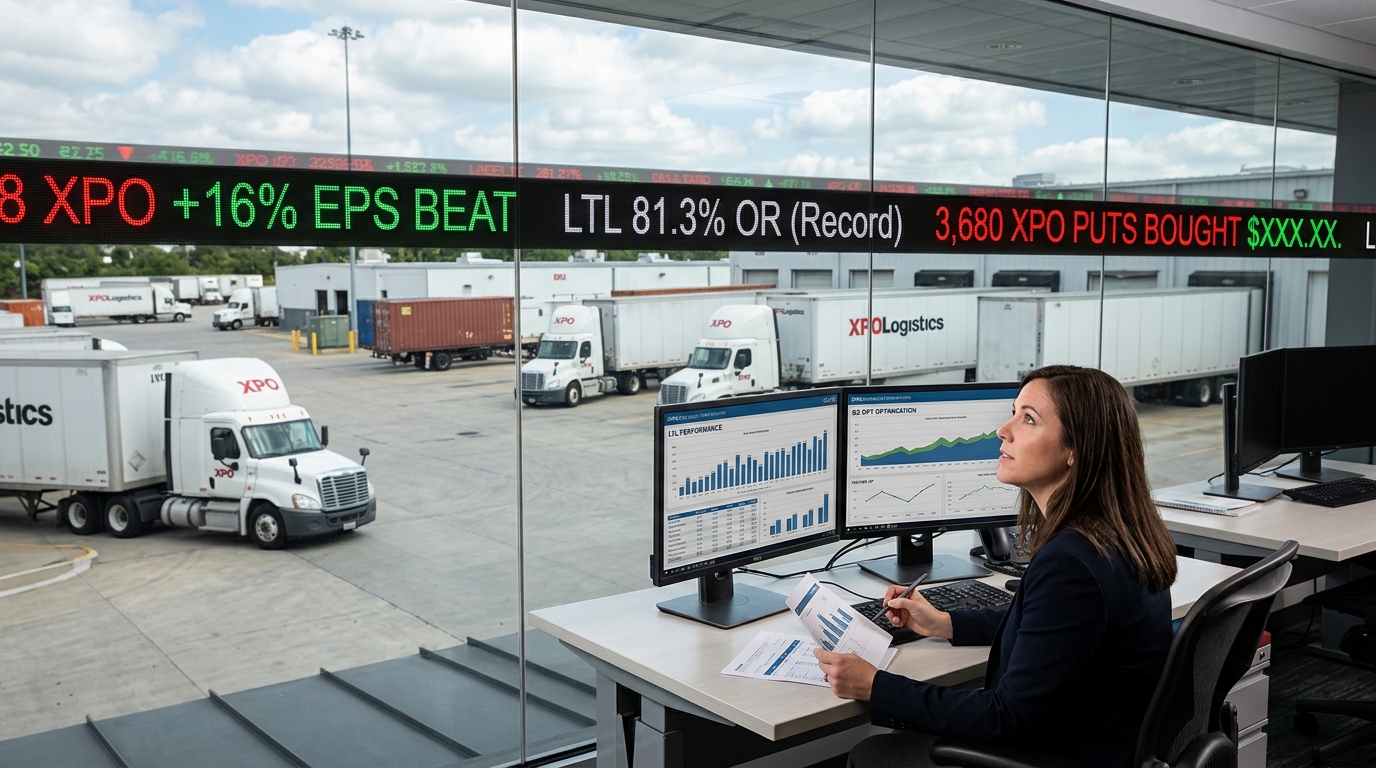
The numbers were unambiguous. XPO beat Q2 estimates with $2.36 billion in revenue and $1.70 in adjusted EPS, driving shares higher in pre-market trading on strong LTL performance. A freight carrier posting a record operating ratio in the middle of an industrywide rate acceleration cycle is exactly what a bull wants to see. And yet, within hours of the results hitting the wire, someone placed a very large bet in the opposite direction.
The Signal
The unusual activity is hard to dismiss. Some 80-to-1 put-to-call activity appeared in XPO, driven primarily by a 3,680-contract block bought on the September 18th 170.00 put for $2.70, when the bid/ask spread was $0.70 by $4.60. The block was identified as a new position based on open interest, and the trade took place above the midpoint of the bid/ask spread, implying bearish intent.
To buy 3,680 contracts above the midpoint on a put that has an open interest of only 48 is not noise. This is not a retail trader hedging a small position. At $2.70 per contract on a 100-share multiplier, the premium spent approaches $1 million. The September 18 expiration gives the position seven weeks to work. The 170 strike sits roughly 15% below XPO’s pre-market price on the day the trade was placed. That is a substantial implied decline required to profit at expiration, though the position profits directionally as the stock falls well before any expiration threshold is crossed.
Why It Matters
The options market is sending a signal that deserves respect, not dismissal. Sophisticated participants routinely use post-earnings put blocks to hedge concentrated long positions, express a macro view, or position ahead of a catalyst that has not yet become public. The fact that the trade arrived on the same day XPO delivered its best-ever LTL operating results raises a specific question: what does the buyer know, or believe, that the headline numbers do not yet reflect?
There are at least three credible interpretations. The first is pure hedging, a large institutional long position in XPO using September puts to protect against a freight market reversal or broader economic slowdown. The second is macro positioning, a bet that the rate cycle XPO management called the “early innings” is closer to the seventh. The third is tactical: the stock is still trading at a meaningful discount to its 52-week high, and someone believes the post-earnings gap fill will be short-lived.
XPO was trading near the top of its 52-week range before the results, suggesting the good news was partially anticipated. When a stock priced for a strong quarter delivers one, the marginal buyer is often less enthusiastic than the headlines imply.
The Company Behind the Signal
XPO posted total revenue of $2.36 billion, representing 13% year-over-year growth for the total company, with LTL revenue of $1.43 billion growing 15% year over year driven by acceleration in both yield and volume. The LTL adjusted operating ratio came in at 79.9%, a record level for the segment and an improvement of 300 basis points year over year.
The margin story is real. A better freight mix and efficiency initiatives produced record operating results in the less-than-truckload unit. XPO said the industry is still in the “early innings” of a multiyear double-digit rate growth cycle. CEO Mario Harik has been explicit about the target: an LTL operating ratio in the 70s, a level that would put XPO in the same conversation as Old Dominion Freight Line.
Harik highlighted progress in reducing damage claims, the rollout of AI-powered trailer loading and route optimization tools, and a focus on higher-margin local and premium services. The AI efficiency push is not marketing language: XPO has said it targets a 12% reduction in empty miles from its AI tools, and management has cited productivity gains from the tools already deployed. That operating leverage, if sustained, is what closes the gap to the 70s operating ratio target.
The balance sheet is improving in parallel. Adjusted EBITDA was $434 million for the quarter. The company generated $308 million of cash flow from operating activities, after $101 million of net capital expenditures, and management said it expects free cash flow to increase meaningfully over time.
Market Expectations
XPO’s 52-week range spans from $116.68 to $232.05. The stock was trading near $197 to $205 in the days surrounding the earnings release, meaning it was already within 12% to 15% of its 52-week high entering the release. The average analyst price target heading into results was about $228 versus a share price of roughly $204. That modest gap between price and target suggests the Street is not collectively pricing in dramatic upside from current levels.
XPO management called the current cycle the “early innings” of multiyear double-digit rate growth, with the company expecting to capture rate increases that outpace competitors by two to three percentage points given investments in its service offering. That is a bullish claim. The put buyer appears to disagree, or at minimum is paying to insure against being wrong about it.
Historical context adds texture. Six months into 2026, the LTL market looks noticeably different from what most forecasters envisioned at the start of the year. Rate increases have arrived faster and with greater force than anticipated, and truckload capacity has tightened ahead of schedule. What arrives faster than expected can also reverse faster. The put block may be a recognition of that cyclical reality.
Strategic Considerations
The options market is giving two competing signals simultaneously: the stock is up on a strong quarter, and a large sophisticated participant just paid nearly $1 million to be short from September 170 down. How does a thoughtful options trader process that?
One approach is to fade the put block with a bull put spread, selling the September 170 put and buying the September 155 put, collecting premium on the view that the bearish bet is wrong and XPO holds above 170 through September expiration. This is a credit strategy that wins in three scenarios: the stock stays flat, rises, or falls modestly but not to 170. It loses if XPO declines 15% or more between now and September 18. The 300-basis-point operating ratio improvement and record operating results make a 15% decline in seven weeks a tail risk, not a base case, but the put block is a reminder that tail risks have buyers.
A more neutral approach is to use the elevated post-event implied volatility to sell a short-dated strangle, collecting premium on the view that the stock will settle into a range after the earnings move. This works if volatility normalizes and the stock neither surges to new highs nor falls sharply. It does not require a directional view on the put block’s intent.
What the 80-to-1 put ratio unambiguously suggests is that the post-earnings drift is not guaranteed to be upward. Buying calls outright after a beat, when a meaningful institutional position is expressing the opposite view, requires a very clear thesis about what the next catalyst is and when it arrives.
What to Watch
Three things will resolve the put block debate. First, July LTL tonnage data. Management expected July to show above 6% tonnage growth versus a year earlier, which would confirm that the second-quarter acceleration was not a one-month anomaly. If July data comes in below that threshold, the put buyer gets the first piece of validation.
Second, the broader industrial economy. Structural pressures that were expected to build gradually have instead compounded at pace, and any reversal in industrial production or a slowdown in goods shipments would hit XPO’s volume directly. A weaker-than-expected ISM manufacturing reading in August would quickly reset expectations for the rate-cycle thesis.
Third, watch Old Dominion’s August data. ODFL is the LTL benchmark. If Old Dominion starts showing operating ratio deterioration or pricing softness that XPO has not yet experienced, the “early innings” call from Harik will face its first real test. That is the data point that either confirms the secular thesis or reveals it as a cyclical one, and it is the exact scenario a September put at $170 is designed to profit from if it plays out.