August 5, 2026
Burry Took the Money. Now Read the Short Book.
His Microsoft and Oracle exits look clean. What he kept, and added to, is the more important signal.
First a note from Profits Run
In case you missed it…
…make sure you get your free “Simple Options Trading For Beginners” book before your link expires.

I eventually plan to charge money for this training, so do yourself a favor and download it now…
That way, no matter what it costs in the future, you’ll have a free copy.
Sound good?
FREE: Simple Options Trading For Beginners << Get It Now
Good Trading,
Bill Poulos
P.S. Go here to save a copy of your “Simple Options Trading For Beginners” book while it’s still free.
Burry Took the Money.
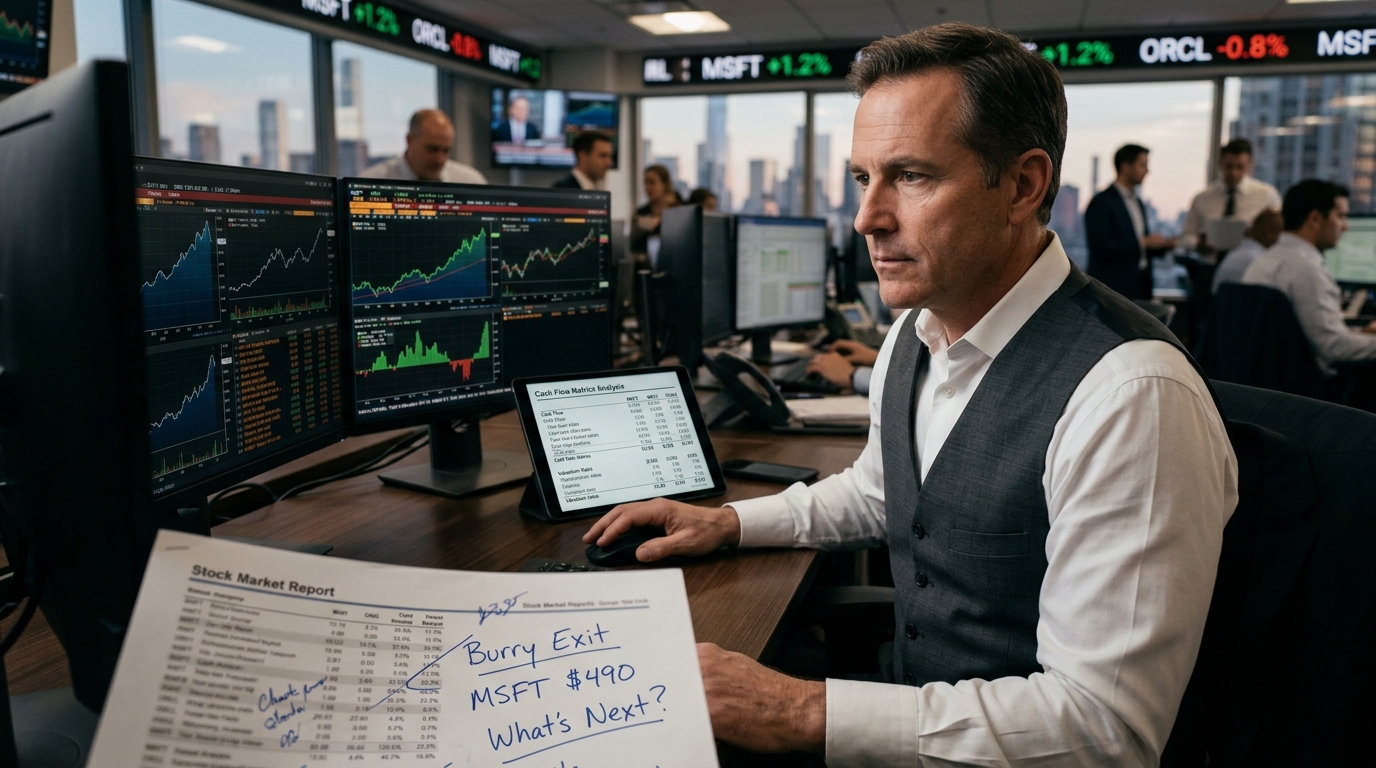
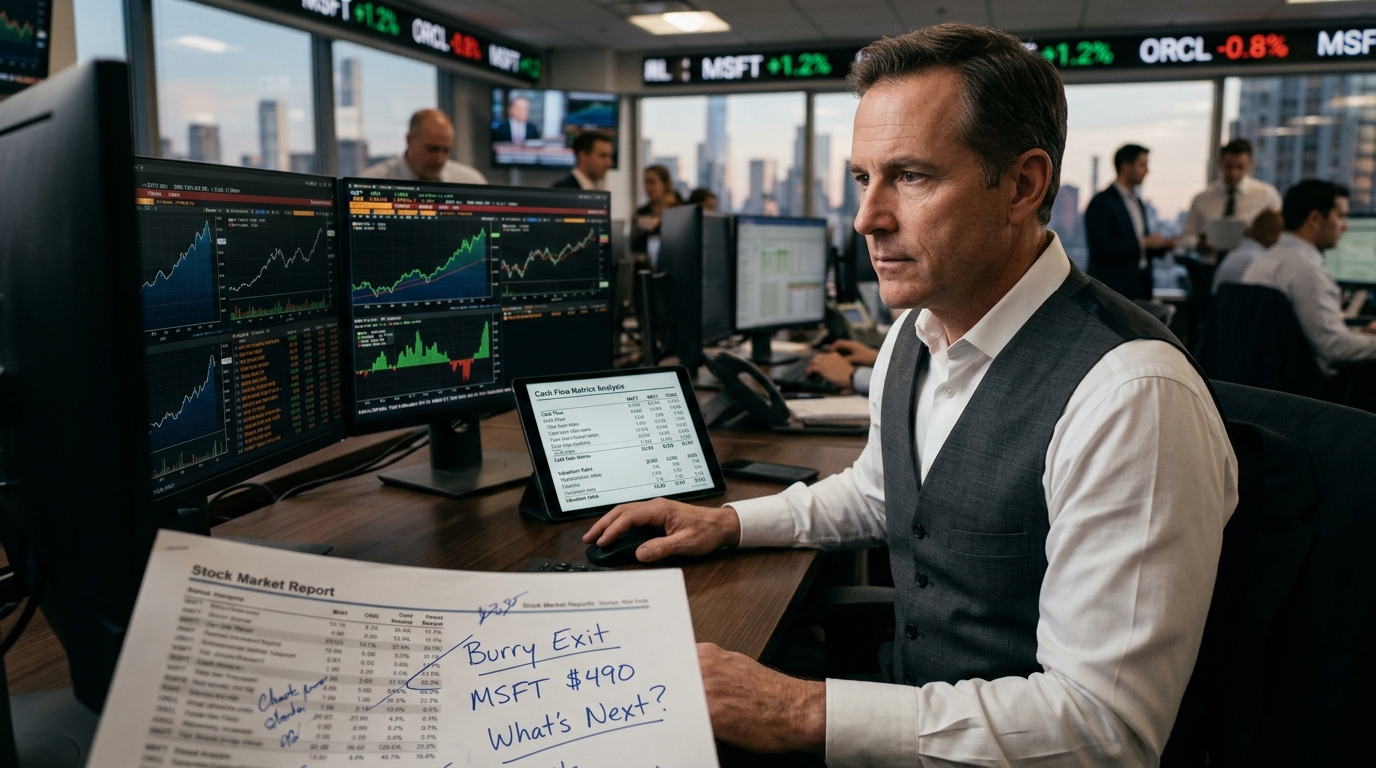
Michael Burry just closed his two most-watched positions of 2026. Everyone is busy grading the trades. That is the wrong exercise.
Yes, he was right on both. The more useful question is what his exits, and more pointedly what he chose to keep, tell you about where he thinks the real pressure in AI-linked equities is still building.
What He Actually Did
In a Substack update this week, Burry disclosed that he has fully exited his long position in Microsoft, closed his Oracle short entirely, and let his January 2026 Palantir puts expire rather than rolling them. He simultaneously rolled his Nvidia and QQQ puts further out in time and added to short positions across the semiconductor complex.
The Oracle closure requires a small footnote. In mid-July, Burry publicly corrected reports that he had fully exited, clarifying that he had sold only half of his January 2027 puts because the position had grown too large. He kept the remaining half at the time. He has since closed the rest and said in his disclosure that the profit was substantial, adding that he may re-enter if volatility eases.
The Microsoft Trade: Entry, Execution, Exit
Burry first disclosed a long position in Microsoft in April 2026, after the stock had sold off roughly 31% from its October 2025 peak. His entry was approximately $415 per share. The structure involved December 2028 LEAP calls struck in the low $700s, a long-dated bet that the selloff was driven by reflexive fear over AI capital spending rather than any deterioration in the underlying business.
He rang the register immediately after Microsoft reported fiscal Q4 2026 results on July 29. The numbers made his thesis look prescient: revenue of $90 billion against a Street estimate near $87.6 billion, Azure growth of 43% in the quarter, and full-year Azure revenue crossing $100 billion for the first time. Microsoft 365 Copilot paid seats more than doubled sequentially to over 30 million, and management guided Azure to approximately 45% constant-currency growth in the fiscal first quarter of 2027. The stock surged more than 25% in the four sessions following the report.
Burry’s own assessment was measured. He wrote that the position benefited from lucky timing and that his enthusiasm for the earnings report did not match the market’s. That is a disciplined read: he entered a hated stock, held through a decisive fundamental beat, and exited into the euphoria rather than with it.
Microsoft: What You Are Paying for Now
The Q4 results were not straightforwardly clean. A $3.2 billion gain on Microsoft’s investment in Anthropic contributed $0.27 to reported EPS, and the company also benefited from lower-than-expected costs tied to its voluntary retirement program. Adjusting for those items, the underlying beat was still real, but narrower than the headline figures suggest.
The structural picture is genuinely strong. Azure’s 43% quarter growth, combined with the Copilot seat milestone, shows that AI monetization has moved from theoretical to measurable. Microsoft’s commercial remaining performance obligations jumped $51 billion in a single quarter to $678 billion, with growth driven primarily by customers outside the AI model developer community, a sign that enterprise adoption is broadening. Capital expenditures reached $41 billion in Q4 alone, up 69% year over year, and management guided Q1 capex above $50 billion.
That capex trajectory is the pivot point for anyone thinking about buying now. The AI demand case is no longer in question. The question is whether the returns on that spending arrive fast enough to justify what is now a considerably higher multiple than the one that attracted Burry in April. Microsoft trades at roughly 25 times forward earnings. If Azure growth moderates even modestly from the mid-40s guided for Q1, the multiple can compress quickly.
The Oracle Trade: What the Bear Case Actually Was
Burry’s Oracle bear thesis, disclosed in a January 2026 Substack post, centered on three things: aggressive AI infrastructure spending, what he described as questionable financing decisions, and heavy customer concentration around OpenAI. Oracle’s stock dropped approximately 51% from its Q3 2025 peak by early February 2026. His puts were struck in the low-to-mid $100s with a January 2027 expiry.
The thesis received institutional validation on July 9, when S&P Global Ratings cut Oracle’s long-term issuer credit rating from BBB to BBB-, one notch above speculative grade. The agency identified Oracle’s concentrated exposure to OpenAI as a key credit risk, noting that OpenAI accounts for roughly half of Oracle’s $638 billion in remaining performance obligations. S&P forecasted Oracle’s fiscal 2027 free operating cash flow deficit widening to nearly $42 billion and projected capital expenditures of $90 billion to $95 billion for the year, sharply above its prior estimate of $60 billion.
The numbers behind that rating action are worth sitting with. FY2026 capital expenditures came in at $55.7 billion, up 162% year over year. Free cash flow was negative $23.7 billion despite $32 billion in operating cash flow. Oracle raised $43 billion in debt and $5 billion in equity during the fiscal year and plans approximately $40 billion more in financing in FY2027, including a previously announced $20 billion at-the-market equity issuance. Adjusted debt-to-leverage is forecast to reach the mid-4x range in FY2027, above the 4x threshold S&P considers appropriate for a BBB-rated issuer.
Burry collected his gain on the puts, did not roll them, and left the door open to re-entering if options pricing becomes more favorable. The bear case played out. He stopped there.
Louis Navellier: Don’t buy OR sell another AI stock…
Until you’ve heard this urgent AI warning from the man who called Nvidia before its 44,000% rise…
According to Louis, a massive reset is coming in an obscure corner of the AI market.
This $100 trillion disruption could send some of the world’s biggest AI stocks to zero… and one off-the-radar stock soaring… starting now.
Oracle: Is It Fixed or Just Cheaper?
Oracle’s FY2026 revenue grew 17% to $67.4 billion. Cloud infrastructure revenue hit $18.1 billion, up 77%. The company guided FY2027 revenue to $90 billion, implying 34% growth, and raised its non-GAAP EPS guidance to $8.05. On those headline metrics, the business looks like it is working.
The complication is the gap between contracted demand and cash in hand. Oracle says 12% of its $638 billion RPO will be recognized as revenue within the next 12 months, with an additional 34% over the two years that follow. That is meaningful visibility, but it is visibility into revenue, not cash. The company’s net cash outlay for capex is expected to reach $70 billion in FY2027, and roughly half the entire backlog is tied to a single customer whose own financial health depends on continued AI investment and external capital.
A forward P/E multiple tells you almost nothing useful about Oracle right now. The right metric is the pace at which that $638 billion converts into recognized revenue and, ultimately, free cash flow. Until that conversion shows up in reported numbers rather than backlog headlines, the stock is a story about execution risk at very large scale.
The Book He Kept
This is the more interesting part of the disclosure. Burry’s remaining short positions include Nvidia, Palantir, Tesla, Micron, Applied Materials, Caterpillar, and the SOXX semiconductor ETF. He recently added to his Nvidia put position and increased outright shorts in Micron and SOXX. He has described the combined SOXX short and related options as one of his larger current holdings.
His Nvidia bear argument is structural. He has written that much of Nvidia’s current demand is not driven by genuine end customers but by off-balance-sheet financing arrangements, citing the Bank for International Settlements’ 2026 annual report. His view is that future revenue in that ecosystem will be largely financed through circular arrangements, a thesis that targets the debt architecture underneath the AI infrastructure buildout rather than the demand headlines on top of it.
Caterpillar’s presence on the short list is telling. The construction equipment maker has been a beneficiary of data center buildout spending. Shorting Caterpillar alongside semiconductors suggests Burry is not just betting against chip valuations but against the physical infrastructure spending cycle that the AI trade has ignited more broadly.
On Palantir: he let the January 2026 puts expire rather than paying for more time, but retained the direct short position. Palantir trades at roughly 86 times forward earnings. His view on the valuation has not changed. He just no longer wants to rent time on options to express it.
Data Snapshot
Microsoft (MSFT), Q4 FY2026:
- Revenue: $90 billion; Street estimate was approximately $87.6 billion.
- Azure growth: 43% in Q4; full-year Azure revenue surpassed $100 billion for the first time.
- Microsoft 365 Copilot: over 30 million paid seats, up from about 20 million in April.
- Commercial RPO: $678 billion, up $51 billion sequentially.
- Q4 capital expenditures: $41 billion, up 69% year over year.
- Q1 FY2027 Azure guidance: approximately 45% constant-currency growth.
- Forward P/E: approximately 25 times.
Oracle (ORCL), FY2026:
- Full-year revenue: $67.4 billion, up 17%; cloud revenue $34 billion, up 39%.
- FY2026 capital expenditures: $55.7 billion, up 162%.
- FY2026 free cash flow: negative $23.7 billion.
- Remaining performance obligations: $638 billion, up 363% year over year.
- FY2027 revenue guidance: $90 billion.
- FY2027 financing plan: approximately $40 billion in debt and equity, including a $20 billion ATM issuance.
- S&P credit rating: BBB-, one notch above speculative grade as of July 9, 2026.
- S&P FY2027 free operating cash flow forecast: negative $42 billion.
- Forward P/E: approximately 18 times.
Bull / Base / Bear
Microsoft Bull: Azure sustains mid-40s growth through FY2027 as capacity constraints ease and Copilot seat adds continue compounding. Capex proves demand-driven rather than speculative. The stock grinds toward prior highs and rerates on FCF improvement.
Microsoft Base: Azure growth holds in the high 30s. Copilot expansion slows from its current pace but remains commercially meaningful. Capex pressure keeps the stock in a wide range. Burry’s exit looks, in hindsight, like a well-timed sale near the top of a trading range.
Microsoft Bear: Capex outpaces revenue growth and pressures free cash flow materially. Azure decelerates once near-term supply constraints ease and demand normalizes. Multiple contracts sharply. The stock revisits the $380-$390 zone that preceded the Q4 surge.
Oracle Bull: The $638 billion backlog converts to recognized revenue at an accelerating pace in FY2027. OCI utilization improves, free cash flow trends toward positive earlier than S&P projects, and the stock rerates on evidence of financial inflection.
Oracle Base: Revenue grows on track with guidance but the $40 billion financing plan and OpenAI concentration risk keep institutional buyers cautious. The stock stays range-bound until cash flow data, not backlog headlines, confirms the thesis.
Oracle Bear: Backlog conversion disappoints. The equity issuance dilutes current holders at a price well below prior highs. Credit metrics deteriorate further. S&P moves the outlook from stable to negative and the stock retests its 52-week low near $121.
Action Plan
On Microsoft: Burry’s exit is not a sell signal for holders, but it is a caution flag for anyone thinking about chasing momentum at $420-plus. The business case is intact. Azure growth is real, Copilot adoption is measurable, and the contracted backlog is growing. The problem is that none of that is a secret anymore, and the multiple now prices execution near-perfectly. If you do not own it, waiting for a pullback before building a position is better math than chasing the post-earnings surge.
On Oracle: Burry covering is not a buy signal. The structural issues he identified, negative free cash flow, heavy customer concentration, and a pending equity issuance as part of a broader $40 billion financing plan, are still fully active. The backlog is real. The question is whether it converts to cash fast enough to offset the leverage being piled on to build the infrastructure that serves it. Wait for evidence of FCF inflection in reported numbers before treating ORCL as a value opportunity rather than a value question.
On the remaining short book: Burry has not walked away from his AI skepticism. He has narrowed it, taken profits where they existed, and concentrated his remaining exposure in the names most directly tied to the capital spending cycle: Nvidia, Micron, SOXX, Applied Materials, and Caterpillar. That is a specific macro call, not a broad market call. Traders with conviction on AI infrastructure durability should treat the semiconductor shorts as the clearest expression of his current thesis and the most direct read on where he expects pressure to build.
Key Levels and Triggers to Watch
- MSFT Azure Q1 FY2027 growth: Management guided approximately 45% constant-currency. Any print below 42% would be read as deceleration and put the multiple under pressure.
- MSFT Copilot seat adds: Over 30 million paid seats now with net adds doubling quarter over quarter. The next update will test whether that momentum is sustainable or a one-quarter spike.
- MSFT capex trajectory: Q1 capex is guided above $50 billion. Watch whether FCF holds up or begins compressing as spending accelerates.
- ORCL RPO conversion rate: Oracle says 12% of the $638 billion RPO converts to revenue within 12 months. That number in the next quarterly report is the primary signal on whether the backlog is turning into cash or just growing larger.
- ORCL free cash flow: Negative $23.7 billion in FY2026. S&P projects a negative $42 billion in FY2027. Any improvement relative to that forecast would be a meaningful catalyst. Deterioration relative to it would not be.
- ORCL equity issuance timing: The $20 billion ATM is part of the approximately $40 billion FY2027 financing plan. Watch for execution timing and pricing, both are near-term equity catalysts either way.
- NVDA/SOXX price action: Burry has described his combined SOXX short and put options as one of his larger positions. The semiconductor ETF’s behavior around earnings and macro data releases is the most direct real-time read on whether his AI infrastructure cycle thesis is gaining or losing traction.
Bottom Line
Burry exited Microsoft because the easy money was made. He is probably right about that. The company just posted a decisive quarter, beat on every major line, and gave guidance that confirmed Azure is still accelerating. None of that goes away. But the stock no longer offers the margin of safety that made the April entry defensible, and Burry said as much when he wrote that his enthusiasm for the earnings report did not match the market’s.
He covered Oracle because the bear case played out, not because the bull case arrived. A 51% drop from peak and a substantial profit on January 2027 puts is a clean outcome. The company’s structural problems, negative FCF, near-junk credit, OpenAI concentration, and $40 billion in planned FY2027 financing, are not resolved. They are just priced differently than they were when the trade was on.
What the remaining short book tells you is that Burry’s real conviction sits elsewhere. He is not done with the AI infrastructure cycle question. He has just sharpened his expression of it, moving away from diversified software names and concentrating in the companies most directly inflated by the spending wave: chip makers, chip equipment, the ETF that holds them all, and the industrial names riding the data center construction cycle. That is not capitulation. It is refinement.