
Market Snapshot
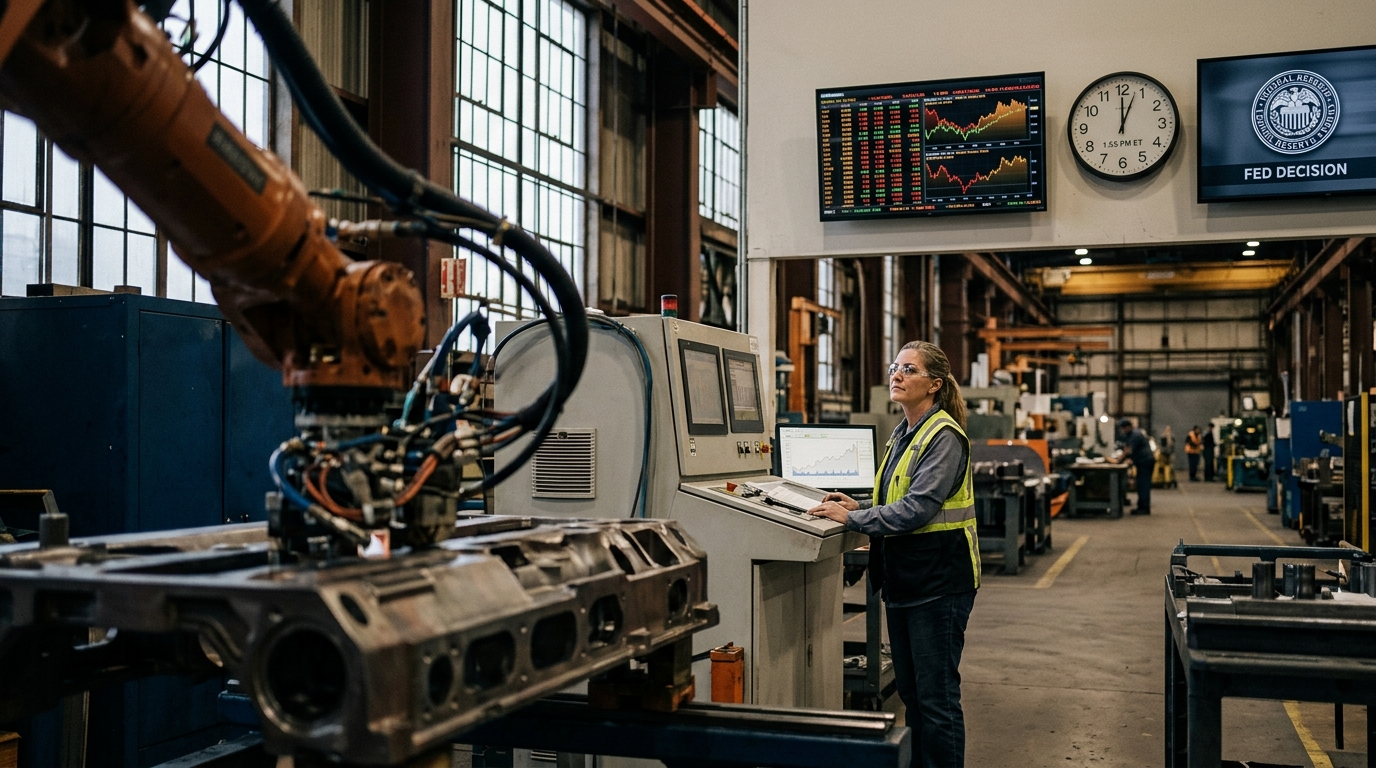
The dominant tone heading into August 6: broadly constructive, but with meaningful internal tension. The Dow Jones Industrial Average hit a record on Monday, while the Nasdaq Composite posted a 2.1% gain before giving some of it back Wednesday. On August 5, the Dow held a roughly 0.5% gain while the Nasdaq fell about 0.8% and the S&P 500 was modestly higher. That divergence matters: cyclicals are holding and tech is digesting. VIX remains contained. Treasuries are calm relative to the Fed noise. Crude oil is not a headwind this week. The real action is inside the Q2 earnings results now landing, and those results are what the AI rally thesis lives or dies on.
Stocks in Focus
Palantir (PLTR). This is the single most important AI software data point of the week. Palantir beat Wall Street expectations in Q2 2026, reporting adjusted EPS of $0.41 on revenue of about $1.94 billion, above forecasts of roughly $0.34 to $0.35 and $1.81 billion respectively. The headline growth rate of 93% year over year is attention-getting. The composition is what matters more. U.S. commercial revenue rose 149% year over year to $764 million; U.S. government revenue grew 90% to $809 million. Total U.S. revenue reached $1.57 billion, a 115% increase from a year ago. These are not token-generation abstractions. These are enterprise contracts converting AI spend into recognized revenue. The company said it generated $1.22 billion in adjusted free cash flow and highlighted a “Rule of 40” score of 155%. It also said it surpassed $1 billion milestones in GAAP net income, adjusted free cash flow, and adjusted operating income simultaneously. Palantir closed $3.37 billion in total contract value during the quarter, up 49% year over year, including a record $2.13 billion in U.S. commercial contract value. Guidance was raised again: full-year revenue guidance lifted to $8.15 billion to $8.16 billion, with U.S. commercial revenue targeted at more than $3.42 billion, representing at least 134% growth. Watch: whether PLTR can hold the post-earnings pop above $130. The stock was already down 29% year to date before this report. The recovery move is still fragile.
Nvidia (NVDA). The most recent fiscal quarter (Q1 FY2027, ended April 2026) delivered record total revenue of $81.6 billion, while Data Center revenue was $75.2 billion, up 21% from the prior quarter and up 92% from a year ago. The stock fell after the analyst call, a pattern worth monitoring. Buyers are showing up in the hardware chain even when Nvidia itself disappoints. Broadcom guided fiscal Q3 revenue of about $29.4 billion, an 84% year-over-year increase, which is its own bullish signal for the infrastructure layer.
Sector Watch
AI infrastructure: still the leader, but bifurcating. Returns across AI-related industries have varied significantly in 2026. Companies tied to AI servers, optical components, and memory technologies have delivered the strongest gains, while hyperscalers and chip designers have underperformed relative to other AI sub-sectors. That tells you something about where the money is going: not into the companies spending the capital, but into the companies supplying the parts. Global semiconductor sales hit a record $120.6 billion in May 2026, up 104.1% year over year, marking the 15th consecutive month of sequential growth. WSTS now forecasts the global semiconductor market will reach about $1.51 trillion in 2026. That is being built out in real manufacturing capacity right now. Reuters reported that ASML said chip demand is outpacing supply and customers are raising short- and medium-term demand expectations. Applied Materials delivered record quarterly performance, but its specific 2026 equipment growth expectation is less consistently reported across primary company filings, so treat that figure as directional rather than precise.
The broader market is finally participating. Equal-weight leadership has been showing up in 2026, with the equal-weight S&P 500 trending ahead of the cap-weighted index at points this year as the mega-cap rally shows signs of broadening. The outperformance of the equal-weight S&P 500 relative to the traditional market-cap-weighted index signals that the market rally is broadening, according to experts. This is the breadth confirmation bears said would never come. It is not unambiguous, concentration in the largest names remains historically elevated. That tension is the story: broadening signs versus a regime still defined by megacap heft.
Catalyst Calendar
- Remaining Q2 earnings (AI-adjacent): Several semiconductor and software names are still reporting through mid-August. Each report either validates or erodes the capex-to-revenue conversion thesis that the AI rally depends on.
- July CPI (August 12): The single most consequential macro release this month. A hot reading could revive September hike probabilities and compress multiples across the AI sector.
- Nvidia fiscal Q2 FY2027 (late August): The Q2 number and the Vera Rubin ramp commentary will set expectations for the rest of 2026.
- Fed speakers: Following the most recent meeting, any Fed communication that shifts September odds meaningfully will move rate-sensitive positions across tech.
Technical Radar
Nasdaq Composite: Support near 26,200. Holding above this level after the Wednesday fade is the first test. A close below it opens a retest of the 25,800 range. Resistance at 26,800, the prior all-time high from mid-July.
Palantir: The post-earnings reaction zone between $128 and $135 is critical. The stock spent months below $100 before the Q2 surge. Bears will push back hard at the gap open. Bulls need a weekly close above $132 to establish new support.
Semiconductor ETF (SOXX): Memory and compute-related stocks currently appear the most attractive from a valuation perspective when measured by PEG ratios. SOXX has been outpacing chip designers on a relative basis. Watch for rotation from fabless names into memory and optical interconnect plays if the index stalls at resistance.
Equal-weight (RSP) vs. cap-weight (SPY) ratio: Put the cap-weighted S&P 500 next to the equal-weight version. If the index is ripping and equal-weight is chopping, you are staring at a narrow rally. Right now the ratio is improving. That is a green light for risk exposure across a broader basket, but monitor it weekly.
Risk Radar
The capex-to-revenue gap. This is the central structural risk of the entire AI trade. CreditSights has put 2026 capex for the top five hyperscalers at roughly $750 billion in one estimate, while other commentary has framed a wider $700 billion to $900 billion range. The application layer has not yet generated revenue at a pace that justifies the infrastructure. If Q3 guidance from cloud providers shows any deceleration, that gap becomes a political problem for AI bulls.
Valuation concentration. The concentration of AI-related gains among a relatively small number of large-cap technology stocks has raised concerns about market fragility. If these companies fail to meet elevated expectations, the resulting correction could have broader market implications given their substantial weighting in major indices.
Earnings quality, not just growth rate. The recent rally in AI-related stocks, particularly in the semiconductor sector, is facing increased scrutiny as market watchers question the sustainability of soaring margins. Operating leverage is real and valuable, until volume slows. It provides no buffer if orders disappoint.
The Fed is not neutral. If July CPI on August 12 comes in above consensus, September becomes a live hike meeting and every duration-sensitive AI multiple gets repriced.
The Cheat Sheet
Top Market Theme: Strategists at Jefferies argue that the AI rally still appears fundamentally supported rather than excessively speculative, with gains driven primarily by earnings expansion instead of valuation multiple inflation, a dynamic they describe as sustainable.
Stock to Watch: Palantir. The company delivered 93% year-over-year revenue growth, with U.S. commercial revenue accelerating to 149% growth. The stock is recovering from a 29% year-to-date decline. The Q2 data is the strongest evidence yet that AI software monetization is real and accelerating, not a future promise.
Sector to Watch: AI infrastructure hardware, specifically memory, optical interconnect, and advanced packaging. WSTS forecasts the global semiconductor market will reach about $1.51 trillion in 2026, underscoring how fast the buildout is scaling.
Biggest Risk: The August 12 CPI reading. A hot number resurrects the September hike and compresses every AI multiple simultaneously. Foundational strength does not mean linear performance. Volatility is expected as investors navigate the tension between growth and reality.
Biggest Opportunity: The stocks that sold off hardest in the first half while fundamentals held, Palantir and select semiconductor equipment names, are the ones where the risk-reward is most asymmetric now.
One Thing to Remember: The question is not whether AI is real. Palantir’s 149% U.S. commercial revenue growth and Nvidia’s $75.2 billion Data Center quarter say it is real. The question is whether you are paying for that growth at a price that leaves room for error. For the names that corrected sharply in H1 while the business accelerated, the answer is increasingly yes.