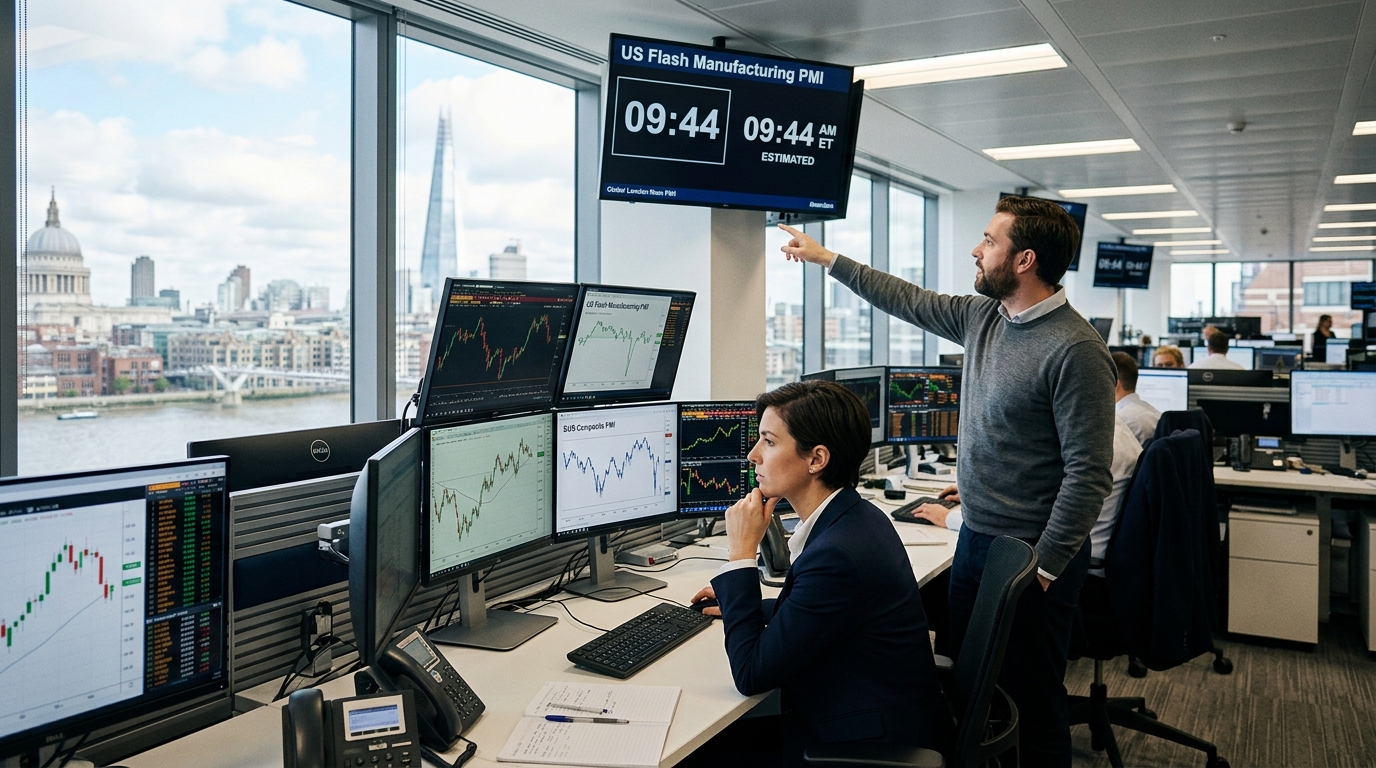
Europe delivered the most convincing batch of activity data in two years this morning, and now the session hinges on what the US adds to the picture at 9:45 ET.
Germany’s flash composite PMI rose to 53.8 in September from 51.8 in August, its highest reading since October last year. The manufacturing PMI edged down to 54.3 from 54.7, but the move was overshadowed by the services turnaround. German services hit 52.9, a seven-month high that ended a five-month sequence of contraction. That is the detail traders should focus on: manufacturing has been the eurozone’s bright spot all year, and services just rejoined it.
France was the bigger surprise. France’s private sector grew in September at its fastest pace in just over two years, with the flash composite rising to 51.2 from 48.5 in August. The services PMI drove it, climbing to 51.4 from 48.0, a ten-month high. Consensus had penciled in 48.4 for services. The beat was not marginal.
The complication is that all of this expansion is happening directly on top of the ECB’s tightening cycle. The ECB raised its deposit rate to 2.50% at its September 10 meeting, with the new rate taking effect September 16. A rate of 2.50% is widely discussed as being around the upper bound of the ECB’s neutral range, though ECB officials have pushed back on treating it as a hard threshold. Today’s PMIs hand hawks exactly the argument they need: the economy is expanding despite two hikes, so there is room to go further if energy keeps pushing inflation higher.
S&P Global’s Joe Hayes flagged the durability question directly, noting that “new orders barely rose and firms’ own expectations for activity deteriorated.” That is the internal tension in the French read. Surface numbers look strong; forward indicators look cautious. Germany carries a similar caveat: growth is accelerating even as energy costs and tighter policy weigh on sentiment, and the market response has been muted accordingly.
Where the Trade Sets Up
The euro’s reaction will be shaped by the 9:45 US flash PMIs. Expectations sit at 53.6 for manufacturing and 56.0 for services. If the US reading comes in soft, the dollar loses relative yield support, the euro strengthens, and European cyclicals denominated in dollars get a secondary lift. EWG and EZU become the expression: German industrials and financials, which dominate both funds, benefit from a weaker dollar and from the underlying PMI strength simultaneously.
A hot US number runs the opposite way. It keeps dollar momentum intact, compresses the rate-differential benefit that has been leaking into euro assets, and forces a harder look at whether EZU’s roughly 10% year-to-date gain has front-run the fundamental story. The ECB is already focused more on inflation than on growth readings, so stronger US data that lifts global yields would simply add another headwind above the ECB’s own tightening.
The DAX is where conviction trades live today. The PMI data is giving the bulls what they want: growth broadening from manufacturing into services.
The Risk Dashboard
Watch the 9:45 ET US prints first. A services reading above 57 would likely sell European outperformance into the New York open. Hold that thought until the numbers cross. After that, oil matters as much as any economic data: eurozone energy inflation has accelerated recently amid renewed disruption risks around the Strait of Hormuz, and any fresh escalation will force the ECB’s hand regardless of what PMIs say about demand.
Highest conviction: long EWG on a soft US services print. The German composite is at a near-year high, services have turned, and the technical picture would benefit from dollar softness. The thesis weakens if US data surprises to the upside or if crude breaks back above $100. Keep that as the line in the sand.