
Most traders have never noticed the weird market anomaly that happens at 9:35 AM every morning.
They’re too busy with lagging indicators trying to predict the next move… when the market makers have already set the tone for the trading day.
It’s this weird anomaly that points us to the market maker’s key levels above and below.
And by playing the move within that range…
Regular folks like you have been able to reach for $100 or more (on a $1K stake) over 600 times in the last 2 years.
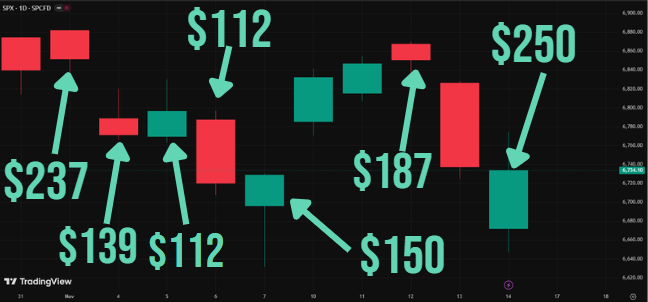
We’ve seen this straightforward approach play out whether the market broke out… broke down… or stayed choppy.
Granted, I can’t make trading guarantees here.
But I’ve opened up the data behind those trades, as well as how you can get in on the very next morning opportunity.
You’ll find the full details right here.
See you in the market.
Chris Pulver
Two Catalysts Will Reset the Fed’s Next Move This Week

Friday’s payroll report landed like a trapdoor. Employers added just 29,000 jobs in September, against a consensus forecast of 90,000. Within hours, CME FedWatch pricing for an October hike fell from roughly 64% a week earlier to about 23%. That reset did not resolve the week’s biggest question. It opened one.
The tension traders have to trade around right now is not whether October happens. It probably does not. The tension is what Monday and Wednesday reveal about December, and about whether Chairman Kevin Warsh’s stated conviction that inflation has been “too high for too long” holds up against a labor market that just posted its softest month of the year.
The Market Environment
The 2-year yield, the maturity most attuned to shifts in Fed policy, slipped about 6 basis points on Friday. That followed a week in which 10-year yields had touched roughly 5.34% intraday, their highest levels since 2002. The two-day round trip from multi-decade highs to a jobs-driven rally captures the entire macro problem: inflation signals and labor signals pointing in opposite directions, with the minutes and ISM services as this week’s tiebreakers.
TLT caught a Friday bid alongside the Treasury rally. Those moves are entirely reversible if Monday’s ISM services prices-paid component echoes what manufacturing prices-paid just delivered.
The Biggest Opportunity: Two-Year Treasuries Around Monday’s Open
The ISM manufacturing prices-paid index climbed 6.8 percentage points in September to 77.9, returning close to the level seen at the beginning of the Iran war. That is the inflationary context walking into Monday’s services release.
The September ISM Services report is expected to point to a healthy, expanding services sector, with the headline index seen easing modestly but staying comfortably above the 50 breakeven threshold. The prices-paid sub-index, previously at 72.6, is the number to watch: services inflation is where tariff and wage pressure show up last and leave slowest.
If services prices-paid approaches or exceeds the manufacturing read, the two-year yield snaps back higher and TLT faces renewed selling. If it moderates, the Friday rally has legs and rate-sensitive sectors can extend. Either outcome sets the directional trade for the week, which is why two-year Treasuries are the clearest expression of the thesis going into 10am Monday.
Wednesday: The Minutes That Rewrite October’s Calculus
Fed policymakers voted 12-0 to raise the federal funds rate to 3.75%–4.00% on September 16, marking the first rate hike since July 2023. Warsh declined to commit to future rate hikes at the press conference, though the dot plot indicated expectations for one additional increase this year. The minutes, due Wednesday at 2pm Eastern, will show how much of that unanimity was conviction and how much was data-conditional.
Only 29,000 jobs were added in September, and the BLS cut its July and August tallies by a combined 60,000, the same months that underpinned the Fed’s September 16 decision. Jefferies chief U.S. economist Thomas Simons wrote that the September jobs number “should be the nail in the coffin for an October hike.” The minutes will reveal whether FOMC members were already flagging labor-market fragility at the September meeting or whether the soft payroll data is genuinely new information.
Sector Rotation and Risk Dashboard
Rate-sensitive sectors including REITs, utilities, and regional banks move in near-lockstep with two-year yields at this stage of the cycle. A strong ISM services prices-paid number Monday morning reverses Friday’s rally before most retail traders have processed the headline. The dollar, which weakened after payrolls, faces the same binary: hot services inflation is dollar-positive; a soft read extends the jobs-driven slide.
Investors are still pricing a meaningful chance of a Fed hike in December even with October largely off the table, so the minutes’ language on the threshold for that second move will matter to anyone positioned in SPY or longer-duration fixed income through year-end.
Trader’s Action Plan
The two-year Treasury yield is the single number to watch from 10am Monday. A services prices-paid reading above 74 challenges the Friday bid across rate-sensitive assets. A reading below 70 likely confirms TLT’s reversal has room to run. Wednesday’s minutes are the secondary catalyst: watch for any dissent language or explicit references to labor-market weakness that could shift December hike odds lower. Until those two releases clear, high-conviction new positions in either direction carry more headline risk than the market is pricing.