
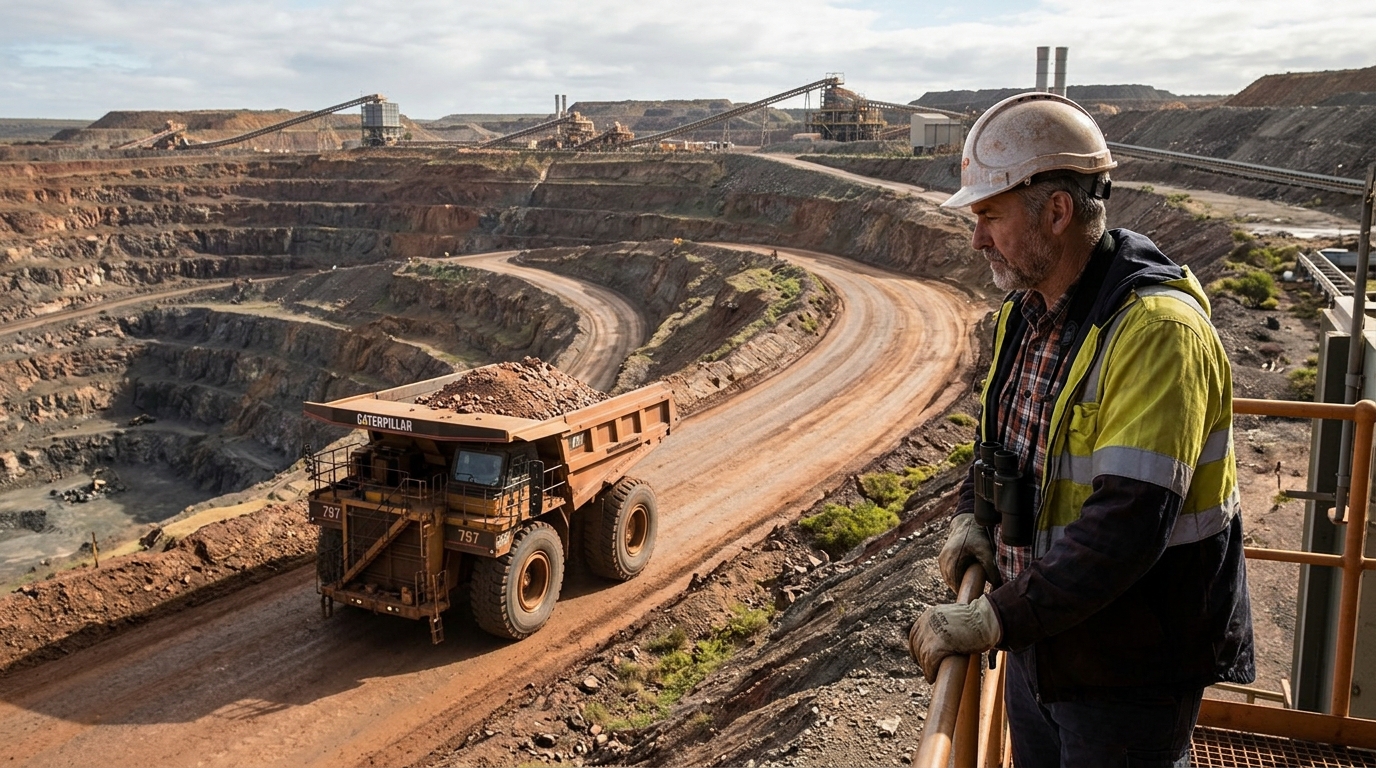
The best mining fortunes have rarely been built by committing capital when sentiment is buoyant. They were built in moments exactly like this one.
Copper lost nearly 6% on November 18 in its deepest single-day drop since April 2025. By that point, a record Chinese premium was drawing metal out of the United States, where inventories had swelled on tariff expectations, leaving Shanghai short. On November 19, Shanghai spot premiums were quoted at a record 7,250 yuan per tonne, and the Yangshan import premium hit record territory around $500 per tonne. Two markets, opposite signals. Futures sellers were exiting; physical buyers were scrambling at any price.
Into that contradiction, BHP today walked investors through a staged plan to transform its South Australian copper province.
What BHP Is Actually Building
At an investor presentation during an Olympic Dam site tour, BHP outlined plans to double its copper production in South Australia to 650,000 tonnes a year by 2040, at a cost of $13.6 billion to $17.4 billion, which would make the region comparable in scale to Chile’s Escondida. The programme brings together Olympic Dam, Carrapateena, Prominent Hill, and the Ankata deposit under a single regional expansion plan.
BHP is advancing the Prominent Hill expansion, the Carrapateena expansion, and Olympic Dam mine and concentrator growth alongside a smelter and refinery expansion, with the smelter’s final investment decision scheduled for the second half of calendar 2027 and first production targeted for calendar 2032. A final investment decision on the broader plan is due in the first half of next year.
At Olympic Dam specifically, BHP plans to introduce block caving, a large-scale underground mining method suited to deep ore bodies, alongside two-stage smelting. The expansion also includes hydrometallurgical and concentrator upgrades that are expected to increase uranium production by around 50% to 5 to 6 kilotonnes per annum.
Why the Timing Is the Point
Olympic Dam has been deferred before. BHP shelved a previous $30 billion expansion at the mine in 2012, citing weaker commodity markets and a slowing global economy. That decision, made into weakness, delayed a generation of output. This time, BHP is committing into weakness again, but the structure has changed materially.
BHP is now framing growth as a staged build with a clear cost ceiling, after broadening its regional footprint by buying OZ Minerals and grouping Olympic Dam with Prominent Hill and Carrapateena under Copper South Australia. Staged capital with defined decision gates is not the same animal as a $30 billion open-pit dream. It is fundable, modelable, and cancellable at each gate if the economics shift. That discipline matters.
BHP expects global copper demand to exceed 45 million tonnes per year by 2040, around 30% higher than current levels. The problem for supply is that increasing output from mines is becoming structurally harder, with new copper deposits becoming rarer and development costs rising. Every year of deferred investment tightens that gap further.
The Mogul Mindset
The divergence between paper copper and physical copper right now is worth sitting with. The copper price fell about 6% in a single day to a seven-month low while Shanghai ran short of deliverable metal and Chinese buyers paid record premiums, a split that points to forced liquidation rather than collapsing demand. Leveraged funds were selling a thesis; manufacturers were paying any premium to secure cathode. Those are not the same actor, and they are not sending the same message.
BHP is reading the physical market, not the futures screen. The company aims to increase Copper South Australia output to about 500,000 tonnes per year by 2035 and up to 650,000 tonnes by 2040, with the region contributing about one-third of BHP’s copper growth through 2035, supporting a broader target of roughly 2 million tonnes of attributable copper production annually by the middle of the next decade.
Whether BHP pulls the trigger on the final investment decision in the first half of 2027 will depend on project costs, the copper forward curve, and the South Australian regulatory environment. Those are real risks. So is execution at a mine that has historically underdelivered against optimistic production forecasts. But the core logic is not complicated: the world needs more copper, it is becoming harder to find and develop, and the company sitting on one of the largest undeveloped copper orebodies on the planet just said, in public, to investors standing at the site, that it intends to build it. That is not noise. That is a capital allocation decision fourteen years in the making.