
June 4, 2026
Honeywell Quantum Spin Is Now Public
What the Quantinuum IPO means for HON investors right now
Honeywell (HON): The Quantum Spin That Wall Street Is Watching
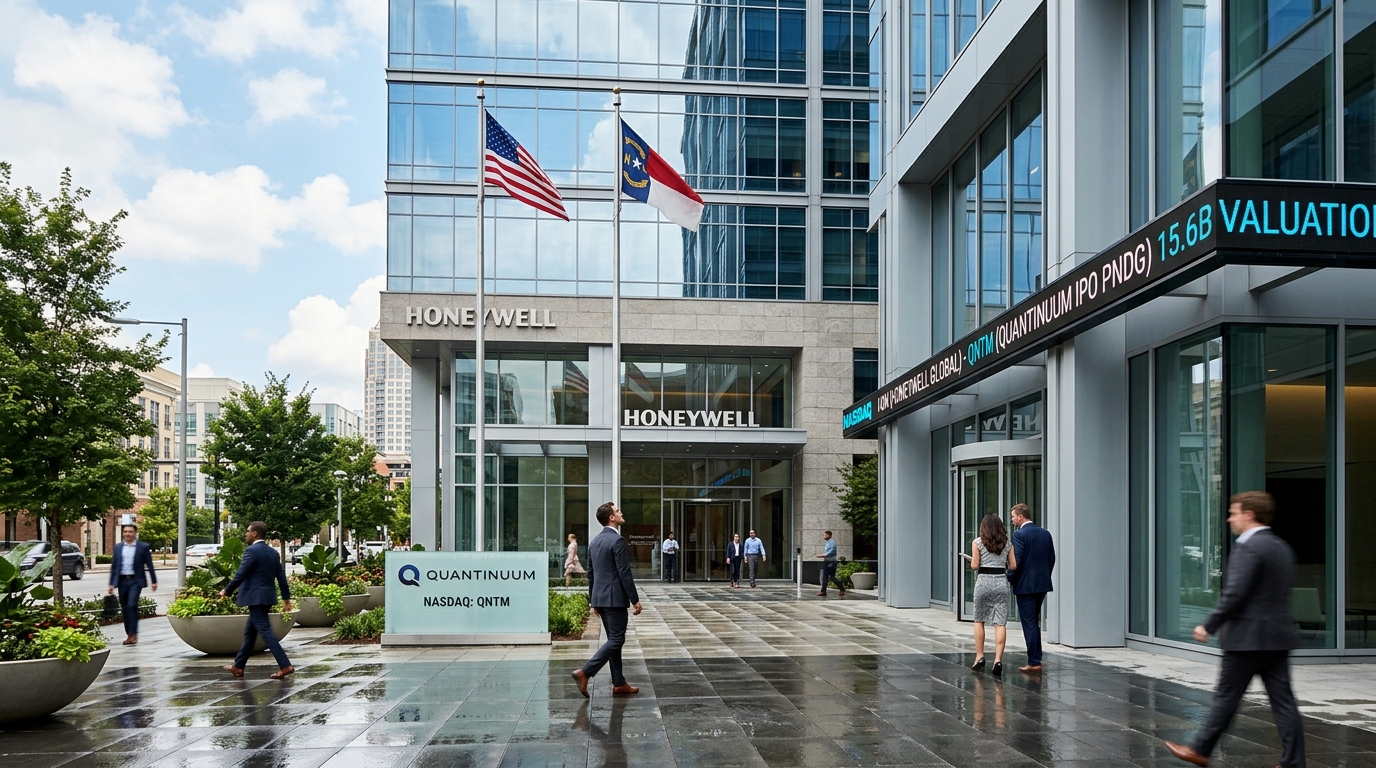
June 3rd. That’s when it happened. Quantinuum, the quantum computing unit that Honeywell has been quietly building for years, priced its Nasdaq IPO at $60 per share, raised $1.68 billion, and walked out the door with a $15.6 billion post-IPO valuation. Ticker: QNT. It was the kind of debut that makes you stop and recalibrate, especially when the broader tech sector has been leaking value for weeks.
Here’s where I’m at on this.
Honeywell isn’t a startup. It’s a 100-plus-year-old Charlotte, North Carolina industrial conglomerate with roughly 101,000 employees globally, deep aerospace contracts, building automation systems, and industrial process technology baked into the bones of major infrastructure worldwide. The company that just IPO’d a quantum computing unit at a $15.6 billion valuation also makes aircraft components and factory sensors. That context matters when you’re trying to figure out what HON actually is right now, because it’s genuinely mid-transformation.
The SpaceX filing is public. The window is closing.
June 12 is now confirmed. $75 billion. Ticker SPCX. The largest IPO in history.
You will not get shares. The 21-bank syndicate already locked them up.
But the S-1 just exposed the one company Musk cannot operate without.
It’s publicly traded. It’s still cheap. And in 22 days, the whole world will know its name.
Dylan Jovine is giving it away – free – before the window closes.
Honeywell is splitting into three separate public companies. The spin-off of Solstice Advanced Materials closed October 30, 2025. Full separations of Automation and Aerospace Technologies are still in process. This is not a stable, unified business. It’s a conglomerate in the middle of dismantling itself, and Quantinuum was the most visible piece of that.
Quantinuum itself was formed in 2021 when Honeywell merged its internal quantum unit with Cambridge Quantum, a U.K.-based software firm. The tech stack is built on trapped-ion hardware paired with enterprise quantum software, including development tools like TKET, with real-world targets in chemistry simulation, cryptography, and optimization. Clients include Airbus, BMW Group, JPMorgan Chase, and Amgen. That list sounds diversified. The part people skip: RIKEN, a single Japanese research institute, generated 90% of 2025 revenue. One client. Ninety percent. That’s the kind of concentration risk that doesn’t show up in the headline valuation.
On the technical side, the progress is real. A joint project with Microsoft produced four logical qubits with error rates 800 times lower than the corresponding physical error rates. In quantum computing, error correction is the wall everyone keeps running into. That result doesn’t knock the wall down, but it’s a meaningful crack. Quantinuum now runs four commercial quantum systems globally, with a fifth coming online in Singapore by late 2026.
Slight tangent worth noting: the Trump administration committed $2 billion across nine quantum companies. That’s policy momentum layered on top of private capital momentum, and it changes the risk calculus on sector exposure in a way that’s hard to fully quantify right now.
The competitive picture is where things get complicated.
IonQ (IONQ) is the most direct comp. Largest pure-play by revenue, with roughly $130 million in 2025 sales and 2026 guidance of $225-245 million. QNT is coming in at $30.9 million in annual revenue with losses widening faster than revenue is growing. The $15.6 billion valuation on that revenue base is not a fundamentals trade. It’s a long-duration bet on a technology that doesn’t have a commercial scale proof point yet. IBM, Google, D-Wave (QBTS), and Rigetti (RGTI) round out the public competitive set, each with different hardware approaches and different runway. North America holds about 61% of the global quantum computing market today. The U.S. market was valued near $617.5 million in 2025 and is projected to reach $8.5 billion by 2035 at a CAGR approaching 30%. That’s the addressable market everyone is underwriting right now.
Why are companies flying spy planes over Elon’s closely-guarded AI lab?
Elon did the seemingly impossible – far faster than anyone expected…
And it’s sent the tech industry into PANIC MODE.
ChatGPT, Claude, Google Gemini, and DeepSeek could soon become obsolete.
And three little-known firms could soar 10X or higher as a result.
Back to HON the stock, because that’s the actual tradeable asset most people here own.
The earnings picture has been consistent. Q1 2025 came in with 8% sales growth, 4% organic, and a second straight quarter of double-digit organic growth in defense and space. Q2 matched it: 8% sales growth, 5% organic, double-digit defense and space again, adjusted EPS of $2.75 up 10% year over year. Q3 held the line with 7% sales growth, 6% organic, EPS of $2.86 up 32%, adjusted EPS of $2.82 up 9%. Full-year 2025 guidance pointed to 6% revenue growth and adjusted EPS of $10.60-$10.70. The defense segment has been the engine. Not quantum. Defense.
Technically, HON’s 52-week range runs $186.76 to $248.18. The all-time closing high was $246.68 on March 2, 2026. It’s pulled back since. Moving averages currently signal a Strong Buy on the daily. Goldman Sachs bumped its price target to $276 from $258. Analyst consensus sits at $247.22 average, with a high of $292 and a low of $198. Beta is 0.84, which is the part I keep coming back to. For investors who want quantum exposure without riding the 20-30% daily swings you see in IONQ or RGTI on any given catalyst, HON gives you a quieter entry point into the same general theme.
The NEW #1 Stock in the World
The tiny company holds 250 patents on the most important tech breakthrough since the silicon chip in 1958.
What the QNT IPO does is create a public pricing mechanism for a technology that was previously buried inside a conglomerate’s balance sheet. That’s new information. Whether the market is right to value it at $15.6 billion on $30.9 million in revenue is a completely separate question, and honestly, nobody has a clean answer to that yet.
The answer is going to take quarters, not days.
— The Editorial Desk