While IBM was making history for all the wrong reasons, ASML reported this morning and quietly made a very different kind of statement.
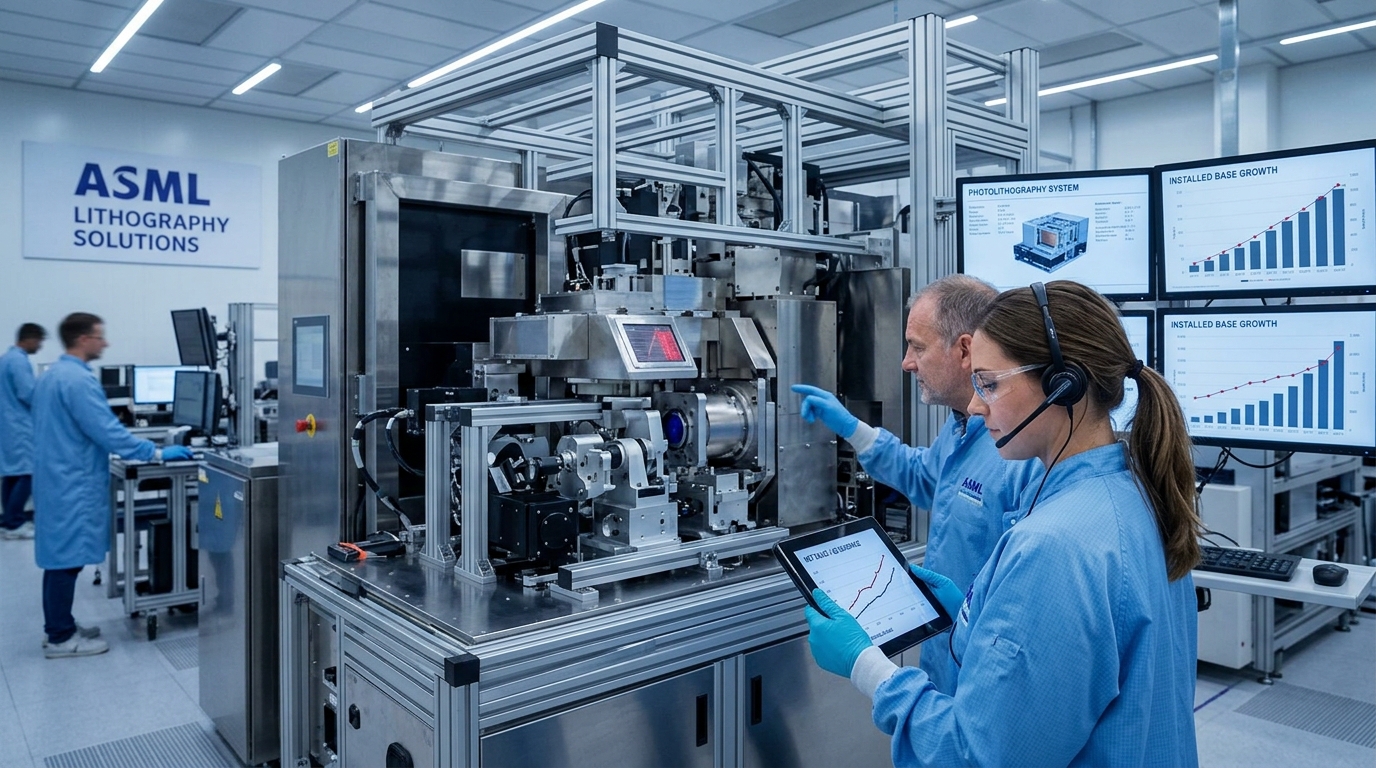
The Dutch chip equipment maker — the only company on earth that manufactures extreme ultraviolet lithography machines — posted Q2 2026 net sales of 9.33 billion euros with a gross margin of 54.0%, both above its own guidance. Net income came in at 2.92 billion euros. And then management did what the market had been waiting on: they raised full-year guidance in 2026.
Analyst Targets (current)
- BofA Securities: Buy, target $2,345
- Wells Fargo: Overweight, target $2,200
- JPMorgan: Overweight, target $2,200
- RBC Capital: Outperform, target $2,000
- Bernstein: Buy, target $2,623 (Street high)
- HSBC: Hold, target $315 (downgraded July 14 on foundry bottleneck concerns)
The consensus across 44 analysts is a Strong Buy, with a 12-month average target of roughly $1,907 — though several of those targets were set before this morning’s guidance raise and will likely move higher.
The numbers that matter
ASML’s new full-year 2026 guidance calls for revenue of 43 to 45 billion euros with gross margins of 54% to 56% — a meaningful step up from prior guidance. Q3 2026 guidance came in at 11.0 to 12.0 billion euros in sales with a 55% to 57% gross margin, both above what analysts had been modeling.
Here is the number that stood out: the installed base business — servicing and upgrading machines already sitting inside customer factories — reached 2.8 billion euros in Q2, or roughly 300 million euros above expectations. That segment is developing into a second earnings engine alongside new EUV system sales, and it carries incremental margins far above ASML’s overall reported operating margin.
Memory demand is a particular standout. Management highlighted that pricing for DDR and high-bandwidth memory signals a clear need for additional supply, which is translating into accelerated capacity plans from customers. ASML now expects memory revenue to increase approximately 75% this year. Advanced foundry logic revenue is expected to rise about 25%.
The company is also planning to expand capacity, including higher output targets for Low-NA EUV systems and DUV systems, as it looks toward 2027 demand. That is not a company bracing for a slowdown.
What this means beyond ASML itself
There has been a persistent debate in semiconductor land: has the AI chip capex cycle peaked? The IBM warning yesterday — clients shifting spending toward servers, storage, and memory purchases ahead of expected price increases — actually reads as a confirmation that AI infrastructure demand is pulling forward, not fading. ASML’s numbers reinforce that. TSMC and Samsung are expanding production facilities. Memory nodes are requiring higher lithography intensity. The customers are not slowing down. They are accelerating.
What is interesting is how the IBM and ASML stories interact. IBM’s pain is, in a roundabout way, a demand signal for chip equipment. Enterprise clients are buying servers and memory chips right now. Those chips require lithography machines. Those machines come from ASML. It is one ecosystem.
The risk that does not go away
China export controls. ASML’s CEO Christophe Fouquet has flagged export controls as an ongoing uncertainty for the outlook. That caveat is still live. Any tightening of restrictions on DUV systems into China — which remains a meaningful revenue source — would require another guidance revision in the wrong direction. That is the tail risk the bulls have been living with all year.
There is also a valuation conversation worth having. ASML stock had gained approximately 65% year-to-date before today’s results. The stock touched a 52-week high of about $2,000 in late June. At current levels near $1,797, shares are trading at roughly 52 times forward adjusted earnings. That is not cheap. But incremental margins on new revenue are running around 48%, earnings are scaling faster than sales, and the installed base business is adding durability to the growth profile that did not fully exist two years ago.
Bull / Base / Bear
Bull: The guidance raise signals that AI chip demand is compounding. Memory and logic both accelerate. The 2027 order book fills. Stock pushes toward $2,200-$2,600 as earnings estimates move higher across the Street.
Base: Guidance holds at current levels. China export risk stays contained. Stock grinds higher into year-end as EPS estimates converge with the new revenue range. Price action stays in the $1,800-$2,000 corridor.
Bear: Export controls on DUV shipments into China expand. Customer capex slows in late 2026 as hyperscaler AI spending faces scrutiny. High valuation leaves the stock exposed. The $1,707 technical support level comes into focus.
Technical picture
ASML shares rose in Amsterdam trading after the results and added further in after-hours U.S. trading, last seen near $1,838. The symmetrical triangle that had been forming around $1,808 may have broken to the upside. Prior targets from options market structure pointed to $1,860 and $1,903 on a clean breakout. The $1,785 level is the line to watch on any pullback.
The part of this story that does not get enough attention: ASML is in the middle of a €12.0 billion share repurchase program for 2026 to 2028. Management increased the dividend 17% earlier this year. These are not signals a company sends when it sees demand softening. They are signals of a business that is confident in its long-range cash generation.
The AI infrastructure build is not a 2026 story. It is a multi-year capital cycle. And ASML, as the only company that makes the machines that make the chips that run the models, is at the center of it. This morning’s numbers were a data point in that direction.
For informational purposes only.