
July 16, 2026
VLO Options Are Buying Time
Big August call volume points past earnings, not at it.
First a note from Base Camp Trading
Hey Trader,
Before the market opens again, read this…
My top trader, Thomas Wood, just released a new strategy he calls Opening Bell Trades.
This simple system is designed specifically to help regular investors generate income from his #1 trade setup.
I’m talking about finding monster winners like these…
- 113% on GOOGL
- 240% on META
- 70% on CAG
- 37% on MCD
- 139% on GLD
Best of all, he looks for these trades every morning starting at 9:30 AM and by 10 he’s done.
Everything you need to know about how this works is in a free report called “The Opening Bell Trade Guide”…
Take a few seconds and download FREE right now before this link stops working.
This report won’t be free forever, so grab it now while you can.
Once it’s on your computer, you’ll have it for good-no matter what we charge other traders for it later.
No credit card required. No strings attached.
>> Get Your FREE “Opening Bell Breakouts” Trade Guide Here
This guide shows you the exact 15-minute window trade he uses, and how to spot the setups the big funds are watching.
FREE: Discover One Simple Options Trade You Can Make Each Morning – and Be Done by 10 AM.
To better trading,
Drew Day
Founder & CEO
Base Camp Trading
P.S. Inside, you’ll see why Thomas uses weekly options and how to use them to trade stocks like GOOGL, META, and TSLA with as little as $75. Go here to save a copy of the “Opening Bell Trade Guide” before its taken down.
VLO Options Are Buying Time
The first clue is not Valero. It’s the date on the contract.
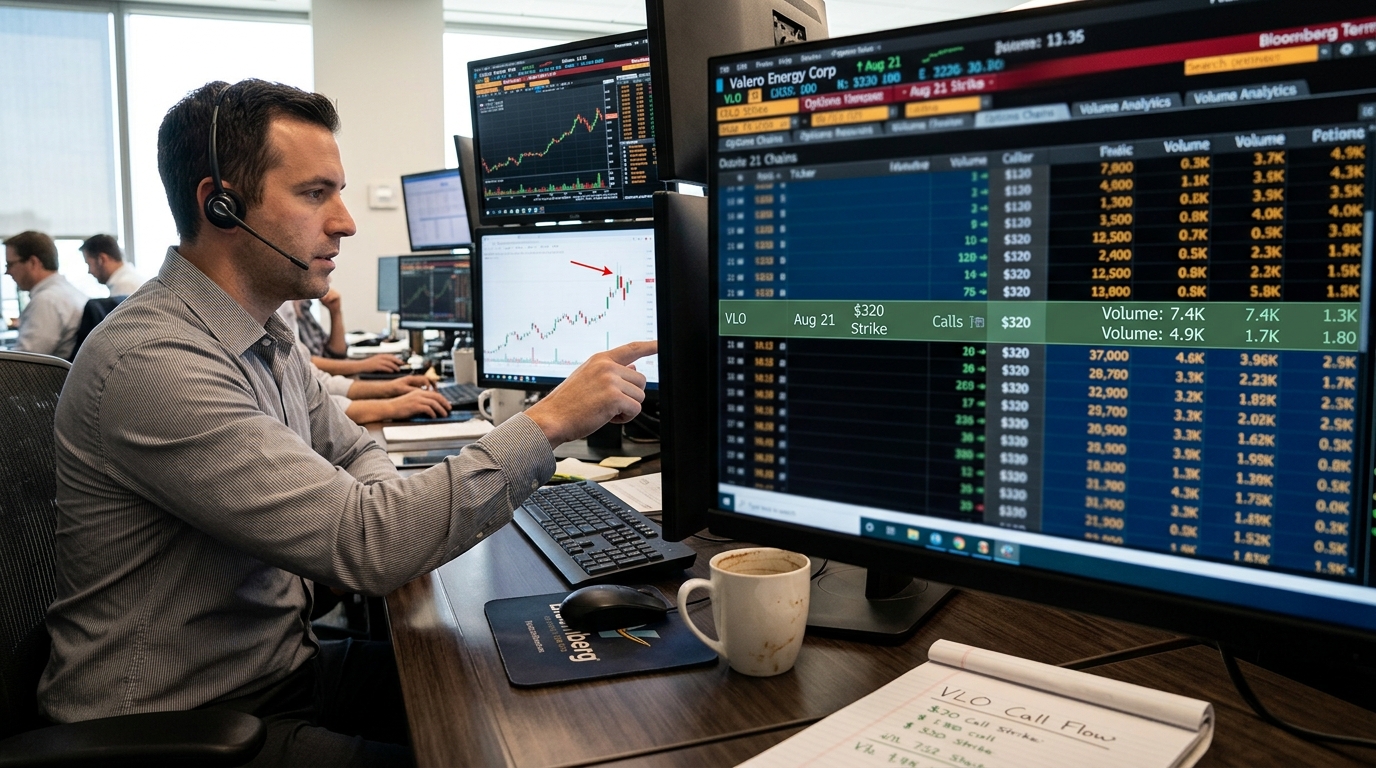
On July 15, Valero (VLO) lit up the unusual options scanners with heavy volume in the Aug 21 $320 calls. Benzinga’s feed shows a 4,900-contract burst at 4:36pm ET, with total volume around 5,325 contracts versus open interest around 101. That is the kind of volume-to-open-interest mismatch that usually means new positioning, not housekeeping. ([benzinga.com](https://www.benzinga.com/calendars/unusual-options-activity?utm_source=openai))
But the part people skip is the expiry choice. August.
The signal
Valero is confirmed to report earnings on Thursday, July 30, 2026 before the open. ([tipranks.com](https://www.tipranks.com/stocks/vlo/earnings?utm_source=openai))
If this was purely an earnings-day wager, you would usually expect the loudest activity to cluster in the weekly options that cover the event. Instead, someone reached past that and paid for time.
That does not automatically mean “someone knows it rips.” It more often reads like: I want exposure to what happens after the number. Guidance digestion. A multi-week move in crack spreads. A slow grind that doesn’t pay if you only own two days of optionality.
Why it matters
Unusual call volume can be noisy. One block can be a roll. One sweep can be a hedge. Fine.
But when volume dwarfs open interest at a specific strike and date, the options market is at least telling you where attention is being paid. In this case, it is paying attention to a window that extends beyond the earnings reaction. That is a different game.
The company behind the signal
Valero is a refining business, so the stock can behave like a company on some days and like a macro instrument on others. That dual personality is exactly why the options market is useful here.
From the last company release (Q1 2026), Valero reported net income attributable to stockholders of $1.3 billion, or $4.22 per share, versus a net loss in Q1 2025. It also confirmed it raised the quarterly dividend to $1.20 per share (announced Jan. 22, 2026). ([investorvalero.com](https://investorvalero.com/news/news-details/2026/Valero-Energy-Reports-First-Quarter-2026-Results/default.aspx?utm_source=openai))
So this is not a “survival” equity story. The options market is leaning into timing and volatility around catalysts, not a balance sheet rescue.
What looks priced in
I’m going to be careful here: I am not including a fresh implied-move percentage today because the number moves intraday and I can’t verify a current figure from a primary source in this pass.
What we can say with confidence is structural: the market is actively paying for optionality beyond July 30. That implies the buyer cares about the post-earnings path, not only the immediate gap. And because the strike is far out, they are explicitly expressing upside convexity, not a tight hedge.
Strategic considerations
Here’s where I land: when the flow buys time past earnings, I default to defined-risk structures that still give you that window.
A call debit spread in the Aug 21 line is the clean expression if your view is “upside is underappreciated over weeks, not days.” You keep upside exposure, you reduce premium outlay, and you lower the damage if volatility deflates after the report.
The downside is also real: if the stock ramps hard and fast, the short call in the spread can feel like an anchor. That is the trade-off you accept to avoid paying for every last point of upside.
What to watch next
- Open interest the next morning: does it actually rise at the Aug 21 $320 strike, confirming the July 15 volume was largely opening?
- Repeat flow: do we see the same strike and expiry show up again, or was this a one-and-done?
- Earnings week behavior: does near-dated implied volatility get bid without August following, or does the whole curve lift? The second one is the more interesting signal.
Slight tangent, but it matters: when a trade chooses an expiry that far past the headline, it is often telling you the real catalyst is second-order. Not the report. The reaction.
Worth a look: pull the Aug 21 chain, watch whether that $320 line keeps attracting size, and keep July 30 on the calendar like a hard checkpoint.
– TTR