
July 5, 2026
Copper’s Policy Gate Just Opened
The June 30 Commerce report is in. The 2027 tariff clock is running.
First a note from Profits Run
I’ve been trading for over 50 years.
In that time, I’ve made every mistake an options trader can make – and watched plenty of other people make them too.
Here’s what I learned: the losses you regret most almost never come from a lack of knowledge. They come from skipping a step you already knew to take.
So I wrote down the 7 steps that matter most. On one page. Run it before any options trade.
It’s called the Smart Trade Options Checklist. Normally $29.97. Free today.
Download it free here before your link expires.
Good Trading,
Bill Poulos
P.S. After 50+ years, I can tell you the trades I regret most all skipped one of these 7 checks.
Don’t make the same mistake I did.
FEATURED
Copper’s Policy Gate Just Opened
The U.S. Commerce Department delivered its copper market update to the President on June 30 — right before the holiday weekend. Buried in the policy calendar, easy to miss. The timing was almost too convenient for the people who would rather this not get attention.
Most copper coverage is still stuck on the spot price. That is not the trade.
What matters is the policy architecture now fully assembled around U.S. copper — and what it means for miners, fabricators, downstream manufacturers, and options traders sitting in the middle of it. COMEX copper futures were trading near $6.18 per pound as of July 3, up roughly 23.5% over the past 12 months. The 52-week range: $4.33 to $6.72. That range is doing a lot of communicating if you know how to read it.
The Tariff Ladder Is Already Climbing
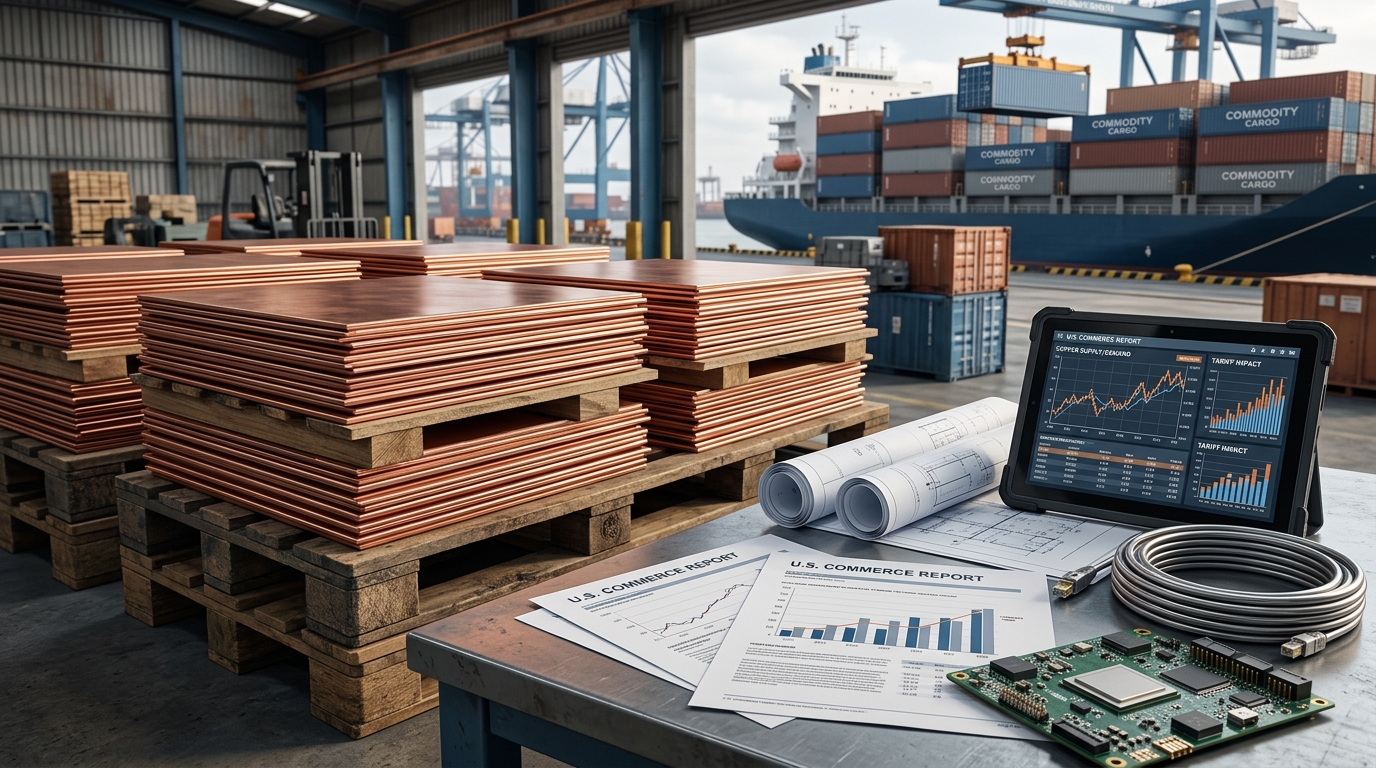
Here is the sequence, because most people only know part of it. On August 1, 2025, the Trump administration imposed 50% tariffs on global imports of semi-finished copper products — pipes, wires, rods, sheets, tubes — and copper-intensive derivatives like cables, connectors, and electrical components. The U.S. imported $16.2 billion worth of covered copper products in 2025. That is real money, and real exposure for every company touching this supply chain.
Then came the April 6, 2026 escalation. A new proclamation applied Section 232 duties to the full customs value of covered products — not just the metal content. The previous system, which split customs value between metal and non-metal components, is gone. For importers of high-value fabricated copper goods, this is not a minor accounting change. It is a step-function increase in real cost exposure. The June 1, 2026 follow-on proclamation refined the framework further: it expanded the 15% transitional rate to additional industrial equipment, lowered the U.S.-content threshold from 95% to 85%, and broadened derivative product coverage. All changes effective June 8.
Elon Musk And The Most Valuable Rock In The World
This rock looks ordinary. But inside this rare-earth metal lies the power to move every Tesla, SpaceX rocket, and Optimus robot on Earth. The problem? China controls 90% of it. Musk may have just discovered a way out of this stranglehold – igniting a $3 trillion boom.
Watch this shocking briefing before Musk goes live with an announcement any day now.
The June 30 Commerce report now enables the next decision. The President may impose a phased tariff on refined copper starting at 15% on January 1, 2027, escalating to 30% in January 2028. Refined copper. Not semi-finished product. The raw feedstock that runs through everything.
Worth noting: copper cathodes — the refined form — were deliberately left out of the original August 2025 action. That gap created an arbitrage that pulled U.S. COMEX warehouse inventories sharply higher. If the refined copper exemption closes in 2027, the stockpiling logic that drove that move reverses, and global tightness outside the U.S. becomes the price driver. That is a meaningful structural shift, not a footnote.
The Supply Side Was Already Broken Before This
Treatment charges — the fee smelters earn for processing copper concentrate — reset to zero for 2026, down from $21.25 per ton in 2025. That number was already historically low against norms that used to run in the $80s. Spot treatment charges have now gone negative. Smelters are paying to secure feedstock. That is not a blip. It is a signal that concentrate availability is genuinely stressed at the mine level — and the broader market has not fully absorbed what that means for future refined supply.
Freeport-McMoRan’s Grasberg mine in Indonesia — one of the world’s largest copper operations — pushed its full restart from 2027 out to 2028 following disruptions. Chile’s national copper output fell 9% year-on-year in March 2026, per Cochilco data. Codelco output declined 10%. BHP’s Escondida fell 15.75%. The Glencore-Anglo American Collahuasi joint venture dropped 10.8%. That is not one bad quarter at one mine — that is a systemic production shortfall across the world’s largest copper-producing country.
China halted sulfuric acid exports from May 1, 2026. J.P. Morgan estimates roughly 15% of global copper production relies directly on sulfuric acid availability. Goldman Sachs flagged that China’s sulfuric acid ban — combined with Strait of Hormuz shipping disruptions — puts approximately 200,000 tons of Chilean production at risk, equivalent to about 1% of global supply. The DRC faces its own timeline pressure: if acid supply delays extend through June, Goldman estimates up to 125,000 tons of DRC output could be curtailed in 2026.
Dividend Expert Reveals His Biggest Income Secrets… Free of Charge
Marc Lichtenfeld – Author of the best-selling book Get Rich With Dividends – is giving away his Ultimate Dividend Package…
Free of charge!
The Demand Side Is Not Going Away
Goldman Sachs projects that grid and power infrastructure will drive more than 60% of copper demand growth through 2030. AI data center construction is consuming copper at a pace that caught even the most aggressive forecasters off guard in 2025. Hyperscale data centers, power distribution networks, liquid cooling systems, and chip packaging are all copper-intensive in ways the traditional demand models did not capture.
Slight tangent, but it matters: copper is no longer tracking Chinese property cycles the way it used to. The demand base has fundamentally shifted. Goldman Sachs now expects the LME copper price to average $12,650 per metric ton in 2026, with a long-run target of $15,000 per metric ton by 2035. Morgan Stanley sees a potential deficit of 600,000 metric tons in 2026 — the largest in more than 20 years. J.P. Morgan forecasts a 330,000-ton deficit. The International Copper Study Group flipped its 2026 outlook from a 209,000-ton surplus as recently as October 2025 to a 150,000-ton deficit by May 2026.
On the macro side: copper futures climbed toward $6.20 per pound on July 3 as softer-than-expected June jobs data reduced Fed rate hike expectations. The U.S. economy added far fewer jobs in June than forecast, cutting the probability of a September Fed rate increase to roughly 50%, down from 67% before the report. Rate-sensitive industrial metals respond to Fed pricing almost as fast as equities. The near-term rate headwind for copper has backed off — for now.
Options Market: What Implied Volatility Is Telling You
This is where it gets interesting for anyone who wants more than a straight directional bet. CME Group’s copper options volumes picked up sharply in May 2026 following a slower April, with monthly average daily volume reaching 8,000 contracts. Weekly copper options — Tuesday and Thursday expiries — have become a real-time tactical tool for traders managing news-driven volatility across the tariff cycle. CME Group’s Volatility Index (CVOL) tracks 30-day implied volatility from copper options in real time. Right now, that index is carrying event risk premium tied directly to one unresolved variable: whether and when the President acts on the June 30 report.
What the options market is pricing: a binary policy outcome with no clear timeline. The President either confirms the phased refined copper tariff or delays it. One year ago, an unexpected copper tariff exemption triggered one of the largest single-day selloffs in copper’s history — a direct reminder of how fast this market can reprice on policy news. That event is now embedded in how options traders approach positioning around any tariff announcement. Implied volatility stays elevated when the outcome is binary and the timing is unknown. That dynamic creates two distinct trading environments at once.
The CME-to-LME copper spread is the cleanest real-time signal available. That spread blew out to $1.30 per pound at its peak during peak tariff speculation — the result of COMEX surging while LME held back. As of early July, COMEX copper was rising while LME declined, with spreads widening again on renewed uncertainty about what the June 30 report recommends. A narrowing spread says the market believes refined copper tariffs are already reflected in prices. A widening spread says pre-tariff positioning is back on. Watch it daily.
Defined-Risk Trade Frameworks
For traders leaning bullish — confirmed 2027 refined copper tariffs, persistent mine supply disruption, accelerating AI infrastructure demand — a defined-risk long structure is worth considering. A bull call spread on COMEX copper futures options with Q4 2026 or Q1 2027 expirations captures the tariff decision window without unlimited downside. A long leg near current levels around $6.20, short leg at $6.80 or higher, limits the premium at risk while keeping meaningful upside exposure if the market pushes through the 52-week high at $6.72.
For traders who think this stays range-bound — no tariff decision before year-end, global inventory working down slowly — a short strangle or iron condor around the $5.80 to $6.50 range collects elevated implied volatility premium without requiring a directional call. The risk is obvious: a sudden White House announcement compresses the position immediately. Conservative sizing and defined exit levels are not optional here.
For traders with a bearish lean — Fed tightens in September, the dollar strengthens, the CME-LME spread collapses as stockpiling unwinds — a defined-risk put spread below $5.80 limits cost while targeting a move toward $5.50. Goldman Sachs itself noted copper is currently trading well above its fair value estimate of around $11,100 per metric ton on the LME, leaving it vulnerable to a downside move if macro conditions deteriorate and investors de-risk. Freeport-McMoRan (FCX) carries listed options with meaningful open interest, giving traders an equity-linked alternative to outright futures for those with lower margin capacity.
These trade frameworks are analytical in nature and are not investment recommendations. Defined-risk structures limit exposure to the premium paid. Always verify current implied volatility levels, strike availability, and expiration dates before placing any trade.
Sector Breakdown: Where the Exposure Lives
The investable copper universe is narrower than people think. The major global miners — BHP, Rio Tinto, Glencore, Anglo American, Freeport-McMoRan — are the obvious first-order exposure. The more interesting tension runs through the downstream. U.S. copper fabricators and manufacturers relying on imported semi-finished products are now facing a 50% tariff on the full customs value of their inputs. The April 2026 shift from metal-content-only valuation to full customs value was a substantial, underappreciated cost increase across construction, transportation, energy, and consumer goods manufacturers.
Two separate trades are running in parallel here. Long the primary producers — miners and refiners who benefit directly from higher realized prices and onshoring incentives. Cautious on the downstream: electrical equipment makers, cable producers, HVAC manufacturers. Those companies are absorbing the tariff cost increase while managing margins in a higher-for-longer rate environment. The spread between those two groups on a relative value basis is worth watching closely.
Price Levels and Key Technical Markers
COMEX copper hit a record high of $6.716 per pound on May 13, 2026, on the July futures contract. After that high, the market pulled back — the June intraday low reached $5.924. That is a roughly 12% correction from peak to trough in less than four weeks. The recovery since then has been steady, with prices climbing back toward $6.20 and holding the $5.80 area as support on any dip.
The next big directional move depends on two things: the President’s actual decision on 2027 refined copper tariffs following the June 30 report, and the pace of Chinese manufacturing recovery as Middle East shipping lanes continue to normalize. Watch $5.80 as the key near-term support level. A clean break below that changes the short-term picture materially. Watch $6.50 to $6.72 as the resistance band — a close above $6.72 on meaningful volume would signal genuine breakout momentum. Goldman Sachs’ current year-end forecast for COMEX sits near $13,735 per metric ton, with fair value estimated at $11,100. That gap between current price and fair value is a real risk factor worth keeping in your model.
Three Scenarios and What Each One Means for Positioning
Bull Case
The President confirms phased refined copper tariffs starting January 2027. U.S. fabricators accelerate domestic sourcing. Mine disruptions in Chile, Indonesia, and the DRC persist through H2 2026, tightening the LME market further. Chinese AI infrastructure spending accelerates. Copper pushes above $6.72 per pound on COMEX, taking out the record high. Major miners re-rate on forward earnings revisions. Bull call spreads on COMEX options and long positions in FCX, BHP, or COPX (Global X Copper Miners ETF) are the relevant vehicles. Morgan Stanley’s 600,000-ton deficit forecast starts pulling Goldman’s long-run $15,000 target forward in analyst models.
Predictive AI Opens New Way of Trading
A new form of AI could double your portfolio by foreseeing the future prices of 2,334 different stocks, to the penny, with 73% backtested accuracy. It’s opened one of the most lucrative new ways to trade in our firm’s 20-year history, which has crushed the market by an average of 5-fold in our studies. You can even chat with it!
Base Case
The 2027 tariff decision gets delayed or scaled back. Current semi-finished tariff framework stays in place. Copper holds in the $5.80 to $6.40 range through year-end as global inventory works down gradually. Mining equities track commodity prices sideways, with modest outperformance over the S&P 500 as earnings revisions drift higher. Short strangles or iron condors around the current trading band collect elevated implied volatility premium while the market waits on White House direction. Goldman Sachs’ 2026 average forecast of $12,650 per metric ton proves roughly correct.
Bear Case
A tariff delay signals the end of U.S. stockpiling. The CME-LME spread collapses as the pre-tariff arbitrage unwinds and global inventory reasserts itself. The Fed hikes in September, the dollar strengthens, and industrial metals face broad selling pressure. Goldman Sachs’ own fair value estimate of $11,100 per metric ton on the LME becomes the anchor, with copper falling back toward $5.50 per pound on COMEX. Mining equities underperform. Defined-risk put spreads below $5.80 are the relevant hedge for this scenario.
The Part Nobody Is Reading Carefully Enough
The Defense Production Act domestic sales requirements are the most underappreciated piece of this entire framework. The July 2025 presidential proclamation recommended that 25% of copper input materials produced in the U.S. be sold domestically starting in 2027, rising to 30% in 2028 and 40% in 2029. That is not a tariff. That is industrial policy with a mandatory quota structure. The long-term implications for where copper processing happens globally — and which companies own that infrastructure — are a bigger story than any single price move.
There is another layer most downstream manufacturers have not fully modeled: on August 19, 2025, DHS added copper to its high-priority enforcement list under the Uyghur Forced Labor Prevention Act. That increases the probability that copper imports face detention or secondary inspection at the border — adding friction and delay costs on top of the tariff structure. Some companies are running tariff cost models without this layer. That is an incomplete picture.
The holiday weekend muffled what was a genuinely significant policy moment. The refined copper tariff decision window is now open. The White House can act at any point between now and year-end. And most portfolios are still treating copper like it is 2019 — before the AI data center buildout, before the mine supply crunch, before the tariff architecture. That gap between perception and reality is usually where the interesting trades live.
Action Checklist
- Monitor the White House for any announcement on the 2027 refined copper tariff. The decision window opened June 30 and runs through year-end. This is the single biggest near-term catalyst.
- Watch the CME-to-LME copper spread daily. Widening = pre-tariff positioning is back on. Narrowing = market believes refined copper tariffs are already reflected in prices.
- Track $5.80 per pound on COMEX as near-term support. A confirmed close below that level changes the short-term picture materially.
- For bullish positioning: consider defined-risk bull call spreads on COMEX copper futures options using Q4 2026 or Q1 2027 expirations. Long near $6.20, short at $6.80 or higher, limits premium at risk while capturing the tariff decision window.
- For range-bound positioning: a short strangle or iron condor around the $5.80 to $6.50 band collects elevated implied volatility premium. Requires clear exit levels given the binary policy risk overhead.
- For bearish or hedging positioning: defined-risk put spreads below $5.80 or short exposure via FCX listed options provide downside coverage if the dollar strengthens and the Fed acts in September.
- Review downstream manufacturing exposure — electrical equipment, cable producers, HVAC companies — for tariff cost absorption risk that has not been fully reflected in forward earnings estimates.
- Track the domestic sales quota framework starting at 25% in 2027. The companies building U.S. copper refining capacity now are making a long-duration structural bet, not a cyclical call.