July 3, 2026
720,000 Workers Vanished in June. The Market Cheered.
The headline miss was the distraction. Here is what it means for the second half.
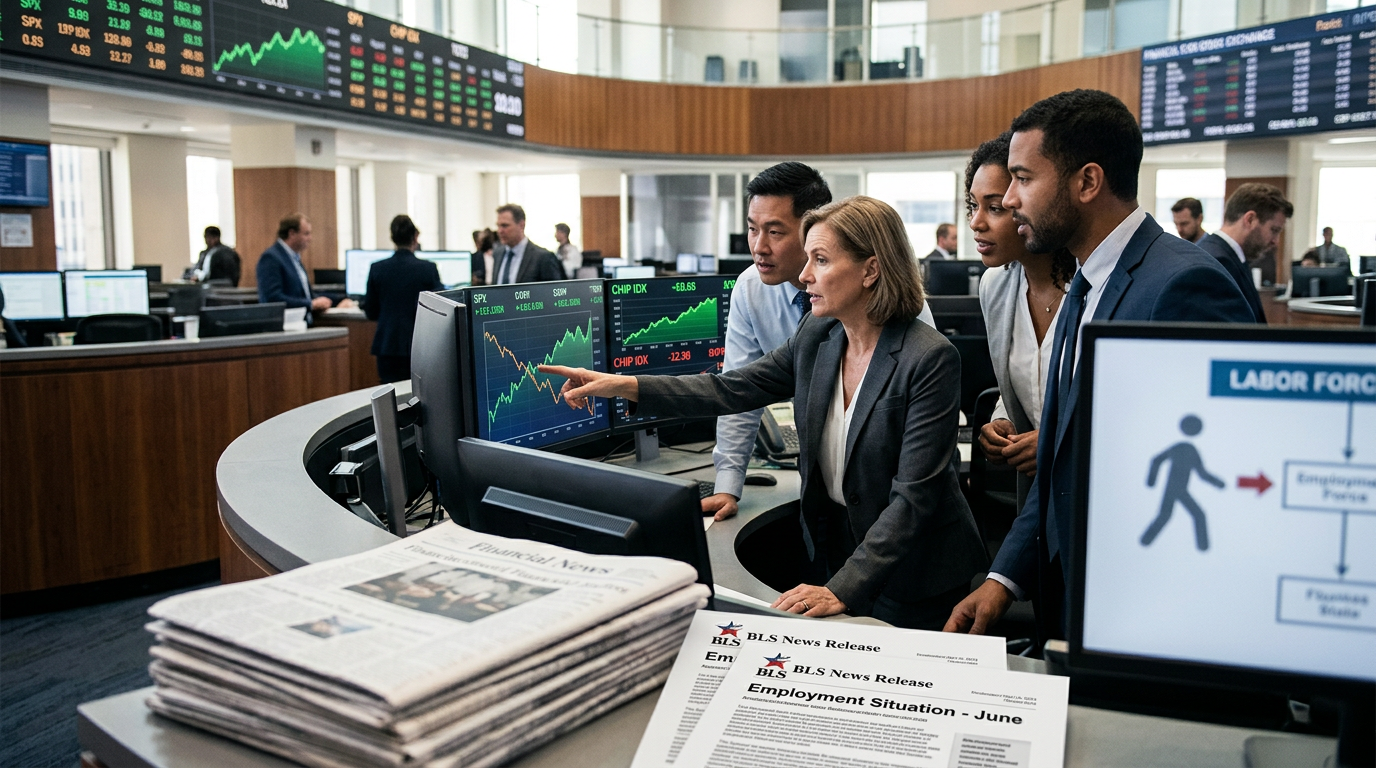
Markets rallied this morning on a bad jobs number. The S&P 500 climbed, chip stocks bounced, and the 2-year Treasury yield dropped. The crowd read 57,000 jobs and thought: good, no rate hike. Fine. That logic holds. But the number buried three pages into the Bureau of Labor Statistics release is the one worth reading twice.
720,000 people left the labor force in June.
Not laid off. Not unemployed. Gone. The unemployment rate fell to 4.2% largely because of an exodus of workers from the labor force. The labor force participation rate slid to 61.5%, the lowest since March 2021. Excluding the Covid-era distortions, that is the lowest participation rate in exactly 50 years, matching levels last seen in June 1976.
Why SpaceX will make investors rich… (but not in the way that you think)
SpaceX is about to mint a fortune.
But none of it will go to the people buying SpaceX’s stock.
Instead, it’ll flow to a handful of tiny “aftershock companies” SpaceX is about to create.
In fact, history shows past aftershocks minted gains of 1,200%… 17,000%… even 299,000% over the decades.
And JC says the SpaceX aftershock could dwarf them all.
Here is the part that should get more attention than it is.
The biggest single-month drop in June came from prime-age workers, those between 25 and 54 years old. Their participation rate fell 0.6 percentage points to 83.3%, the lowest level since December 2023. This is not retirees. This is not immigration policy math. Prime-age workers, the core of the labor force, are the ones pulling back.
The retirement wave story made sense when participation was falling gradually among older cohorts. That story is getting harder to tell when people between 25 and 34 are the ones driving the decline. The data shows the sharpest drops concentrated in that younger slice of the prime-age group, among both men and women.
What the Headline Miss Actually Looked Like
Nonfarm payrolls increased by a seasonally adjusted 57,000 in June, well below the 115,000 Dow Jones consensus forecast and down from a downwardly revised 129,000 in May. The revisions to April and May combined were 74,000 fewer jobs than previously reported, with April now at 148,000 and May at 129,000.
So it is not just June. The revisions suggest the previous two months of apparent strength were partly an illusion. Payroll growth slowed sharply, and the downward revisions to April and May suggest the hiring slowdown runs deeper than the headline numbers first let on.
Average hourly earnings rose 0.3% for the month and 3.5% from a year ago. Wages are holding. The average workweek for all employees on private nonfarm payrolls was unchanged at 34.3 hours, though production and nonsupervisory workers saw their hours edge down 0.1 hour to 33.7. Firms are still technically adding to payrolls, just barely, and the combination of softer hours and a narrowing mix of industries doing the hiring is worth watching into Q3.
The Fed Equation Just Got More Complicated
Kevin Warsh’s first FOMC meeting as Fed chair ended with a unanimous vote to hold the federal funds rate at 3.50% to 3.75%. The dot plot told a different story though. Nine of 19 committee members now project at least one rate hike before year-end, up sharply from March when no official forecast a 2026 hike. Six of those nine project two quarter-point increases.
Today’s soft number buys time. Futures markets had already been pricing in a hold at the July 28-29 meeting. The weak jobs data reinforces that view, though the broader rate path for later in 2026 has not changed much. The market read this morning as a gift. And in the near term, it probably is one.
But there is a tension here that does not resolve cleanly. The Fed’s own inflation projections from the June meeting show headline PCE inflation running at 3.6% by year-end and core at 3.3%, up significantly from the 2.7% projected back in March. The most recent CPI reading put annual inflation at 4.2% in May, the highest in more than three years, driven in part by energy prices tied to the Iran conflict and ongoing tariff effects. Warsh has been unambiguous: the committee is focused on price stability above all else.
Wall Street is calling it the “Warsh Shock.” Here’s how to profit from it…
Nearly half of the world’s biggest money allocators are scrambling to reposition for what they expect to be the most volatile market in years.
Larry Benedict isn’t scrambling. He’s seen this before.
He says the Warsh Shock is setting up the most predictable wealth-building window he’s seen in 20 years… and there’s one ticker right at the center of it.
A cooling labor market that coexists with sticky wages and persistent inflation above 3% is an awkward place for a central bank with no forward guidance playbook. The base case from most forecasters right now is a hold through the rest of 2026, with the risk skewed toward a hike rather than a cut. That is not consensus, but it is increasingly not fringe either.
The AI Capex Collision No One Is Mapping
Here is what makes this jobs number genuinely interesting beyond the Fed calculus.
The sectors losing workers are service workers, hospitality, and lower-wage labor. Leisure and hospitality employment declined by 61,000 in June alone, reflecting weaker than usual seasonal hiring. The sectors receiving the most capital in 2026 are data centers, semiconductors, and AI infrastructure. Google, Amazon, Microsoft, and Meta collectively plan to spend roughly $725 billion on capital expenditures this year, up about 77% from last year’s already record $410 billion.
That is nearly three quarters of a trillion dollars flowing into capital assets. Not labor. Assets.
Amazon alone has guided for $200 billion in capex this year, more than doubling its 2025 outlay. Meta raised its full-year guidance to as much as $145 billion, citing higher component costs and additional data center buildout. Microsoft is tracking above $120 billion for its fiscal year. Google is guiding $175 to $185 billion.
The economy is getting a massive injection of investment spending, but it is going into machines, chips, and cooling systems. Not the sectors shedding workers. The two forces are moving in different directions at the same time, and the intersection of that divergence is probably the most important macro story of the second half of 2026 that markets have not fully absorbed.
The Market Structure Underneath All of This
One more layer worth adding. Retail investors purchased nearly 3.5x the average daily amount on S&P 500 down days during the first half of 2026, the strongest buy-the-dip behavior on record according to Citadel Securities. Even on rallies, they continued to buy nearly 1.5x the daily average. Today was no exception. Bad news, buy more.
Retail traders set a record in June, executing roughly $6.8 billion of options premium per day, 17% above May’s previous record, 65% above the 2025 average, and more than double the historical average. Nearly half of that activity is now in zero-days-to-expiration contracts. In June alone, retail traded approximately $1.9 billion of semiconductor options premium per day, six times the historical average, with roughly 75% of that concentrated in call options.
That is a very concentrated bet in a market that is already very concentrated. The ten largest companies now account for nearly 40% of the S&P 500, near record concentration levels, with their combined index weight up roughly 10% since June 2023.
Semiconductor companies now represent nearly one-fifth of the S&P 500, the highest share on record. Roughly 18 cents of every dollar allocated to the index flows into semiconductor companies. That is a structural reality, not a trading call, and it matters a lot for what happens if sentiment shifts.
SpaceX Targets Wireless, Mode Targets Earnings
SpaceX just put Big Telecom on notice, telling investors its plans to launch a U.S. mobile service for consumers. For most investors, that sounds like a shakeup for the $1.6T telecom industry.
For Mode Mobile, it could mean more revenue.
More connected phones could mean more places for EarnOS, the platform that turns everyday smartphone activity into earning potential.
Mode already reaches 490M+ users, helped users earn and save $1B+, and generated $115M+ in cumulative revenue. With $MODE secured, investors can still access pre-IPO shares at $0.52/share, plus up to 20% bonus shares.
Get the details before this window closes.
Please read the offering circular at invest.modemobile.com. This is a paid advertisement for Mode Mobile’s Regulation A Offering.
What to Watch From Here
The July 28-29 FOMC meeting is the next decision point. Given today’s data, a hold is the overwhelming base case. There is no immediate pressure on the Fed to move, and the softening pace of job growth makes a near-term hike very unlikely. The soft number gives the market room to breathe.
That buys July earnings season the time it needs. Banks report starting July 14. What they say about credit quality, net interest margins, and consumer stress will tell you more about the real economy than today’s employment number did. That is the conversation nobody is having yet, because everyone spent the morning celebrating 57,000.
The real question is whether the labor force keeps contracting. A participation rate at a 50-year low outside of Covid, a prime-age workforce pulling back at a pace not seen in over a decade, and a capital spending cycle reshaping the economy around the workers least positioned to benefit from it. That combination is either a blip or a trend. One more month of data will start to tell us which.
Markets cheered today. The more interesting question starts in about two weeks.