May 28, 2026
Dollar Tree beat by 21 cents and nobody was ready for it
Q1 FY2026 — May 28, 2026
Your free download link is about to expire.
Once it does – this guide goes back to $29.97.
Inside: options trading explained in plain English. No jargon. No textbook talk. Real trade examples you can copy directly into your own account.
Calls. Puts. Strikes. Premiums. All of it – explained the way a friend would explain it over coffee.
Grab your free copy before the link dies.
Download while it’s still free.
Dollar Tree beat by 21 cents and nobody was ready for it
Nobody was positioned for this.
DLTR had been drifting lower heading into the print – down roughly 4.5% in the month prior, with sentiment somewhere between cautious and indifferent. The setup was uninspiring. Analysts had penciled in $1.53 adjusted EPS. That number already felt like a low bar given the macro tailwind discount retail theoretically carries when consumers are stretched. And still, somehow, the street managed to underestimate it.
Adjusted EPS came in at $1.74. That’s a $0.21 beat. Not rounding-error territory – a 38% year-over-year surge in earnings per share, with operating income up 23.2% to $473.3 million and gross margin expanding 120 basis points to 36.8%. Shares jumped 11% in premarket. The reaction wasn’t irrational.
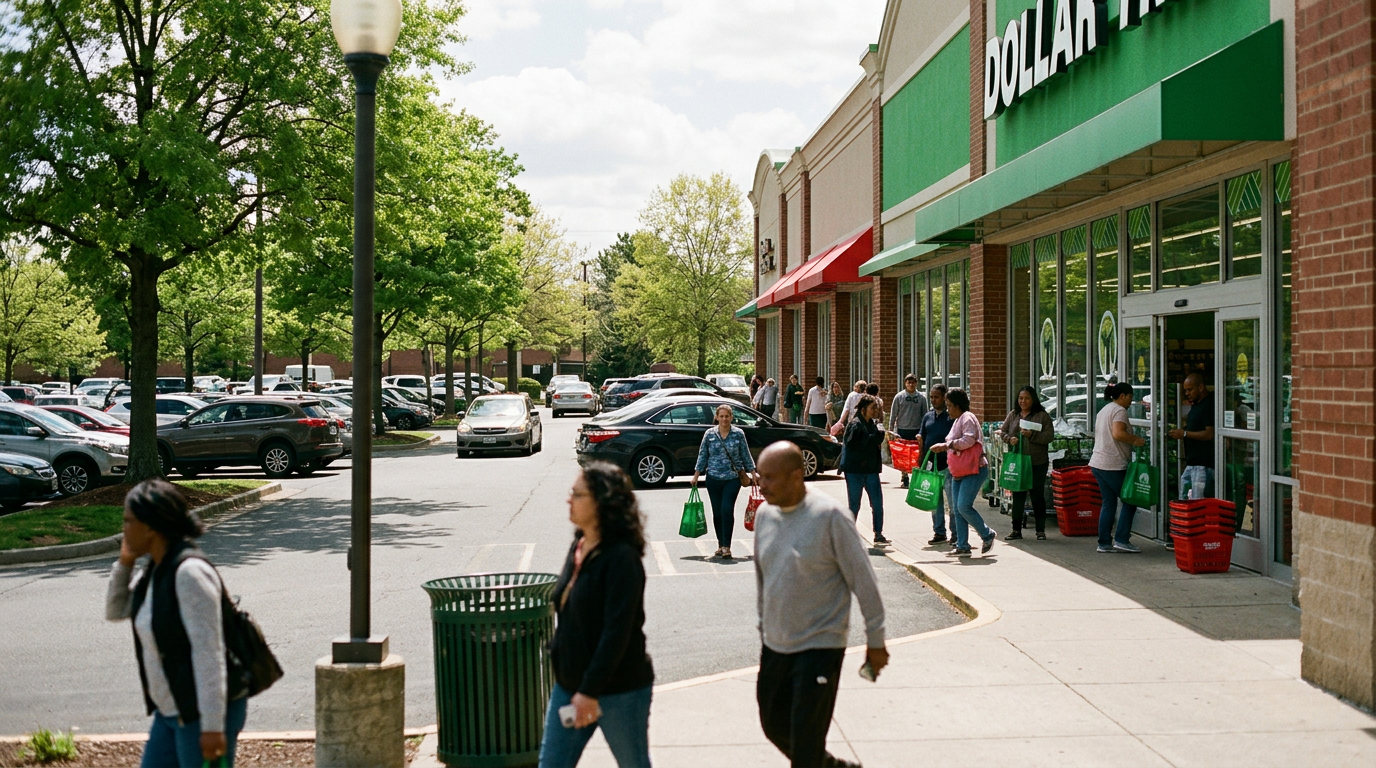
Revenue landed at $4.98 billion, up 7.2% year over year. Comparable store sales grew 3.5%, but the composition is worth slowing down on: average ticket climbed 4.5% while traffic dipped 1.0%. What’s interesting is that framing cuts both ways. On one hand, fewer bodies through the door is a real concern. On the other, customers who are showing up are spending more – and that’s not nothing. Dollar Tree has been pushing into higher-margin discretionary categories for a couple of years now, and the ticket data suggests some of that is actually landing.
Operating cash flow from continuing operations hit $644 million. The company bought back 5.5 million shares for $595 million during the quarter, with $1.3 billion still available under the existing authorization. That’s not a company in distress. That’s capital allocation with conviction.
Then the DoorDash deal dropped – same morning, same news cycle.
On-demand delivery is now live or rolling out across the full U.S. store footprint, which is more than 9,000 locations across 48 states. Customers can order from a catalog of over 10,000 products directly through DoorDash. Slight tangent, but the timing of this announcement alongside an earnings beat wasn’t accidental. Management clearly wanted to reframe the delivery narrative while the market was already paying attention. Whether the channel actually moves traffic numbers in Q2 is the question. Integration announcements are easy. Sustainable order volume is the harder proof point.
Full-year guidance was raised to $6.70–$7.10 adjusted EPS, with the midpoint at $6.90 sitting above the prior consensus of $6.67. Revenue guidance of $20.5–$20.7 billion was held steady. Both numbers are directionally encouraging.
The part people skip: tariffs.
Management has flagged a $70 million Q2 tariff impact across certain import-heavy product categories, and while they’ve reportedly mitigated around 90% of that hit through sourcing shifts and operational adjustments, the math only holds if import volumes stay predictable. Q2 guidance of $1.00–$1.15 adjusted EPS reflects a meaningful sequential step-down from Q1’s $1.74 print. Some of that is seasonality. Some of it is the tariff overhang. The spread between those two explanations is where the risk lives going into summer.
So the question isn’t whether Q1 was good. It clearly was. The question is whether the mechanics that drove the beat – margin expansion, ticket growth, cost discipline – hold up when the tariff buffer thins and Q2 comps get less forgiving. That’s still open.
– The Editorial Desk