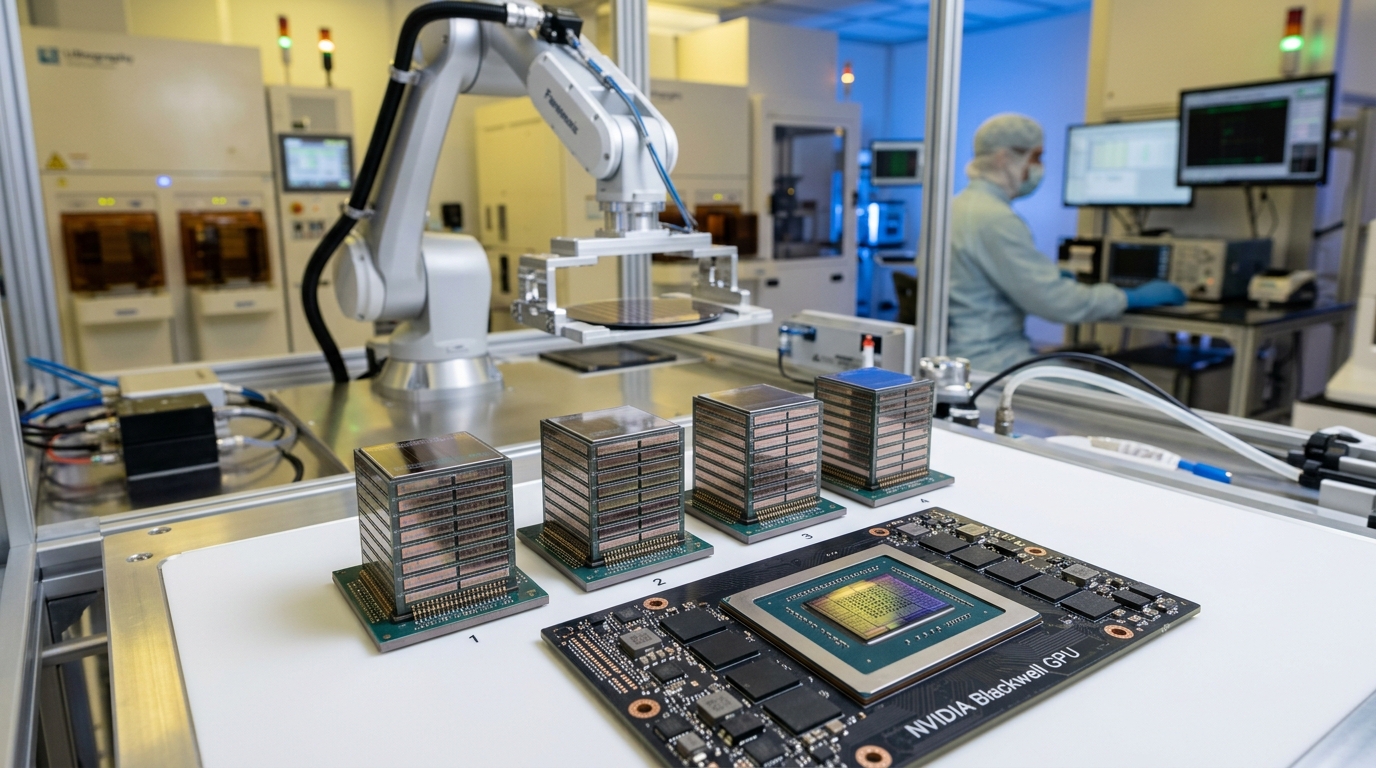
There is a version of Amphenol (APH) that the market loves: the one that just posted a record quarter and guided the next one to 43–45% revenue growth. Then there is the version the market is nervous about: the one carrying $18.7B in debt after the largest acquisition in its history. Both versions report on July 29.
What actually happened in Q1 was notable. Revenue hit a record $7.6 billion, up 58% year-over-year, with 33% organic growth on top of contributions from the CommScope CCS acquisition. Adjusted EPS climbed 68% to $1.06, beating the high end of guidance. Orders reached a record $9.4 billion, resulting in a strong book-to-bill ratio of 1.24. The Communications Solutions segment, now roughly 60% of total APH revenue, is the engine here. AI infrastructure spending is the fuel.
Strong demand tied to AI infrastructure and the IT data communications segment, along with the $10.5B acquisition of CommScope’s Connectivity and Cable Solutions business, contributed to higher sales and a 380 basis point expansion in adjusted operating margin to 27.3%. Management has been explicit: roughly two-thirds of IT datacom growth has been coming from AI-related products.
A slight tangent that matters: there was a real fear heading into Q2 that copper-based interconnects would start losing share to optical solutions in AI data centers. Investors fretted that AI data center connectivity would transition from copper-based interconnects to optical solutions over the intermediate term, creating a potential headwind for Amphenol. That concern appears misplaced, as a meaningful transition is unlikely to occur before the end of the decade. Furthermore, Amphenol maintains exposure to the optical opportunity through its acquisition of CommScope’s Connectivity Solutions business.
What the Street Expects
Q2 2026 guidance stands at sales of $8.1B–$8.2B (+43–45% year-over-year) and adjusted diluted EPS of $1.14–$1.16 (+41–43% year-over-year). Analyst price targets range from $175 at TD Cowen to $215 at JPMorgan. According to 18 analysts, the average rating for APH stock is “Buy,” with a 12-month price target of $189.39, implying roughly 19% upside from the latest price.
Systems have calculated a possible swing of roughly plus or minus 5.52% in the first trading day after the earnings release. The stock’s 52-week range extends from a low of $102.76 to a high of $178.52. At around $152, that puts the post-earnings implied range near $144–$160.
The Two Things Worth Watching
First: IT datacom organic sequential growth. The metric to watch at this earnings report is Q2 IT datacom organic sequential growth against Amphenol’s own low-teens guidance. If actual results land at or above that level, the stock likely moves higher. If datacom orders show any sign of plateauing, that is the risk case.
Second: the debt load. Total debt stands at $18.7B, with net debt of $14.2B and total liquidity of $7.6B including $4.6B in cash and short-term investments. Net leverage of 1.6x is manageable, and free cash flow of $831M in Q1 was 89% of net income. But the adjusted tax rate moved to 27% from 24.5%, partly because of China tax matters — that is margin pressure on the wrong side of the ledger.
Options Market Analysis
Implied volatility on APH has elevated into the event, which is typical. At 30x earnings, sentiment volatility generates attractive implied premiums for put sellers. The key structure question is whether IV rank justifies premium selling versus directional positioning.
Bull case: For traders expecting APH to beat Q2 guidance and sustain its book-to-bill above 1.2, a defined-risk call spread targeting the $160–$170 range captures the move while limiting exposure to the IV crush after results. Historical precedent is instructive: APH jumped as much as 9.2% the morning after its Q1 2026 earnings report, briefly touching $157, then gave nearly all of it back by the close. The fade is the real story: the market is not debating whether Amphenol is a great business. It is debating whether a great business is already priced at 30x forward earnings.
Bear case: For traders expecting margin pressure from the higher tax rate and CommScope integration costs, or a softening in datacom organic sequential growth, a put spread anchored near $145 defines the risk into the event.
Neutral case: For traders expecting results to land in line with guidance but produce a muted reaction, a short strangle around the $144–$165 range collects premium on both sides with the IV crush working in favor post-earnings.
Risk Factors
Customer concentration is elevated, with three customers representing 36%, 15%, and 12% of Q4 revenue. A capex ramp to approximately $1 billion in 2026 introduces execution risk if hyperscaler orders slip.
The record Q1 2026 results and strong Q2 guidance reinforce AI and datacom as the key short-term catalyst, while the biggest risk remains that recent strength reflects demand pulled forward rather than a steady new baseline. The book-to-bill ratio is the cleanest signal on that question. If it holds or rises from 1.24 in Q2, the bull case strengthens. If it retreats toward 1.0, the cycle debate reopens.
Forward Outlook
Full-year 2025 results showed diluted EPS of $3.34, up from $1.92 in 2024, with revenue of $23.1B, up 52%, and net income of $4.27B, up 76%. Revenue is forecast to grow 15% annually on average during the next three years, compared to a 12% growth forecast for the electronic industry in the U.S. The stock’s 52-week range of $102.76 to $178.52 tells you the market has not fully made up its mind on whether APH is a premium AI infrastructure compounder or a cyclical connector manufacturer with an expensive acquisition attached. July 29 does not settle that debate permanently. But it moves the conversation.
Amphenol has beaten EPS estimates in five straight quarters. The guidance range heading into Q2 was specific and tight. The only way the stock sells off meaningfully on Tuesday is if something in the order book or margin line surprises to the downside. Right now, the data does not point there — but the $18.7B debt load and the 30x valuation leave almost no margin for error if it does.