
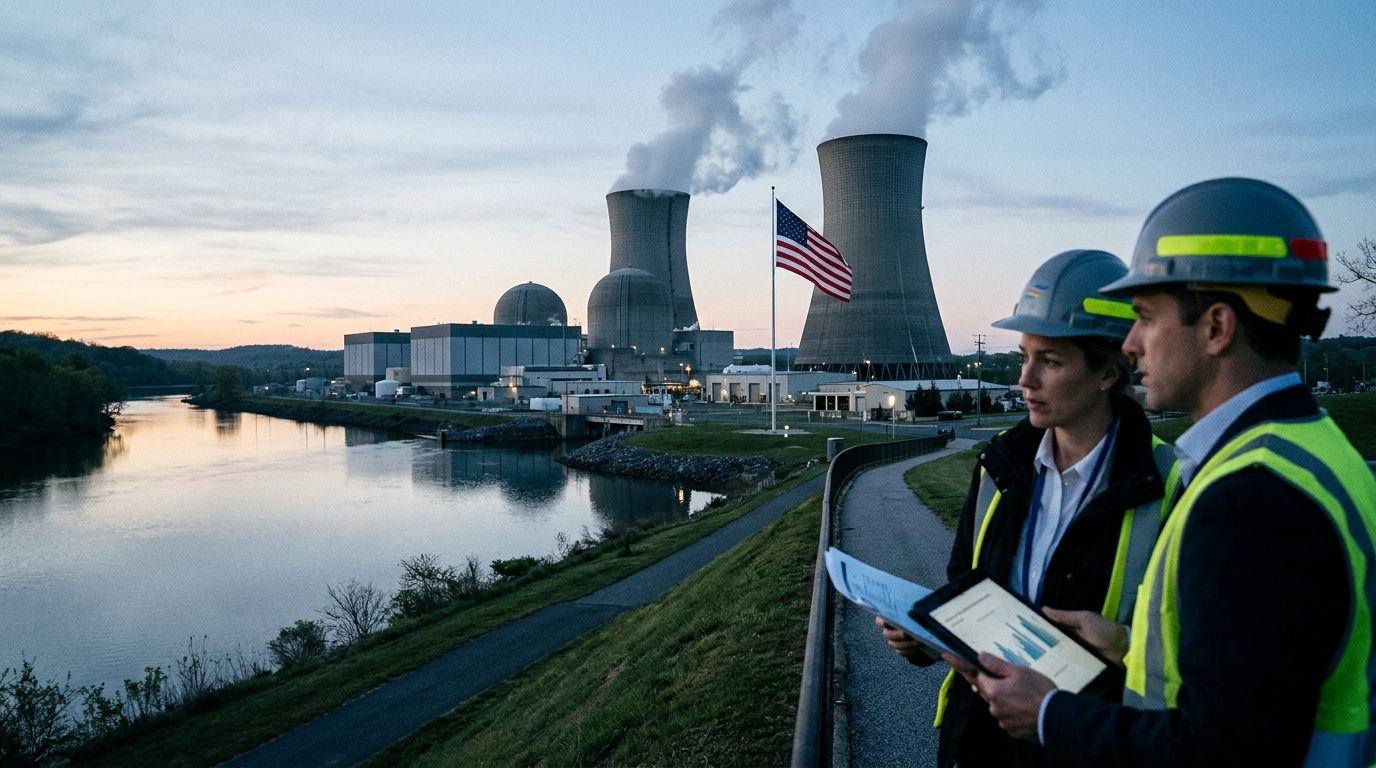
Constellation Energy sits at roughly $285 today, down about 20% year to date, trading as though the AI power demand boom that has transformed every conversation about energy infrastructure simply does not apply to it. That gap between price and reality is what makes CEG the most interesting setup in the utility sector right now.
The company runs the largest nuclear fleet in the United States, about 22 gigawatts of carbon-free baseload generation. Nuclear is the one power source that runs 24 hours a day, 365 days a year, produces zero carbon emissions, and cannot be replicated quickly. Every data center operator building AI infrastructure at scale needs exactly that, and many of them have figured it out. Constellation has signed 20-year power purchase agreements with both Microsoft and Meta, and a long-term deal with Walmart tied to output increases at its Dresden plant in Illinois.
What’s Driving the Opportunity
Constellation’s Q1 2026 results showed adjusted EPS of $2.74 against a $2.53 consensus, with revenue of $11.1 billion. The company reaffirmed full-year adjusted EPS guidance of $11.00 to $12.00 and authorized a $5 billion share buyback. Management guided $8.4 billion in combined free cash flow for 2026 and 2027, rising to $11.5 billion to $13 billion in 2028 and 2029 as new contracts come online.
The Crane nuclear plant restart is advancing after securing a Federal Energy Regulatory Commission waiver, which keeps the second-half 2027 timeline intact. Constellation is also pursuing up to 1 gigawatt of nuclear uprates at existing plants over the next decade, including about 135 megawatts at the Braidwood and Byron facilities in Illinois. These are not speculative projects: they are capacity expansions against contracts already signed.
Evercore ISI resumed coverage with an Outperform rating and a $380 price target, implying roughly 33% upside from current levels. Scotiabank’s target has been as high as $441. Of 22 analysts covering the stock, the consensus is Buy, with an average price target in the mid-$300s.
Why the Stock Is Where It Is
The 2026 slide accelerated around mid-year, when uncertainty around power-market policy and grid cost allocation became a louder political issue. That policy overhang has weighed on CEG even as the business continued to execute. Some analysts also raised concerns about the aging nuclear fleet, rising maintenance costs, and the complexity of grid interconnection for new capacity. Morgan Stanley adjusted its price target in August while maintaining an Overweight rating.
Rate sensitivity is also a factor. With the 10-year Treasury yield near 4.77%, utilities and other long-duration cash flows face valuation pressure regardless of their fundamental quality. If the Federal Reserve shifts from a September hold toward a hike, that pressure extends.
The Bottom Line
The AI infrastructure boom needs power that does not blink. Nuclear is the only source that meets that bar at scale, and Constellation controls the largest fleet of it in the country. The market has spent 2026 focused on the chip layer of the AI trade. The power layer, specifically carbon-free baseload power with 20-year contracts, is equally essential and significantly cheaper today. CEG at roughly $285 is not priced for the contract pipeline it has already signed, let alone the ones still being negotiated. That is the asymmetry.