
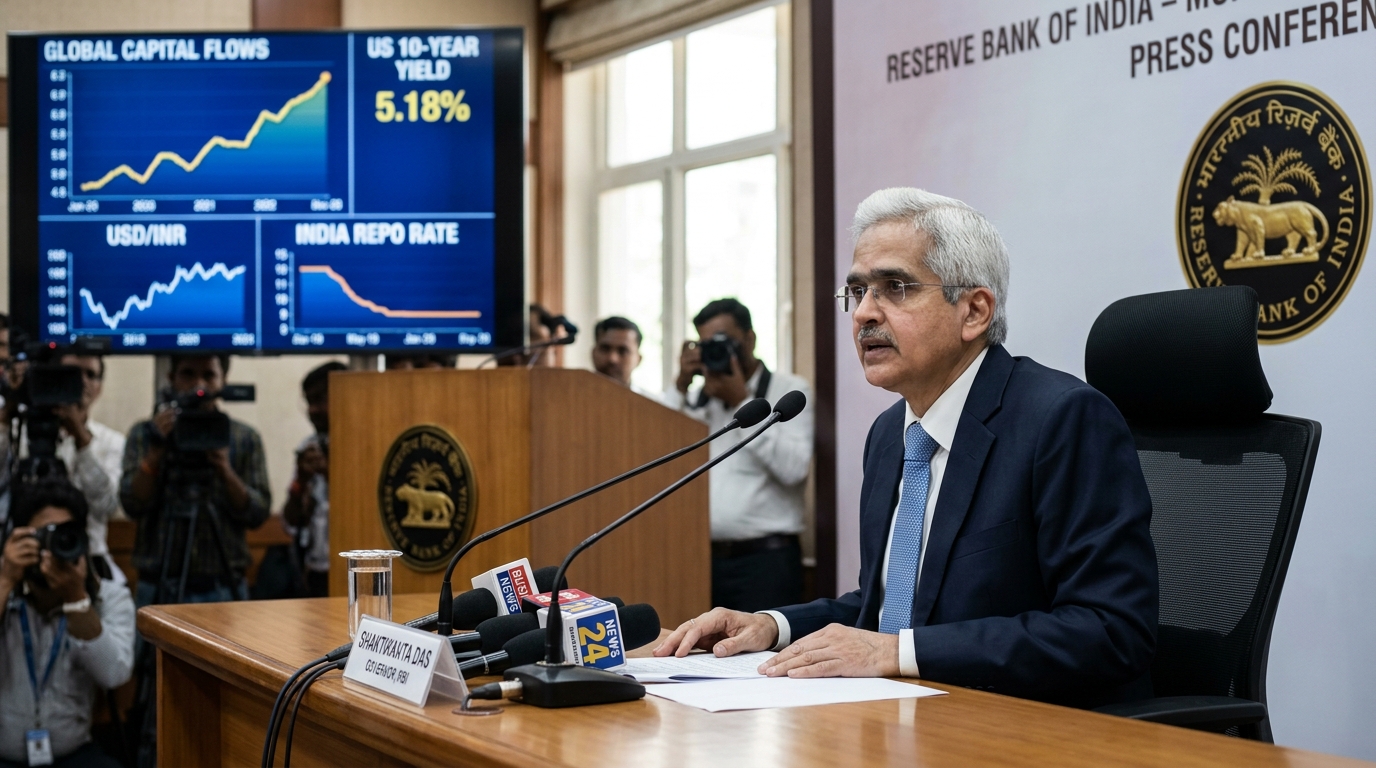
The official case for Wednesday’s Reserve Bank of India decision sounds clean: retail inflation at 4.82%, above the central bank’s 4% target, rising food costs, crude oil that pushed back above $107 a barrel late in September. Raise rates, cool prices. Eight of ten economists in a Business Standard poll back a 25-basis-point hike to 5.50%, and a Reuters poll cited by Mint shows many economists looking for one additional hike in December. Bank of America goes further, projecting 100 basis points of total tightening through the first half of 2027.
But the inflation story, while real, is not the whole story. The more uncomfortable question is whether the RBI is reacting to a rupee in structural retreat rather than a price level that is genuinely threatening.
The Currency Problem Behind the Rate Decision
The rupee traded around 96 to the dollar in mid-September, having weakened roughly 6%-7% since early January. The proximate cause is well understood: Brent crude pushed past $107 as Middle East tensions tightened the energy risk premium, widening India’s import bill, while the US 10-year Treasury yield moved above 5.2%, its highest level since 2002. That combination is corrosive for any emerging market currency. When US Treasuries yield 5%-plus, the argument for holding rupee-denominated assets gets thinner by the week.
India’s own finance ministry has made a version of the same point in its Monthly Economic Review: when global yields rise faster than domestic yields, risk premia compress and the currency takes the strain. In that context, foreign flows can turn abruptly. Late in September, foreign investors were heavy sellers in Indian equities in some sessions, with single-day net outflows running into the thousands of crores.
A 25-basis-point hike does not resolve that arithmetic. It signals intent, which matters, but it does not close a yield gap that has narrowed as US rates have surged.
The Inflation Bull Case Has Limits
The honest version of the inflation argument is that 4.82% CPI is elevated but not alarming. Wholesale inflation, however, accelerated to 9.92% in August, driven by fuel and power costs. If crude stays above $100 and the rupee stays soft, import cost pressure bleeds into consumer prices over the next two quarters. That is the scenario some bank economists have described as a reason for a “pre-emptive” move. The terminal rate debate, not the October decision, is where the real disagreement sits. BofA sees 100 basis points of tightening ahead. The dissenting view, from some domestic economists, is that hiking into the festival season achieves little beyond symbolic tightening.
What This Means for Anyone Holding India
The RBI’s dilemma is not unique. Every emerging market central bank running a current account deficit faces the same pressure when a 5%-plus US Treasury yield resets the global cost of capital. The question for portfolio managers overweight India is whether a hiking cycle that is partly defensive, partly pre-emptive, and partly currency-driven changes the risk-reward on Indian equities and bonds.
INDA, the iShares MSCI India ETF, carries heavy exposure to financials, with HDFC Bank among its largest holdings. HDB, the US-listed depositary receipt, fell about 2.7% on October 2 as emerging-market risk-off sentiment accelerated. ICICI Bank, listed as IBN, faces a related question: a higher-rate environment can support asset yields, but funding costs can move quickly, and credit demand can cool if policy tightens into a growth slowdown.
India’s macro fundamentals remain genuine. Foreign exchange reserves stood at $765.9 billion in the week ended September 18. GDP growth has held near 7% in recent quarters. These are not the conditions that produce a crisis. But they are also not conditions that insulate Indian equities from a global repricing driven by US Treasury yields that have had no near-term reason to fall.
Stocks to Watch
- INDA – The broadest liquid vehicle for US-based India exposure; financials dominate the index weighting, making the ETF directly sensitive to both the rate decision and rupee direction.
- HDB (HDFC Bank) – Already down sharply in 2026; a prolonged hike cycle raises refinancing costs and could compress the loan-growth trajectory that underpins most bull cases for the stock.
- IBN (ICICI Bank) – Similar rate sensitivity, though outcomes depend on deposit pricing and credit demand; watch the next earnings call for guidance language on cost of funds.