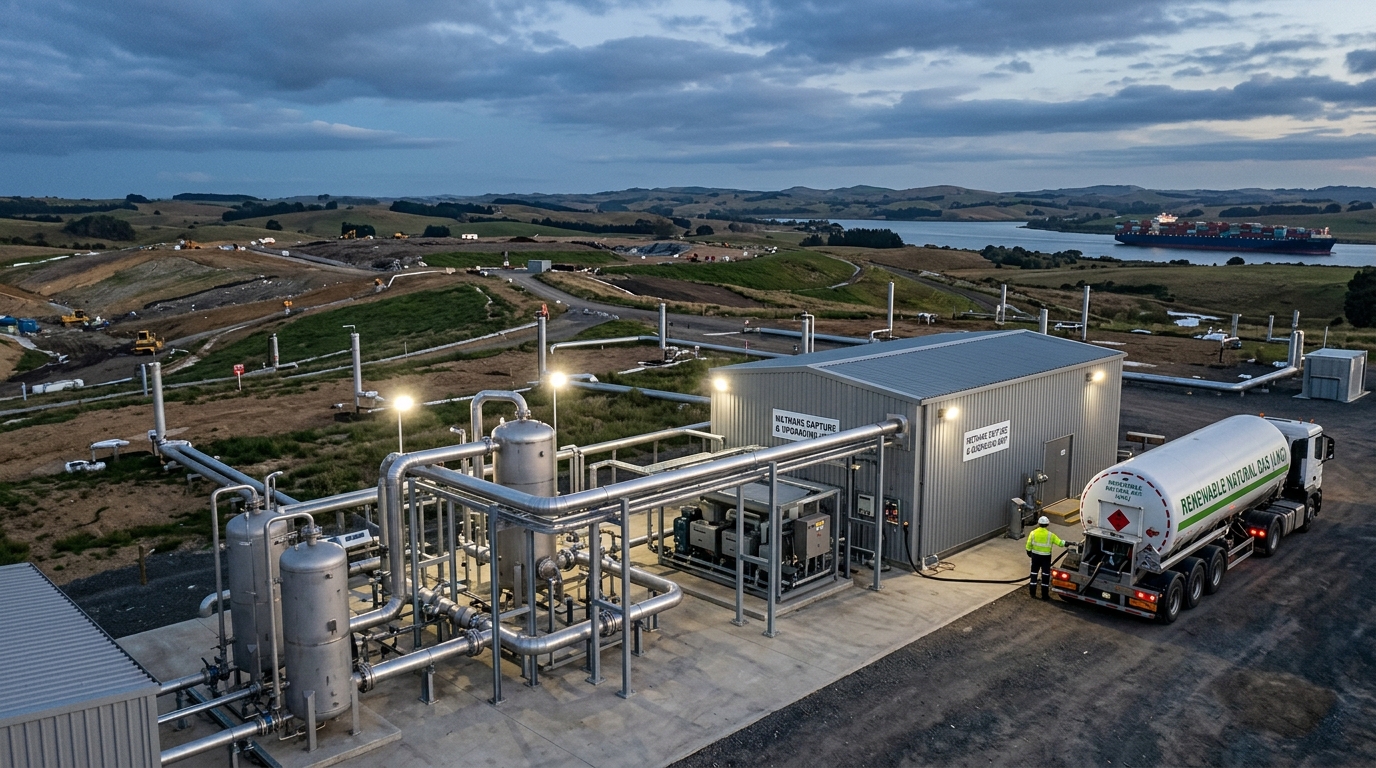
The trade here is not about big oil. It is about a quieter infrastructure layer: rural biogas operators sitting on top of landfills, feedlots, and wastewater sites who are monetizing methane that would otherwise drift into the atmosphere, and selling it into an end market where regulation is increasingly pushing buyers toward lower-carbon fuel options.
Why the Timing Is Forcing Action
Shipping became a hard deadline on January 1, 2026. The EU Emissions Trading System expanded to cover methane and nitrous oxide from vessels, with operators required to surrender allowances for verified in-scope emissions, phased in as a share of emissions (rather than 100% immediately). FuelEU Maritime compounds the pressure, counting methane slip in greenhouse gas intensity calculations using default methane slip factors by engine type; one widely cited default value is 3.1% for certain Otto dual-fuel medium-speed engines. That regulatory shift redirected fleet procurement conversations toward certified lower-carbon alternatives, and renewable natural gas is one fuel option that can fit certain existing engine pathways without a full vessel rebuild.
The Supply Side: Rural Infrastructure Doing the Real Work
The global RNG market reached about $17 billion in 2026 and is widely projected toward the mid-$30 billions by the mid-2030s, implying high-single-digit compounded growth rates across many industry forecasts. North America is often cited at roughly the mid-30% share of current market value in those estimates. Landfill gas accounts for 64% of U.S. RNG production, with more than 559 billion cubic feet captured annually across domestic sites. Total estimated investment in U.S. landfill gas facilities has reached nearly $14.9 billion.
The operators turning those numbers into reported revenue are where positioning begins. Montauk Renewables (MNTK) posted Q2 2026 revenue of $54 million, up 19.7% year over year, with Adjusted EBITDA surging 144.5% to $12.3 million. Full-year RNG revenue guidance holds at $175 to $190 million, with production guided to 5.8 to 6.0 million MMBtu. The Q2 swing from a $5.5 million net loss one year ago to about a $0.2 million profit signals operational leverage beginning to show in the financials.
OPAL Fuels (OPAL) produced 1.2 million MMBtu in Q1 2026, up 9% year over year, against Q1 revenue of $73.4 million. Lower RIN pricing pressure compressed Adjusted EBITDA to $16.7 million. Full-year Adjusted EBITDA guidance of $95 to $110 million assumes D3 RINs at $2.45 and output of 5.4 to 5.8 million MMBtu. Management has flagged signed fleet conversion contracts expected to contribute more meaningfully from 2027.
Waga Energy and Casella Waste Systems brought their third landfill RNG facility online in 2026 at McKean Landfill in Pennsylvania, with a 2,000 SCFM processing capacity rated to produce up to 407,000 MMBtu annually. Waga has reported 30 RNG production units in operation and 19 units under construction, rather than 38 units in operation. Revenue from each project is shared with landfill hosts under long-duration operating agreements, creating a durable infrastructure-style cashflow profile.
The Margin Architecture Traders Should Map
RNG economics run on two revenue channels: the physical fuel sale and the environmental credit stack, specifically D3 RINs under the Renewable Fuel Standard and Low Carbon Fuel Standard credits in qualifying states. Operators with locked long-term offtake agreements can insulate margins from spot RIN volatility. Those without that protection saw direct Adjusted EBITDA compression in Q1 2026 as credit pricing softened. That spread between contracted and uncontracted operators is where relative value positioning sits right now.
Scenario Framework
- Bull Case: D3 RIN prices recover toward $2.70 through H2 2026, fleet conversion contracts accelerate into 2027 delivery, and EU compliance costs push more shipping clients toward certified RNG offtake agreements. Montauk and OPAL both hit the top end of guidance.
- Base Case: RIN pricing holds near $2.45, production volumes land mid-range, and new facility ramp-ups at McKean provide modest volume uplift without moving full-year numbers materially. Sector re-rates toward infrastructure multiples rather than energy multiples.
- Bear Case: RIN prices fall below $2.20, methane collection efficiency at landfill sites underperforms amid wellfield transitions, and EU ETS derogations and carve-outs reduce near-term urgency at the margin. Operators with high uncontracted volume exposure compress to near breakeven Adjusted EBITDA.
Active Trader Framework
Watch D3 RIN spot pricing weekly. A sustained move above $2.60 changes the Q3 earnings calculus for both MNTK and OPAL before October reports. Monitor Waga Energy’s project commissioning pace as a leading indicator of European and transatlantic demand for compliant fuel pathways. Key support for MNTK is anchored around the 2026 revenue guidance midpoint; any production guidance revision is the trigger event. Position sizing should account for credit price sensitivity: each $0.10 move in D3 RIN impacts OPAL Adjusted EBITDA by $5 to $6 million.
Preparation over prediction. The EU regulatory clock is already running. The operators with contracted volumes and diversified credit stacks are the ones best positioned when fleet procurement converts from dialogue to signed offtake.