
Gold and silver are in a powerful bull market – and one ultra-low-priced small-cap precious metals company has quietly built a unique way to capitalize on this historic uptrend.
The company is already generating record revenue from producing gold and silver mines.
It has attracted some of the biggest names in the resource arena.
And it just announced the largest transaction in its history.
Yet incredibly… shares remain largely undiscovered below $1.
That creates an intriguing opportunity to get in early and low as this fast-emerging company enters its biggest growth phase yet.
What makes this story especially compelling is the business model.
Unlike the typical mining firm, this company doesn’t have to build or operate a single mine.
Instead, it puts its capital to work in carefully selected mining projects in exchange for a share of the gold and silver produced:
✔ Exposure to multiple producing mines without operating them
✔ Exploration upside and mine-life growth funded by mine operators
✔ Diversification across multiple metals and jurisdictions
✔ Growing cash flow to be deployed into new royalties and streams
✔ Powerful leverage to rising gold and silver prices
In other words… put capital to work once… generate cash flow… reinvest that cash flow into the next opportunity… rinse and repeat.
That’s the power of the royalty and streaming model – and this soon-to-be-known sub – $1 company is reaching a critical inflection point as you read this.
And there’s another piece of this story you absolutely need to know.
Behind the company is a longstanding strategic relationship with a major mining-focused investment firm – giving it direct access to a steady pipeline of deals across the global mining landscape.
And we’re already seeing that secret weapon hard at work.
The company has just inked a new gold streaming deal on an established producing gold mine – by far the largest transaction in its history – signaling just how much bigger this story is becoming.
And the smart money is already paying attention.
One of the sector’s best-known financiers has put his own money behind the firm and believes it has a durable competitive advantage in the royalty and streaming space.
Better still, he joins the company’s CEO in our exclusive interview.
We’ve put together a FREE online report revealing the full story – including:
✔ The royalty and streaming advantage
✔ Producing assets already generating cash flow
✔ Largest transaction in company history
✔ The secret weapon driving the deal flow
✔ Our exclusive in-depth interview with the CEO and special guest
And with shares still below $1, the opportunity to get in early is right now.
Click here for instant access… and discover this fast-emerging gold-silver royalty firm before the rest of the market catches on.
Caterpillar’s Robot Fleet Is Bigger Than the Auto Industry. Now It Needs to Show Up in Earnings.
Caterpillar reports third-quarter earnings before the open on Thursday, October 29. Analysts are looking for about $7.03 to $7.04 per share on roughly $20.7 billion to $20.8 billion in revenue, which would extend one of the most consistent earnings streaks in the industrial sector. But there is a second question sitting under those numbers that Wall Street has not fully priced, and it concerns Caterpillar’s autonomous trucks quietly reshaping what this company actually is.
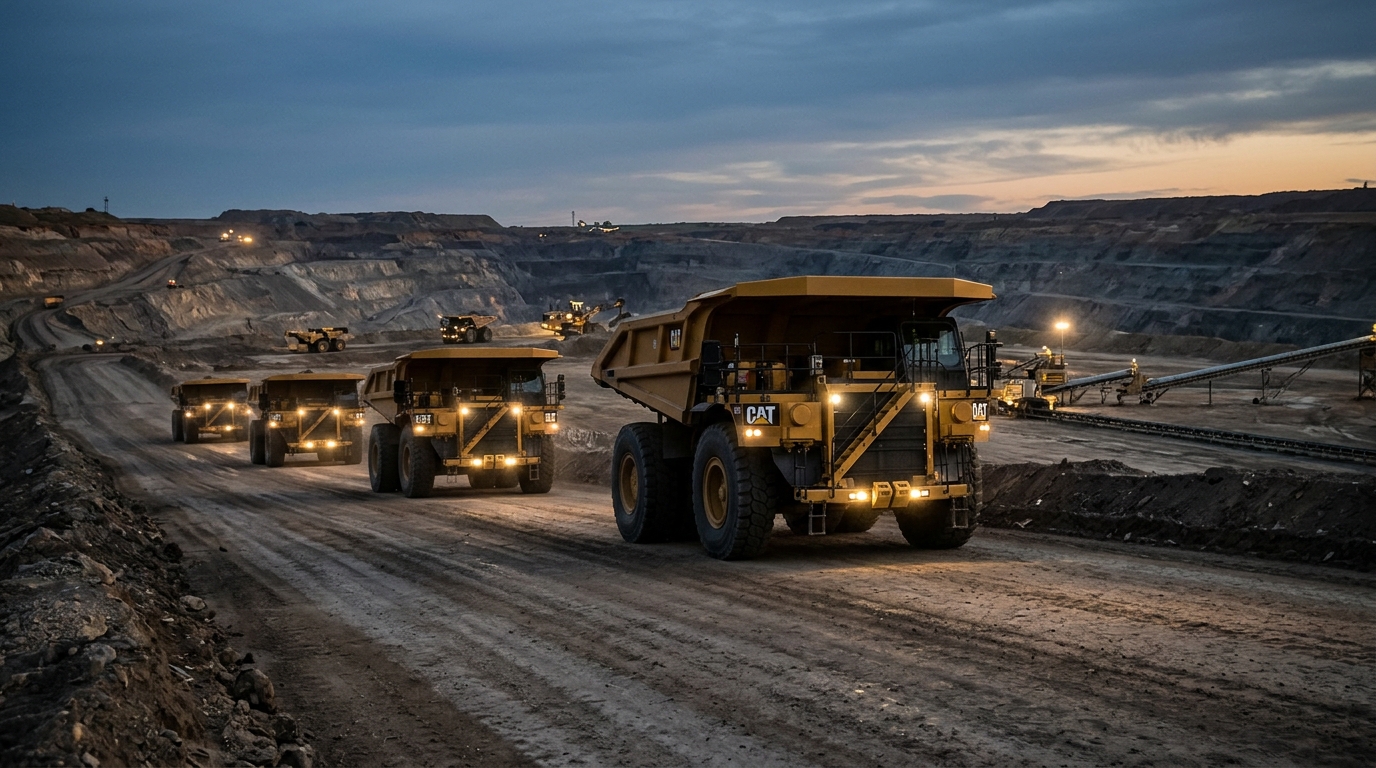
Caterpillar Chief Technology Officer Jaime Mineart said around CES 2026 that the autonomous mining fleet has moved over 11 billion tonnes of material and traveled more than 385 million kilometers autonomously, which Caterpillar said is more than twice the autonomous mileage of the automotive industry, without a single reported injury associated with autonomous hauling. That is not a proof-of-concept milestone. That is decades of operating experience being deployed at scale.
The expansion is accelerating. In September, the company and Luck Stone discussed expanding autonomous hauling to two more Virginia sites, Boscobel and Bealeton, including Caterpillar’s first autonomous deployment of Cat 775 trucks. The Cat 775 detail matters: autonomy has historically lived on the largest mining trucks at copper and iron ore sites, and bringing it to a mid-size class opens the door to aggregates and construction fleets, the volume end of the market.
The mid-size equipment push is not unique to Caterpillar. Deere faces a parallel question about whether its own autonomous and precision-agriculture order book can sustain a premium multiple into 2027.
The hardware getting stuffed into these machines is not commodity gear. Caterpillar has said it is working with NVIDIA and plans to use the NVIDIA Jetson Thor platform across Cat construction, mining and power equipment to support real-time AI inference and next-generation autonomy. That architecture is what makes underground and remote operations viable without operators on site.
The NVIDIA Jetson Thor integration points to a broader supply constraint that runs through the whole AI hardware stack. Electrical switchgear lead times of 52 to 104 weeks are already gating the data center buildout that feeds demand for AI-capable industrial equipment.
Group president Bob De Lange has said the company’s next target is to triple the number of autonomous trucks, as part of a broader 2030 push that includes reaching 2 million connected and reporting assets. Tripling nearly 700 trucks implies roughly 2,000 autonomous units. At current deployment rates, that is a meaningful equipment and software services opportunity, none of which Caterpillar currently breaks out as a distinct revenue line in its filings.
That opacity is the central trading risk around Thursday’s number. Caterpillar does not disclose AI or autonomy services as a distinct revenue line, so the financial materiality of the push relative to Caterpillar’s core equipment business cannot be established from public records. You are buying a business that beat Q2 adjusted profit per share estimates by $1.95 and posted its first-ever quarter above $20 billion in sales and revenues, backed by a record $72 billion backlog. The autonomous fleet is an embedded option on that, not a separate bet.
The trade is straightforward. Analysts’ Q3 estimates vary by source, but the range clusters around roughly $7.0 to $7.1 in EPS, and Caterpillar has exceeded Wall Street’s EPS estimates in recent quarters. A fifth beat likely sustains the momentum. Watch for any language around autonomous fleet contract wins, software attach rates, or the Fortescue and Carmeuse deployments. Those are the earliest indicators that the robot fleet is becoming a margin story rather than a capital expenditure story. Until then, the machinery business is doing the heavy lifting, and it has been doing it without missing.