
Dear Reader,
My name is Jeff Brown, founder and CEO of Brownstone Research.
And I want you to circle one date on your calendar…
That’s the day a tiny company could announce a huge supply deal with Elon Musk.
It’s a stock trading at under $1…
In an overlooked sector you’d never associate with tech.
But Musk’s robots, microchips and AI satellites all rely on it.

And on page 37 of the SpaceX IPO filing, Musk names this sector directly.
Why does that matter?
Because Musk raised $85.7 billion from the SpaceX IPO…
And a further $25 billion by selling bonds.
That money is about to flow downstream.
And when a Musk supplier in this sector announced a deal before…
The stock soared 395% in a single day.
That’s almost five times your money…
Before the sun goes down.
I recently sat down with an insider in this sector to talk about what could happen on November 11.
A man who once turned $13,140 of his own money…
Into around $1.85 million in under a year.
In our urgent strategy session, we reveal the name and ticker of a crucial Musk supplier…
Entirely for free.
But once November 11 arrives, this opportunity could be gone.
Click here to watch the strategy session before November 11.
We have so much to look forward to,
Jeff Brown
Founder & CEO, Brownstone Research
Brent at $92 and Falling. Another Tanker Burned in Hormuz.
There is a contradiction sitting in the middle of the oil market right now, and it deserves more attention than it is getting.
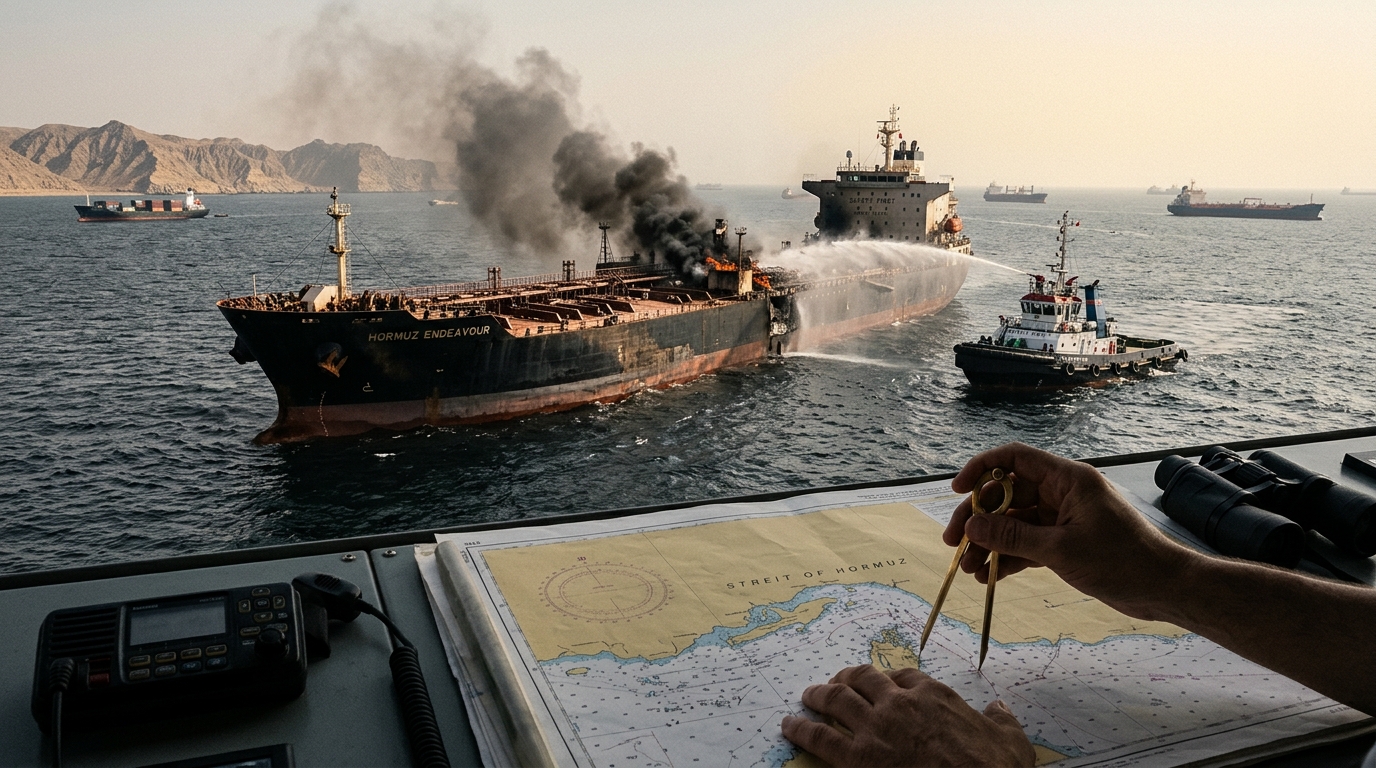
Iran’s army said last week that an oil tanker struck a mine and caught fire in the Strait of Hormuz, where the country has been targeting ships that transit without its authorisation. On Tuesday, Iran’s Revolutionary Guard said three vessels struck naval mines and caught fire in the strait. That is four vessels in roughly a week, not two days. Recent incidents also undercut any claim that the mine threat in and around the strait is fully resolved.
Brent crude was hovering around $92 a barrel on Wednesday morning after settling Tuesday at $91.49, its lowest settlement since late August. Over the past month, Brent has fallen roughly 14%, though it is still about 41% higher than a year ago. Over the last 52 weeks, Brent has traded between roughly $58.92 and $118.35. The round trip from the late-October high to $91 is what makes the latest mine reports so analytically interesting: physical risk and price have been moving in opposite directions.
The reason for the sell-off is not a mystery. Traders have been unwinding the geopolitical risk premium as expectations have grown that the conflict between the U.S. and Iran could move toward de-escalation. Oil slid again Tuesday after President Donald Trump said the Iran war could end “fairly soon,” and Brent briefly dipped below $90 for the first time since late August before recovering. Markets moved on the headline and have not fully unwound. The latest shipping incidents have not changed that posture, at least not yet.
This is where the trade lives. The diplomatic optimism that pushed Brent down sharply over the last month is not confirmed. One energy analyst argued there is no way the Iranian regime would let the Strait of Hormuz be open for oil to flow at pre-war levels. Meanwhile, the United States has been enforcing a naval blockade on Iran and has been helping tankers move through the area, a corridor that carried about one-fifth of the world’s oil before the war. Ships are still burning. The market is pricing the ceasefire, not the conflict.
The Two Sides of the Contradiction
Cheap oil at $92 creates clear winners among consumers of crude. Airlines stand to benefit from cost savings, but the draft’s specific jet-fuel figure cannot be verified and has been removed. That is still meaningful relief for carriers whose fuel bills have been punishing since the conflict began earlier this year. The same logic applies to refiners processing cheaper feedstock, though the margin story is more complicated: if crude falls $5 but refined-product prices fall $6, the refiner does not benefit. Conversely, if product prices rise faster than crude, margins expand. The gap between refined-product prices and crude costs matters more than crude alone.
On the other side sit the tanker operators. Frontline (FRO) reported net income of $659.2 million in the second quarter of 2026. Scorpio Tankers (STNG) is one of the clearest plays on refined-product shipping, but the draft’s claim that parts of its LR2 fleet earned around $80,000 per day on a time-charter basis is not supported by its 2026 disclosures and has been softened. Both FRO and STNG have priced in a prolonged disruption. A genuine diplomatic resolution would crater their earnings outlook faster than any single mine report could save it.
How to Frame the Setup
The core question is whether the market has over-corrected on peace hopes. Four tankers hit in two days is not consistent with the most widely reported timeline, and that sentence has been corrected. Even so, multiple mine incidents in the strait within days of each other is not consistent with a corridor that is cleanly reopening. That asymmetry, price falling while incidents recur, is not sustainable in one direction indefinitely.
Watch the $90 level in Brent closely. Brent slipped below $90 for the first time since late August intraday on Tuesday before recovering. A confirmed close below that level would signal the market is fully discounting the conflict. A bounce back above $95 on fresh incident reports would confirm the peace premium was premature. For traders, the clearest action is monitoring whether tanker-incident frequency rises while crude continues to drift. That divergence, if it holds, is the opportunity.