Dear Reader,
Take a look at this magazine cover…

On the surface, it seems like a joke.
But Newsweek printed it before the 2016 election.
That’s how sure the so-called “experts” were… that Hillary would win.
One man said they were wrong.
His name is Jim Rickards. He’s a former advisor to four presidents, the Pentagon and the CIA. And in 2024, he predicted the exact number of electoral votes Trump would get.
Today, the same experts are calling Trump a “lame duck.”
Rickards says they’re wrong again.
He says, “Trump is saving his best move for last. And Congress could be powerless to stop it.”
What’s at stake is a fortune that’s been locked away for 164 years. It’s worth an estimated $150 trillion. To put that number into perspective, that’s enough to make every single family in America millionaires.
And investors who know what to expect could make a potential fortune.
For the full story, click here.
Regards,
Matt Insley
Publisher, Paradigm Press
The Yuan Is at a Four-Year High. Most Traders Aren’t Positioned for What Comes Next.
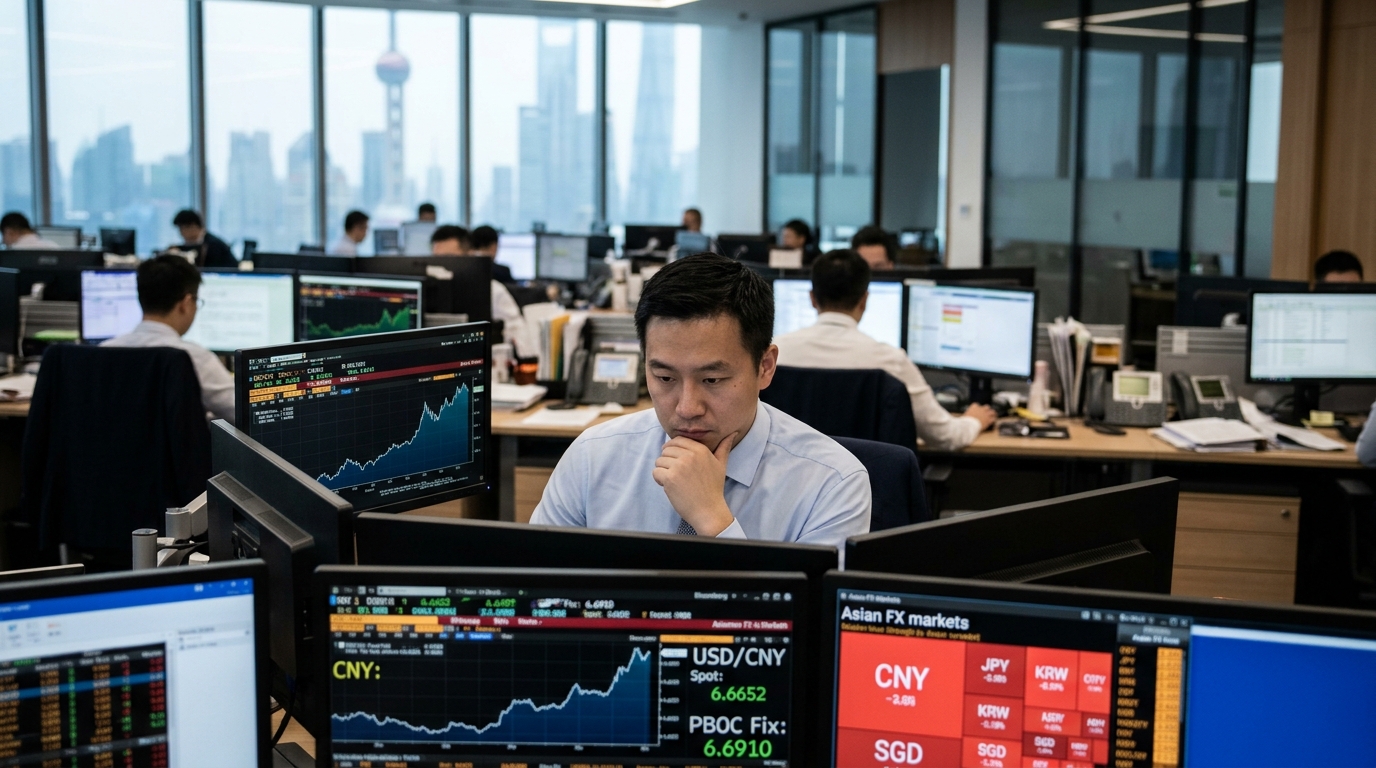
The Chinese yuan has become one of the most consequential and least-traded moves in global currency markets this year. The onshore rate closed at 6.6458 per dollar on November 2, its firmest level since mid-2022, and has held near that territory through this week, with spot trading around 6.6652 as of Friday morning in Shanghai. China’s yuan dipped just 0.06% against the dollar on Friday as the central bank set its daily midpoint at 6.7075, its strongest fixing level since July 2022.
That gap between the fix and spot is the story. Friday’s official fixing diverged from a Reuters projection of 6.6604, landing at 6.7075 instead. A fix set materially weaker than the consensus is the PBOC’s standard channel for signaling tolerance of depreciation, and the gap to expectation matters more than the level itself. In past episodes, the sequence has been a run of consecutive fixes on the weak side of estimates, followed by attention on whether the onshore rate pins to the weak edge of the trading band. Beijing is using the fix to manage the pace of appreciation, not reverse it.
China’s yuan firmed against the dollar to its strongest level in more than four years and was headed for a fourth straight month of gains, as exporters continued to convert dollar holdings into the local currency. A firmer currency poses a challenge for exporters whose dollar holdings lose value as the yuan climbs, and as a result they have been selling dollars and stepping up hedging, adding further upward pressure on the yuan. That self-reinforcing loop is precisely what makes this move harder to fade than it looks.
Goldman Sachs has repeatedly revised its yuan forecast stronger and still believes markets are underpricing the move. Goldman Sachs expects China’s yuan to strengthen to 6.40 per dollar within a year, from around 6.69 now, and puts the yuan’s undervaluation at 20% to 25%, calling that estimate conservative. Goldman strategist Kamakshya Trivedi said he had been surprised that consensus forecasts and forward markets still had not caught up each time Goldman moved its forecast stronger.
The position asymmetry is real. Most dollar-based portfolios carry little to no short-dollar, long-yuan exposure despite the currency’s roughly 5% gain against the dollar this year. The dollar now buys about 6.69 yuan, down more than 4% since the start of 2026, and the yuan has also gained more than 8% against the euro this year.
The knock-on for regional currencies is where active traders need to pay attention. Many Asian economies trade heavily with China and their currencies tend to track the yuan, so a managed climb in Beijing tends to lift regional currencies alongside it, with knock-on effects for anyone holding Asian bonds or equities in dollar terms. The divergence within Asia is already visible: the Korean won is up about 6% against the dollar in 2026 and the yuan about 5%, while the ringgit and Singapore dollar are flat and the baht, peso and rupiah are down 6% to 8%.
The divergence within Asia is not only a trading story — it is a policy stress test. India’s central bank has already been forced to respond to currency pressure driven by the same dollar and yuan dynamics pulling at regional peers.
The ringgit in particular is being pulled in opposing directions by a strengthening dollar and persistent yuan appreciation. The dollar’s rebound has prevented the ringgit from strengthening beyond the 4.00 level, while yuan gains have limited further weakness. That compression creates a range-bound trade in MYR that may break once the PBOC’s tolerance shifts.
Chinese exporters face a harder calculation. In the first half of 2026, the median net profit margin among more than 5,000 Chinese firms was about 4.9%, and currency-related losses during that period amounted to around 70 billion yuan. Banks in coastal regions have been asked by regulators to raise hedging ratios above 40%, with some local branches even offering subsidies to companies that expand hedging activity.
The hedging pressure on exporters sits inside a broader cost squeeze. China’s factory-gate inflation has surged to a four-year high while consumer prices remain flat, compressing the margins that make currency losses so damaging.
For the week ahead: watch the gap between the PBOC’s daily fix and Reuters estimates. When that spread begins to close consistently, it signals the central bank is allowing the market to lead rather than manage the pace. That is the moment spot USD/CNY tests toward 6.60 and EM Asian FX rallies alongside it. Until then, the yuan’s grind higher continues to be one of the most underappreciated position risks in global portfolios.