
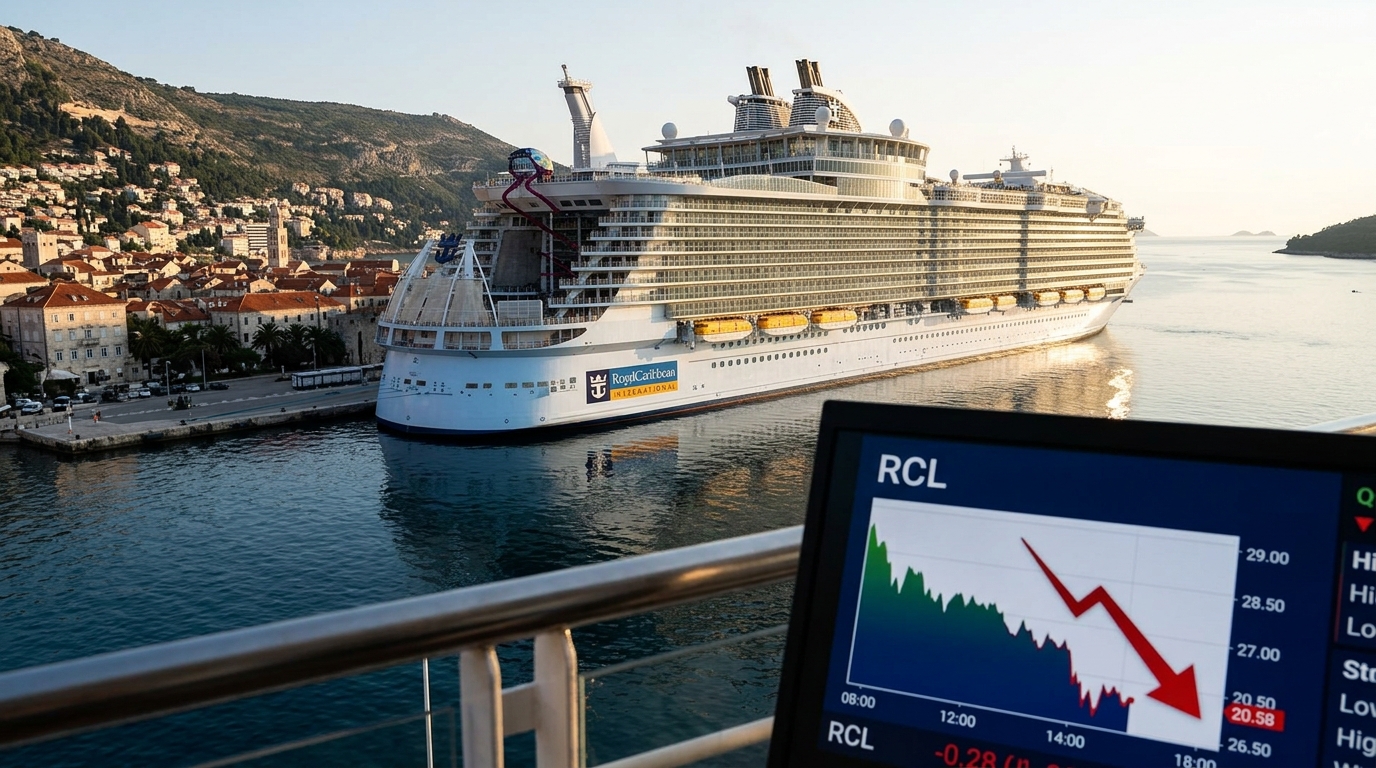
Royal Caribbean just delivered an earnings beat and raised full-year guidance. The stock fell in premarket anyway. That gap is worth understanding before the next session.
Q2 adjusted EPS came in at $4.21, beating the $3.97 consensus by about 6%. Revenue reached $4.83 billion, up 6.5% year over year and slightly above the analyst mark of $4.81 billion. Load factor hit 110%. Results were driven by strong close-in demand, lower-than-expected costs, and favorable joint-venture performance.
Full-year adjusted earnings guidance moved up to $17.73 to $17.87 per share, from the prior range of $17.10 to $17.50. The midpoint of $17.80 sits comfortably above the analyst consensus of $17.51 heading into the print. That is not a cautious guide. That is confidence.
So what is the problem?
Two things. First, the company trimmed its annual revenue growth forecast to approximately 9% from approximately 10%, citing what management described as a modest booking impact from prolonged geopolitical tensions. Mediterranean itineraries and select West Coast Mexico sailings took the hit. Second, quarterly fuel expenses jumped 27% to $355 million as Middle East tensions pushed oil costs higher. Even with nearly 60% of 2026 fuel consumption hedged, the company expects fuel costs to reduce full-year earnings by roughly 62 cents per share.
Here is where I think the market is misreading this. The earnings guidance went up by $0.50 at the midpoint even as the revenue forecast came down. That means cost controls and onboard spending are picking up the slack that geopolitical pressure is creating on yield. The underlying consumer is not breaking. CFO Naftali Holtz said consumer demand for cruise experiences remains strong, and that 2027 booking trends are pacing ahead of historical levels, including for itineraries affected by geopolitical disruptions this year.
That last sentence is the one traders might be sleeping on.
The company also took delivery of the Legend of the Seas during Q2, the third ship in its Icon class, and has committed financing for two additional Icon-class ships, Icon VI and Icon VII. This fleet buildout keeps capacity growth running at approximately 6.6% for the full year. Citi lowered its price target on RCL to $327 from $362 but maintained its Buy rating, citing favorable secular growth dynamics in the cruise industry.
What matters over the next several sessions:
- Whether the geopolitical booking impact is seen as temporary or structural by the broader market
- Oil price direction given RCL’s roughly 40% of fuel consumption remaining unhedged
- Any further Q3 color on Mediterranean booking recovery as tensions evolve
- Whether the cruise sector peers, Carnival and Norwegian, echo or contradict the demand commentary
The stock hit an all-time high near $346 in January after a massive earnings beat. It has pulled back sharply since. The business kept growing. The question is whether the gap between the fundamentals and the current price is an opportunity or a warning. The 2027 booking commentary suggests the demand side is healthier than the stock is pricing. The fuel bill and geopolitics are real, but they are also known quantities at this point.
Q3 earnings are scheduled for late October. A lot can shift between now and then.