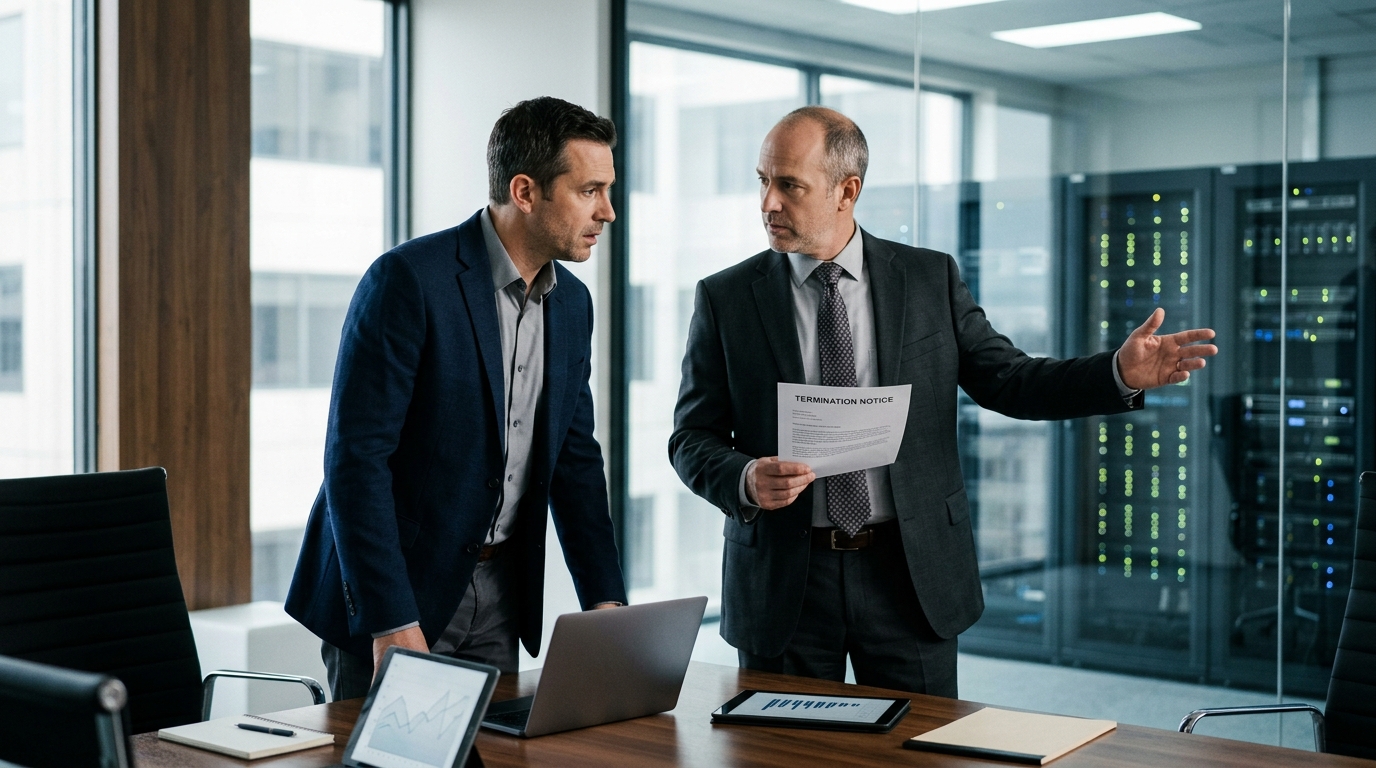
On August 28, OpenAI did something that textbooks rarely describe but great investors always fear. It flipped a contractual switch. OpenAI notified SpaceX that it intends to wind down its contract providing models to Cursor, with a proposed shutoff date of November 12, 2026, giving the maximum notice the agreement allows. The letter was addressed to a rocket company. The lesson belongs to every investor who has ever admired a fast-growing software business without asking who actually owns the engine underneath it.
SpaceX completed its acquisition of Anysphere, the developer of Cursor, in an all-stock transaction valued at $60 billion. In its announcement that the deal closed, Cursor repeatedly referenced SpaceX’s computing infrastructure and said it will have access to a vast fleet of GPUs. Fourteen days after the ink dried, one of Cursor’s most important model suppliers handed back the keys.
OpenAI explained that it is making this choice because it cannot be confident SpaceX will use its technology within its terms of service, based on its “experience with Elon Musk’s companies violating contracts.” OpenAI has pointed to Musk’s under-oath testimony that xAI had partly used OpenAI technology to train its own models, a practice OpenAI says violates its terms. The trust was already gone before Cursor changed hands.
The 5% Defense and What It Misses
Cursor CEO Michael Truell said: “OpenAI models serve about 5% of Cursor user traffic, and we’re speaking with the OpenAI team to resolve this.” That number is meant to be reassuring. Cursor still offers models from Anthropic, Google, and SpaceXAI, so November 12 ends OpenAI’s direct in-editor integration rather than the rest of the product. The business is not broken. But the 5% figure is not the point a disciplined investor should care about.
The point is the mechanism. OpenAI said its contract included a clause giving it a limited window to end the agreement after a change in ownership. A change-of-control clause is a standard commercial instrument. It exists precisely because one party anticipated a day when the counterpart would no longer be who it signed with. Cursor, for all its genuine strengths, was building its product on inputs it did not control and could not prevent a rival from withdrawing.
Charlie Munger spent decades returning to a single question when evaluating businesses: who has the leverage? A company that must license its core capability from a competitor has already surrendered a portion of its moat to that competitor’s goodwill. Anthropic co-founder Tom Brown has said Anthropic is scaling up compute capacity with SpaceX, and Anthropic has described the deal as increasing its available capacity. One supplier just departed. Another just signaled it is ready to deepen its position.
Where This Leaves the Investment Map
Anysphere reported around $4 billion in annualized revenue by June 2026. That is a genuinely exceptional growth curve. Morgan Stanley maintained a $300 base price target on SpaceX, and estimated Cursor could contribute about $13 billion in SpaceX revenue in 2027. The bull case is real. But the OpenAI cutoff has now demonstrated, in public, that the model supply chain for AI coding tools is contested terrain where corporate rivalries translate directly into product availability.
For investors looking at this space, the question is not whether Cursor survives November 12. It almost certainly does, with Anthropic and Google filling the gap. The question is which businesses in the AI stack own their inputs rather than rent them. Here it was an acquisition triggering a contract clause. It could just as easily be a price change, a rate-limit cut, a policy shift, or a deprecation. The franchise you do not fully own is the franchise someone else can change on short notice. November 12 is the calendar proof.