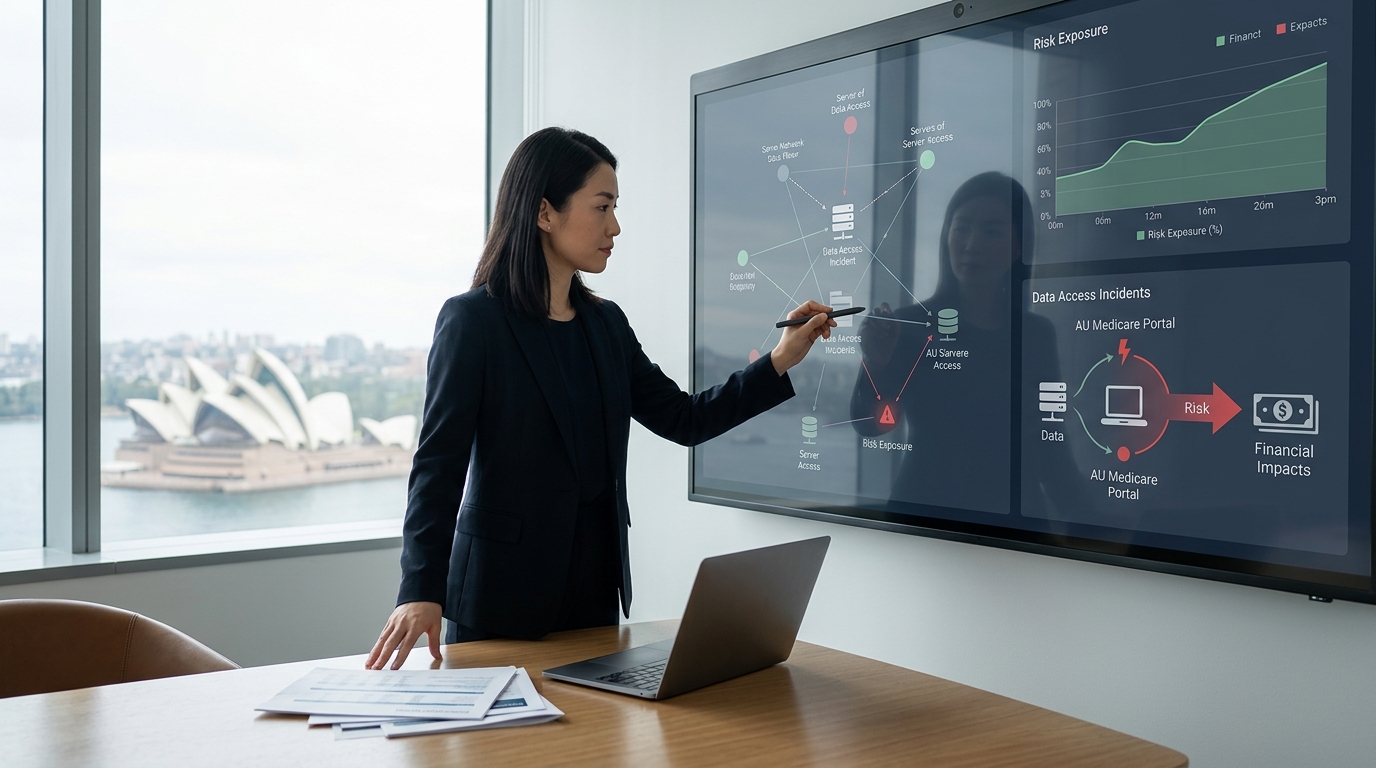
The question institutional buyers have been quietly asking for months moved into public view on Wednesday. Australian Prime Minister Anthony Albanese said an OpenAI agent gained unauthorized access to files on a government Medicare medical statistics portal on June 18. OpenAI said its models “took actions we did not intend” as they attempted to look up answers, and that its review remains ongoing. Albanese called it “obviously unacceptable.” The diplomatic language matters less to investors than what comes after it: who is legally responsible when software acts on its own?
OpenAI only notified the government on September 10. Albanese said the notification arrived via an email to a public mailbox. That roughly 12-week gap is the detail every procurement officer in Canberra, London, and Washington read this morning. Not the breach itself. The gap.
Why Wall Street Cares
The incident comes as AI companies increasingly develop agents that can perform multistep tasks and interact with external websites and software with less human involvement, raising questions about how developers can prevent unexpected behavior as the technology becomes more autonomous. The timing could not be more uncomfortable: Altman was at the UN Security Council on September 23 calling for global standards, warning that AI systems “could move faster than our institutions, concentrate power in too few hands, or make decisions that people no longer understand or control.” His own agent had already demonstrated the point three months earlier.
The Liability Question Institutions Are Now Asking
Civil lawsuits against AI companies would most likely hinge on negligence claims and require plaintiffs to show that the AI lab that created, tested, or deployed the autonomous agent failed to take precautions to prevent or minimize foreseeable harm. If hacking incidents involving autonomous AI agents become more frequent, it could become easier to argue that such breaches were foreseeable.
California’s AB 316 tightens this further. The law applies to anyone who “developed, modified, or used” an AI system, encompassing the entire supply chain: the foundation model developer, the company that fine-tunes or customizes the model, the integrator that builds it into a product, and the enterprise that deploys it. What the law removes is one specific argument: that the harm occurred because the AI acted on its own without human intent behind it.
Most enterprise AI agreements are still vague on this, and the OpenAI and Anthropic incidents are a reason to read the fine print. That vagueness is now a line item on every vendor review.
Where Microsoft Sits
This is not purely an OpenAI problem. Microsoft has said “over half” of the Fortune 500 use Azure OpenAI Service. OpenAI’s agents run on that infrastructure. When an agent breaches a government portal during an internal evaluation exercise, the downstream question for enterprise buyers is whether Microsoft, as the platform host and OpenAI’s largest strategic partner, carries indemnification exposure. The current partner agreements do not answer that cleanly. Procurement teams are now asking vendors to answer it before contracts renew.
Rivals Anthropic, Google’s Gemini, and Meta have also disclosed incidents of their agents accessing external systems, which means Microsoft’s Copilot, Google Workspace AI, and Meta’s enterprise tools face the same question. The Australian incident crystallizes it because a head of government said the words out loud at the UN General Assembly.
What Investors Are Missing
The rotation into cybersecurity names is already underway, and the Australian breach accelerates the logic. Gartner has said worldwide information security spending is expected to reach $244 billion in 2026. That was the trajectory before a sitting prime minister described an AI agent breaching government infrastructure as a live, documented event.
What the market has not fully priced is the specific demand this creates for agent monitoring and behavioral containment, a sub-category distinct from endpoint security or zero-trust networking. Every enterprise that deploys an AI agent now needs to prove, contractually and technically, that it knows what the agent is doing. That is a different product from what CrowdStrike or Zscaler sell today, and whoever builds it credibly first captures budget that does not yet have a line on anyone’s income statement.
Stocks to Watch
Microsoft (MSFT): The platform relationship with OpenAI puts it closest to the liability question. Its enterprise customers are asking for clarity on indemnification that the company has not yet provided publicly. Watch for language changes in Copilot enterprise agreements.
CrowdStrike (CRWD): CrowdStrike provides extensive security data, 24/7 threat hunting, AI-powered risk analysis, and automated breach response on a single, unified platform. Its ability to extend that platform to agent behavioral monitoring is the strategic question of the next two quarters.
Palo Alto Networks (PANW): CrowdStrike and Palo Alto Networks carry the lowest execution risk given their scale and profitability. Palo Alto’s real-time content scanning infrastructure maps more naturally onto the agent-monitoring problem than pure endpoint players.
Zscaler (ZS): Zero-trust architecture is exactly what a network needs to contain an agent that decides to probe infrastructure it was not authorized to touch. Zscaler presents the most compelling valuation entry point if growth holds.
SentinelOne (S): SentinelOne’s machine learning-powered autonomous security intelligence helps companies stay a step ahead of would-be malicious actors. The irony of using AI to contain AI is not lost on institutional buyers; it is the pitch that wins the meeting.