
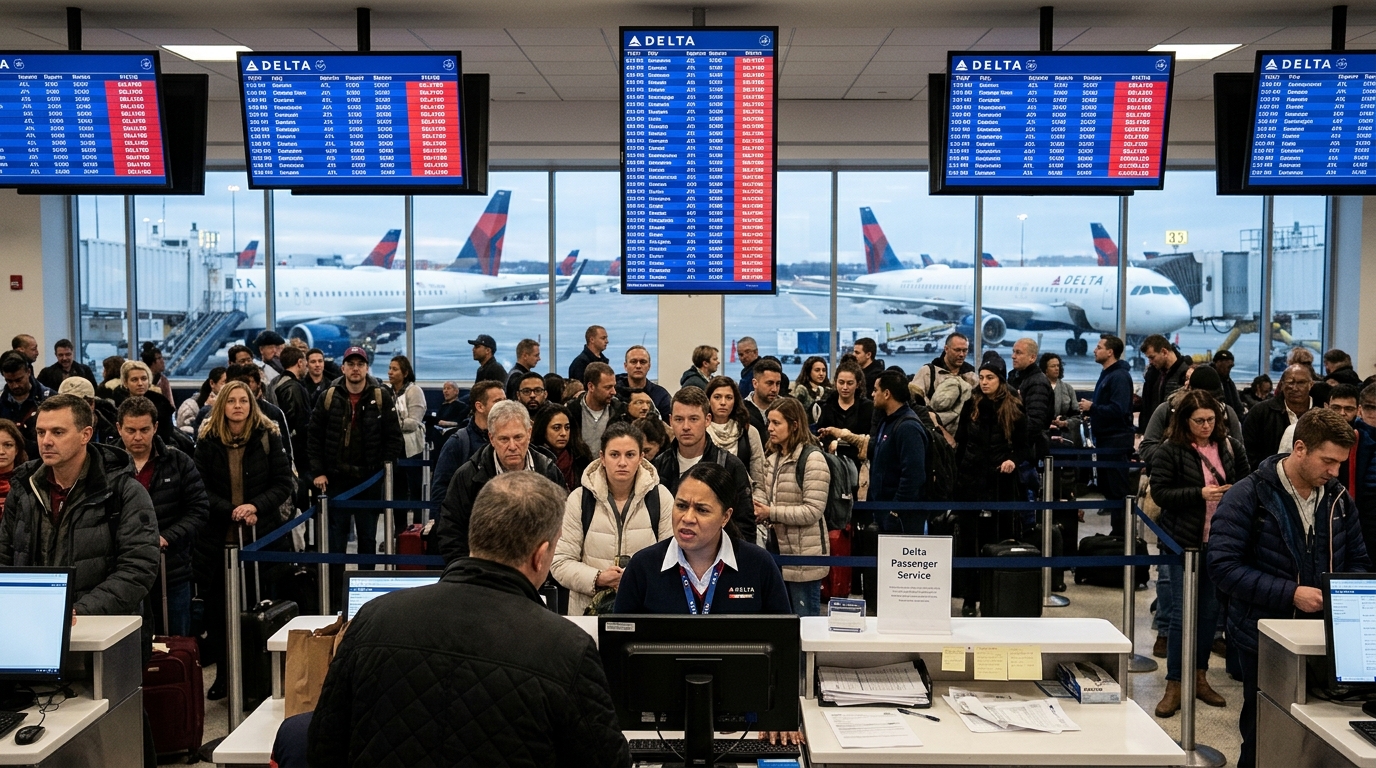
Over 1,000 Delta flights were delayed Sunday after the automated system that calculates an aircraft’s weight malfunctioned during a busy pre-Thanksgiving travel period. By evening, the numbers were worse. FlightAware reported that roughly 58%, or about 2,000, of Delta’s flights were delayed as of Sunday evening.
Delta’s weight and balance instructions for baggage crews are planned at the Operations and Customer Center in Atlanta using a system called ALIS, the Automated Load Instruction System. Because aircraft load calculations are legally mandated before any commercial flight can depart, the failure of ALIS immediately slowed gate operations nationwide. Delta’s teams used manual workarounds to get flights off the ground while they worked to restore the automation. The airline said roughly 70% of the delays and cancellations were connected to the automation issue, with the remainder due to inclement weather.
The failure caused an hourlong ground stop for some flights into Hartsfield-Jackson Atlanta International Airport, Delta’s biggest hub and the world’s busiest airport. The FAA reported average delays of roughly 57 minutes for Atlanta-bound flights, with some wait times stretching nearly two hours. Delta said Sunday that the automation for departing flight weight and balance calculations had been restored, but residual delays may continue into Monday morning as aircraft and crews reposition across the country.
Why This Matters for DAL at the Open
The timing is the story. Hartsfield-Jackson alone expects about 4 million passengers through December 1. Nearly 29 million passengers are expected to fly on U.S. airlines between November 20 and November 30, with Sunday, November 29 and Monday, November 30 expected to be the busiest travel days. A Monday morning schedule that is already dislocated, with crews and aircraft out of position, compounds risk going into the highest-volume days of the year.
This is also the second major technology failure for Delta in recent memory. United Airlines experienced an issue tied to its Unimatic systems in August 2025 that triggered more than 1,000 delays and dozens of cancellations. The Delta outage follows the FAA’s nationwide ground stop on November 13 and a United Airlines system outage on November 16. Three separate technology-driven disruptions in ten days raises a broader question about aviation infrastructure heading into peak demand.
DAL last closed at $80.01. Analysts remain broadly positive, but the specific mix of ratings and the exact consensus price target varies by data provider and changes frequently. The gap between longer-term targets and the current price reflects genuine earnings confidence, but operational credibility is now on trial across the busiest week of the year.
Sector Read
Watch how UAL, AAL, and LUV trade relative to DAL at the open. Any carrier that can demonstrate clean Monday operations captures a reputational edge that may move bookings in real time. Thanksgiving week loads leave almost no room to absorb displaced passengers, with many flights running very full and limited open seats on later departures.
The Cheat Sheet
- Top Theme: Operational risk in aviation is concentrated and sequential, DAL is the carrier to watch today.
- Stock to Watch: DAL. The system is restored, but schedule recovery across a nationwide network takes days, not hours, and Sunday and Monday after Thanksgiving are expected to be the peak travel days.
- Sector to Watch: Airlines. Any divergence between DAL and UAL or AAL this morning signals whether the market is pricing this as Delta-specific or sector-wide.
- Biggest Risk: A second disruption, weather event, or crew positioning failure before the peak travel days could turn a recoverable story into a material earnings event.
- One Thing to Remember: Restoration of the automation system is not the same as a restored schedule. Watch Monday’s completion factor before concluding the problem is behind DAL.