
July 21, 2026
OPI: The Post-Chapter 11 Reality Check
Debt relief helps. Cash flow decides.
Heads up –
I just set you up with a temporary link that skips the order page for my Simple Options Trading For Beginners guide. No cart. No checkout. It lets you skip ahead to the download page.
The only catch?
The link expires soon. Once it goes, you have to pay $29.97.
Use the backdoor link below to get free access before it closes.
Simple Options Trading For Beginners << BACKDOOR LINK
Good Trading,
Bill Poulos
Markets love a clean before-and-after.
Before: too much debt, a broken capital structure, a Chapter 11 filing. After: a lighter balance sheet, new equity, and a ticker that looks investable again.
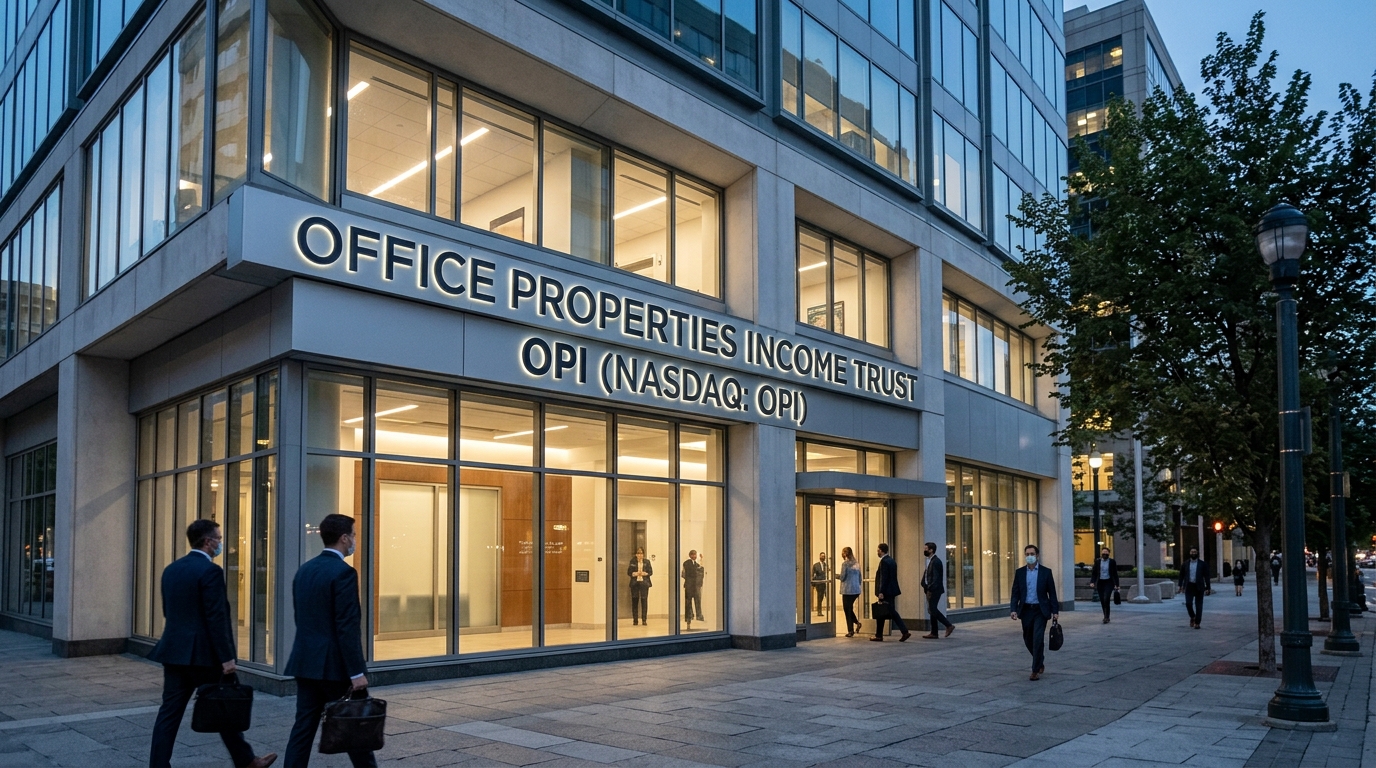
Office Properties Income Trust (Nasdaq: OPI) is living inside that before-and-after right now. It emerged from Chapter 11 on June 17, 2026, after reducing debt by approximately $714 million. Old common equity was canceled. New shares began trading June 18.
So here is the question that matters for value investors: did OPI become cheap, or did it just become tradable again?
Step One: Separate the Capital Structure From the Business
OPI filed voluntary Chapter 11 petitions on October 30, 2025, in the U.S. Bankruptcy Court for the Southern District of Texas. The process was pre-arranged. Holders of roughly 80% of its September 2029 senior secured notes had signed on to a Restructuring Support Agreement before the filing.
The plan was confirmed April 22, 2026. The effective date was June 17, 2026. Here is the mechanical change investors should actually anchor to:
- Debt reduced by approximately $714 million through the restructuring
- OPI emerged with about $1.7 billion of debt outstanding
- The $425 million revolving credit facility was amended and bears interest at 9.1%
- $300 million of 9.0% Senior Secured Notes due March 2029 and $177 million of mortgage debt were reinstated
- Holders of 3.25% Senior Secured Notes due March 2027 received approximately $385 million of new 8.375% senior secured notes due December 2029 (with scheduled principal payments through maturity)
- Holders of 9.0% Senior Secured Notes due September 2029 received approximately $420 million of new 10.0% senior secured exit notes due June 2031 plus newly issued common shares
- All old common equity was canceled, and about 21.95 million new shares were issued
That is a real reduction in obligations. It is also a reset that came with high-cost debt. A 9.1% revolver and 10.0% secured exit notes are not a gentle funding environment. They are a timer.
And the identity of the shareholder base changed. Creditors are now owners. A significant portion of the reorganized equity is held by former noteholders, including affiliates of Helix Partners Management and Redwood Capital Management.
This matters because the new owners are not buying a “growth” story. They are trying to convert what used to be an impaired credit into a recoverable equity value.
Step Two: What Does OPI Own, and Who Pays the Rent?
OPI is an office REIT. It owns 122 wholly owned properties across 29 states and Washington, D.C., totaling approximately 17.1 million rentable square feet.
The optimistic angle is tenant quality. As of June 30, 2025, approximately 59% of revenues came from investment-grade rated tenants. In an office market where credit matters more than it did five years ago, that is a legitimate asset.
There is also a structural detail you cannot ignore. OPI is managed by The RMR Group under five-year property and business management agreements signed as part of the post-reorganization structure. RMR manages about $40 billion in assets and has more than 35 years of experience in commercial real estate. But an external manager also means expenses that do not flex down as quickly as you want when the fundamentals weaken.
Step Three: The Cheap Test (Where the Story Gets Uncomfortable)
Here is where I am at: you cannot call something “cheap” just because the equity is smaller after a bankruptcy.
As of July 17, 2026, OPI traded around $18.03 with about 21.95 million shares outstanding, putting market cap near $395 million. Add roughly $1.7 billion of debt, and enterprise value is still heavy for a business that is not currently producing healthy cash flow.
That is the problem. Not the headline debt reduction. The cash flow.
On recent trailing figures, revenue is about $442.6 million. But operating cash flow and free cash flow have been negative, and profitability has been deeply negative. Those are not “temporary sentiment” numbers. Those are “the engine is not working” numbers.
It is totally possible for a post-bankruptcy equity to become a bargain. But the bargain typically comes from one of two things:
- A business that is fundamentally sound, but temporarily overleveraged
- Assets that are undervalued on the balance sheet and can be sold above implied market value
OPI might still fit that second bucket in selective cases. But the first bucket requires proof, and OPI does not have it yet.
The Macro Backdrop: Office Is Improving, Slowly
Slight tangent, but it matters because it frames the entire bull case.
Office is not “back.” But it is not getting worse everywhere, every quarter, either.
Marcus and Millichap research shows national office vacancy has declined from a peak around 17.3% in 2024 to 16.1% as of Q1 2026. They forecast further improvement in 2026, with vacancy declining to 15.9% by year-end.
That is the tailwind OPI investors are implicitly leaning on. If vacancy is drifting lower, leasing pressure eases. Rent cuts slow down. Tenant defaults do not spike. You can survive long enough to refinance and sell assets on better terms.
But this is where value investors need to stay skeptical. The office market is bifurcated. Even if the national numbers improve, lower-quality buildings can still bleed. And OPI is dealing with expensive debt right now. A slow improvement in vacancy does not automatically translate into a fast improvement in free cash flow.
What Would Have to Happen for Perception to Improve?
There is no single magic catalyst here. OPI is a grind. A sequence.
If you are looking for the “cheap but not broken” pattern, I would want to see three things over the next few quarters:
- Stabilization in cash flow. Not a great quarter. Not an adjusted metric. Real operating cash flow that stops going the wrong way.
- Asset sales that reduce debt without destroying the rent roll. Selling a building to pay down debt is only helpful if the remaining portfolio can carry itself.
- Evidence that investment-grade tenants are renewing at workable economics. The 59% figure only matters if those leases persist.
One more detail: Odeon Capital initiated coverage on OPI on July 7, 2026 with a Buy rating and a $27 price target. That can matter at the margin for visibility and flows. It does not change the economics.
Cheap or Broken?
Here is my disciplined read.
OPI is not a classic value situation. It is a post-bankruptcy equity where the upside depends on a sector recovery plus execution, while the downside is still very real because the debt is still large and the cost of that debt is high.
That does not make it untouchable. It makes it a different category. A high-variance situation, not a “fundamentals bargain.”
If you believe office fundamentals will keep improving through 2026 and into 2027, and if you believe OPI can convert that macro improvement into positive cash flow quickly enough, then the stock may eventually look mispriced versus the assets and the tenant base.
If you do not believe that, the market is probably doing exactly what it should be doing: demanding proof.
Worth a look? Yes, as a watchlist case study in how capital structure resets work.
A best bargain in the market today? Not yet. Not until the cash flow stops bleeding.
– The Cheap Investor