
July 17, 2026
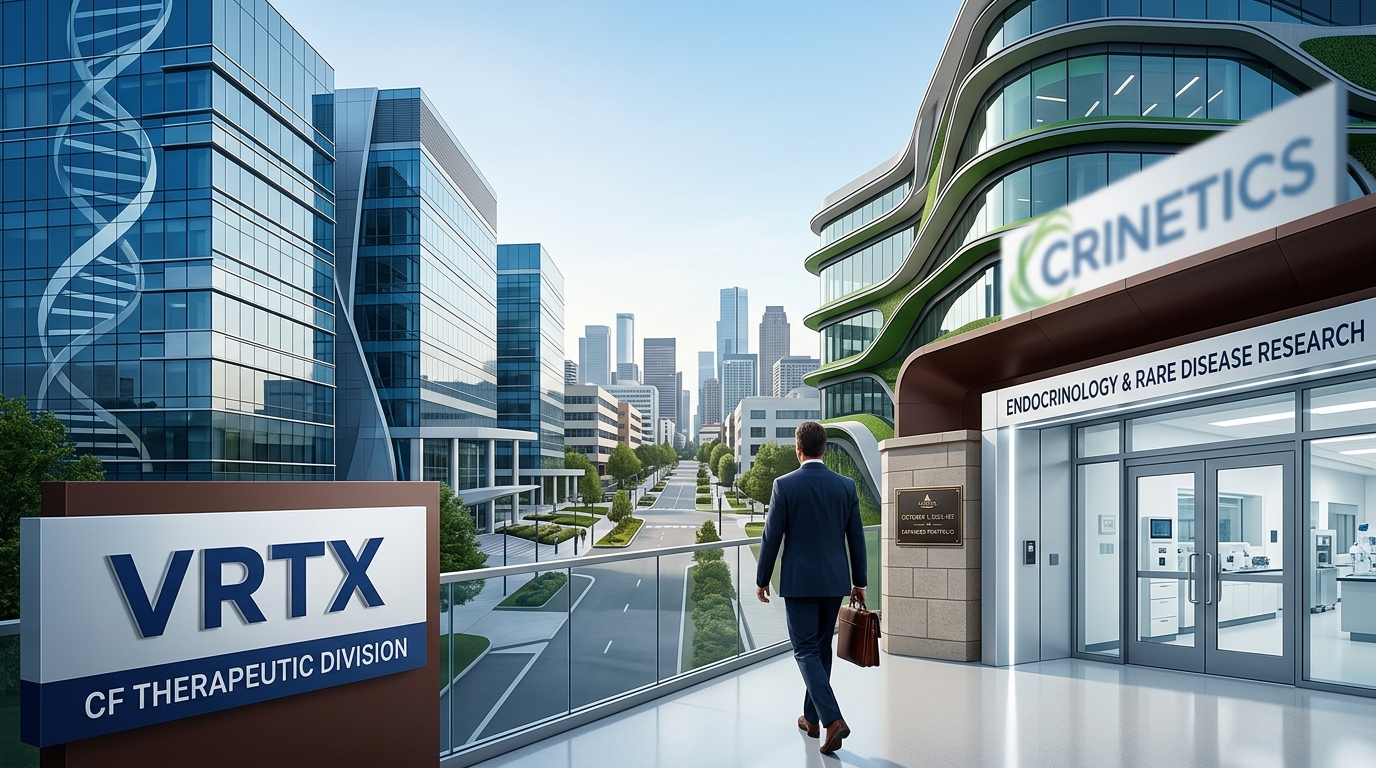
Vertex Just Spent $10 Billion to Stop Being a One-Disease Company
The Crinetics deal is expected to close in Q3. August 3 is what investors need to watch.
First a note from Base Camp Trading
Dear Trader,
My top income trading expert, Dave Aquino, just released a 1-hour trading strategy designed specifically to help regular investors generate enough income to become financially independent…
Without taking on excessive amounts of risk.
I’m talking about having the opportunity to collect $500 on Monday…
$563 on Wednesday…
Then as much as $625 on Friday.
Week in. And week out.
To better trading,
– Drew Day
Partner
Base Camp Trading
Hey there, bargain hunter.
Vertex Pharmaceuticals (NASDAQ: VRTX) is one of the most durable biotech businesses alive. It owns the cystic fibrosis treatment market the way a landlord owns a neighborhood. Trikafta, its flagship CF drug, generates billions in annual revenue with near-zero competition. The company has printed consistent double-digit growth for years.
The problem with a monopoly is that it stops looking like growth and starts looking like risk. Investors have known for years that Vertex needs a second pillar before the CF ceiling becomes a ceiling. That’s exactly what the Crinetics deal is.
What Just Happened
On July 6, Vertex announced it would acquire Crinetics Pharmaceuticals in an all-cash deal at $85 per share, for a total equity value of approximately $10 billion, or about $8.8 billion net of estimated cash. The deal was unanimously approved by both boards and is expected to close in Q3 2026. Crinetics shares nearly doubled on the news. Vertex shares barely moved.
That reaction from VRTX investors tells you something. The market isn’t sure yet whether Vertex overpaid or just bought exactly the right asset at exactly the right moment.
What Vertex Is Actually Buying
Crinetics has two key assets. The first is PALSONIFY (paltusotine), a once-daily oral treatment for adults with acromegaly. It received FDA approval on September 25, 2025, and the European Commission approved PALSONIFY in April 2026.
The second and arguably bigger asset is atumelnant, currently in Phase 3 development for congenital adrenal hyperplasia (CAH). Vertex’s own materials describe the combined PALSONIFY and atumelnant opportunity as more than $5 billion in potential annual revenue at peak.
Combined, Vertex expects the deal to become accretive to non-GAAP operating income by 2029.
Why This Is a Different Kind of Deal
Vertex is not buying a late-stage asset to plug a single revenue gap. It is buying an endocrine platform. PALSONIFY becomes a commercial launching pad. Atumelnant follows into CAH and potentially Cushing’s syndrome. The rare disease playbook Vertex perfected in CF — find an underserved patient population, develop the best oral therapy, price at premium — maps almost exactly onto what Crinetics has been building.
What’s interesting here is that PALSONIFY’s competitive runway just got longer. The FDA issued a complete response letter (CRL) to Camurus for its acromegaly product Oclaiz, pushing back a key challenger. That gives Vertex more time to lock in prescribers before a competitor can enter the space.
The Balance Sheet Question
Ten billion dollars is real money, even for Vertex. The company has said it expects to fund the deal from cash on hand plus $4.5 billion of fully committed bridge financing. Still, investors watching the August 3 Q2 earnings call will want to understand the financing structure and how management expects to balance the Crinetics integration with ongoing CF and other pipeline investments.
VRTX has been up about 15% year to date heading into the deal close. The stock has not reacted dramatically in either direction since the announcement. That measured response suggests the market sees this as sensible strategy rather than a panic acquisition. But the proof is going to live in how fast PALSONIFY scales and whether atumelnant holds up through Phase 3 completion.
What August 3 Means
Vertex reports Q2 2026 earnings on August 3, after market close. That call will be the first opportunity to hear management walk through integration timelines, commercial milestones for PALSONIFY, and any update on the atumelnant Phase 3 data schedule. It is also the first earnings call in a while where CF revenue will not be the only thing on the agenda.
Cheap Investor Scorecard
- PALSONIFY commercial traction (about 70% reimbursed at Q1 end): Strong early signal
- Atumelnant Phase 3 timeline: Key watch item post-close
- Deal accretion target (2029): Longer runway than the market wanted
- Vertex CF revenue base: Still the engine, still dominant
- Competitive runway for PALSONIFY (Camurus CRL): Extended
- Peak revenue potential for Crinetics assets (Vertex projects $5B+): Significant if delivered
- VRTX Q2 earnings: August 3, first integration read
- Valuation: VRTX up 15% YTD, not distressed, not expensive relative to pipeline
The deal logic is clean. A company with a proven rare disease playbook just acquired a platform with two high-potential assets in underpenetrated markets. The execution risk is real but manageable. Whether $10 billion was the right price is a question atumelnant’s Phase 3 data will answer long before Wall Street does.
August 3 is worth your calendar.