August 9, 2026
TOST Is 47% Off Its High. The Business Isn’t.
Record locations, raised guidance, and a Google AI deal the market is still processing.
First a note from Profits Run
Before you place another trade…
…make sure you use this 5-part formula that makes every trade a SAFE trade:
Why are we giving this away?
Because we think you’ll love it so much that you’ll come back to us down the road for more advanced training.
Make sense?
Click here to download the Safe Trade Options Formula…
Good Trading,
Bill Poulos
P.S. Take 5 seconds and get your free copy of the “Safe Trade Options Formula” right now before you close this email.
TOST Is 47% Off Its High. The Business Isn’t.
The S&P 500 closed Friday at a record 7,757, up 3.6% on the week. The Nasdaq gained 5.2%, driven in part by a chip stock bounce. Stocks posted a second straight week of gains after an unexpectedly weak July jobs number reduced pressure on the Fed to move rates higher at its September meeting. The broad environment is constructive, risk appetite is recovering, and the forward earnings picture looks intact.
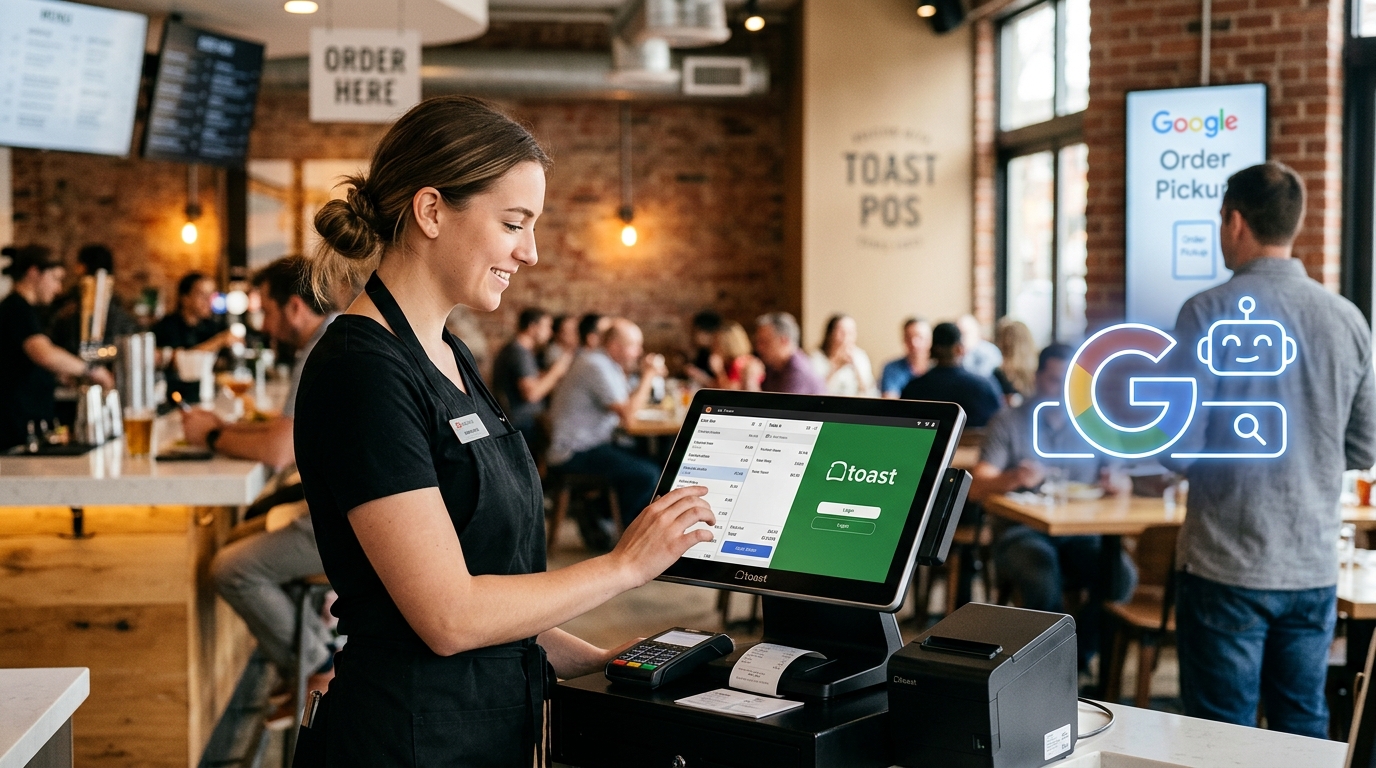
Inside that backdrop, one name deserves close attention this week. Toast (NYSE: TOST) reported its strongest quarter ever on August 4, announced a live AI ordering integration with Google Maps on August 6, and is still trading near $34.50, roughly 47% below its all-time closing high of $65.22 from November 2021. Those three facts are the entire debate in this stock right now.
Market Environment
The Fed held rates steady at 3.50%–3.75% at its July 29 meeting, with three dissenting votes favoring a hike. Fed Chair Kevin Warsh has eliminated forward guidance, so September is live in both directions. Markets currently price in two 25-basis-point hikes in 2026, and the June dot plot lifted the year-end rate projection to a 3.6%–4.1% range. That uncertainty is the single largest macro overhang on growth names, including TOST.
The VIX pulled back last week following the weak payroll print, and the S&P 500 crossed 7,700 for the first time ever on Thursday before extending gains Friday. Sector rotation continues to favor technology and AI-adjacent names. Restaurant technology, specifically the intersection of POS infrastructure and agentic commerce, sits at the center of that rotation in a way it did not a year ago.
The Biggest Opportunity: TOST
Three events landed in five days. Taken separately, any one of them would be worth tracking. Together, they make this the highest-conviction idea in this issue.
Q2 2026 Scoreboard
Reported August 4, after market close:
- Revenue: $1.91 billion, up 23.1% year over year, beating the $1.87 billion consensus by 1.8%
- GAAP EPS: $0.26, beating the $0.20 consensus by 28.2%, nearly double the $0.13 reported a year earlier
- Adjusted EBITDA: $221 million vs. $195 million expected, a 13.3% beat; margin of 37%, up 240 basis points year over year
- GAAP operating income: $152 million, representing a 26% operating margin
- Net income: $154 million, up from $80 million in Q2 2025
- Gross Payment Volume: $60.7 billion, up 22% year over year
- ARR: $2.4 billion, up 25% year over year
- Net new locations: a record 9,500 in the quarter, bringing the total to approximately 180,000, up 22% year over year
- Recurring gross profit streams: up 28% year over year
- Full-year 2026 adjusted EBITDA guidance raised to $805 million–$825 million, from the prior $790 million–$810 million range
- Full-year 2026 recurring gross profit growth guidance raised to 23%–25%
The company also hit what management called the Rule of 50 in Q2, with recurring gross profit growth plus operating margin reaching 57%. Management reiterated a long-term path to $10 billion in ARR and 40%-plus adjusted EBITDA margins.
The stock gained roughly 4.7% on August 5. It is now near $34.50, within its 52-week range of $22.26 to $46.81. The market liked the quarter but has not yet re-rated the company. That gap is the opportunity.
What Toast Actually Is
The company started as a point-of-sale hardware vendor and spent the last five years building something considerably larger. Today the platform combines POS hardware, payment processing, online ordering, kitchen display systems, drive-thru technology, payroll, scheduling, inventory management, food cost analytics via xtraCHEF, catering and events software, guest loyalty tools, and, since October 2025, Toast IQ: a conversational AI assistant built on each operator’s own sales, labor, menu, and operational data. The long-term vision, articulated by CEO Aman Narang on the Q2 call, is an agentic platform that takes on the outsourced work of marketing, payroll, inventory, and bookkeeping for restaurant operators using their own data as context.
The economic model is a hybrid of recurring SaaS subscription fees and a payments take rate on every dollar flowing through its terminals. Total take rate reached 98 basis points in Q2, up 5 basis points year over year. ARR at $2.4 billion and GPV at $60.7 billion are the outputs. Toast earns a clip on every transaction at roughly 180,000 locations, and that clip compounds as the location count rises and as those locations do more volume.
Hardware is sold at near-cost or below to win new customers. It is the strategic loss leader that feeds the recurring engine. The hardware gross profit line is also the line most exposed to the memory chip cost headwind management flagged for the back half of 2026 and into 2027. More on that below.
You’re Being LIED To About The Iran War
Forget EVERYTHING you’ve heard about the Iran war.
Especially the reasons why we’re bombing the country.
The Google Deal: The AI Angle the Market Hasn’t Priced
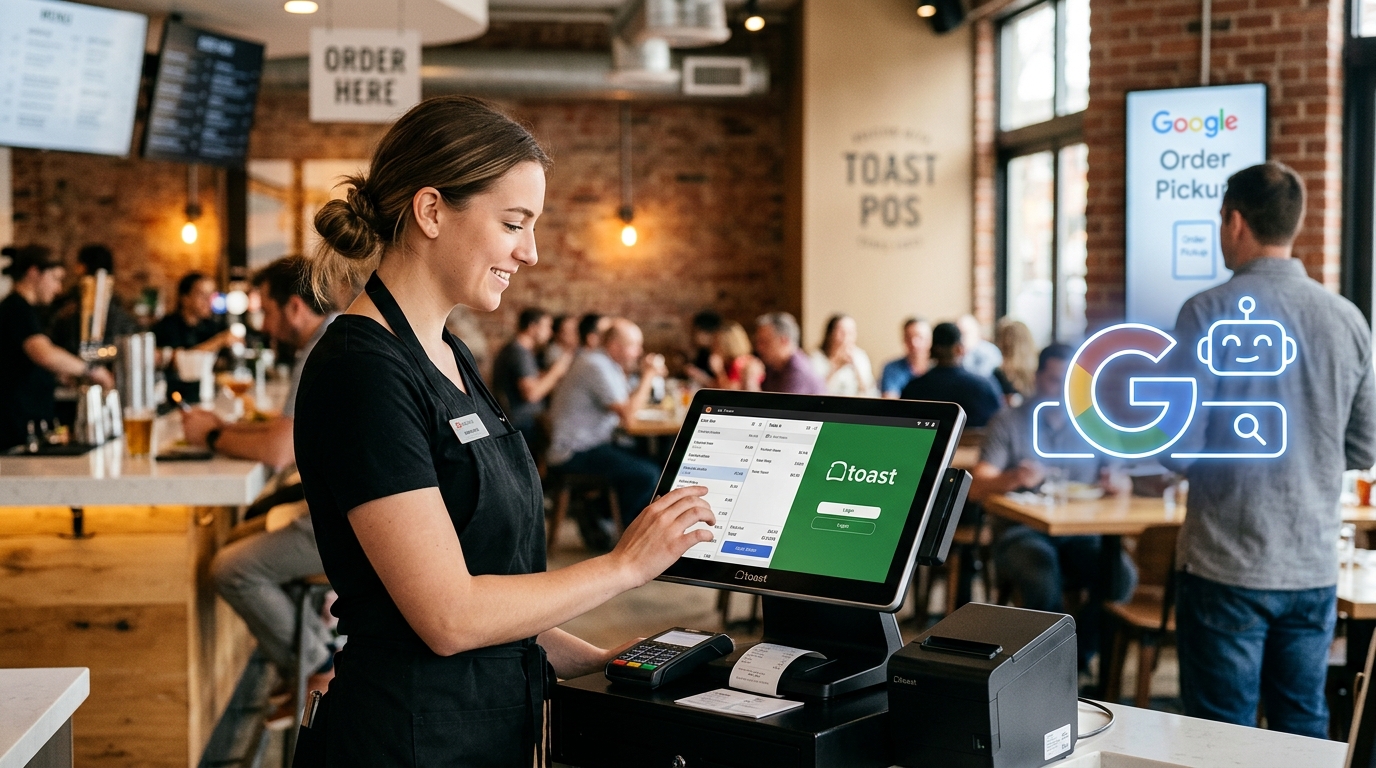
Two days after earnings, on August 6, Toast announced a live expansion of its integration with Google that brings agentic food ordering to Ask Maps, a conversational AI feature inside Google Maps. When a diner asks by voice or text for a restaurant recommendation or a specific dish, Ask Maps can now surface a Toast restaurant’s menu and carry that request through to a completed order, without the customer leaving Google.
The more consequential piece is the protocol layer. Toast is a co-developer of the Universal Commerce Protocol (UCP) for Food, an open standard defining how AI agents discover menus, order, and check out with restaurants across Google Search, Maps, and Gemini. Alongside Block (Square), DoorDash, Google, and Uber Eats, Toast is one of five inaugural members of the UCP Food Tech Council, the body that governs the technical roadmap for agentic local food ordering. Working alongside those partners, Toast is helping shape how the protocol expands, ensuring that restaurants retain control of their menus, pricing, and guest relationships, and that orders flow through first-party systems rather than third-party commission structures.
To seed early adoption, Toast is offering $5 in Toast Cash to guests who place a qualifying order of $30 or more through a Toast restaurant via Ask Maps. That promotion is expected to launch in late August, which is also when the broader Ask Maps integration is set to expand. That is the date to watch.
The UCP itself launched in January 2026 at the National Retail Federation conference, co-developed with Shopify, Etsy, Wayfair, Target, and Walmart, and endorsed by more than 20 partners. By May it had extended to hotel booking and food delivery across additional geographies. Real-world adoption has been slow at the merchant level: a scan of public websites in May found only 26 detectable implementations. The food-specific integration with Toast sidesteps that problem entirely. The integration happens once, at the platform level, reaching roughly 180,000 restaurant locations rather than requiring each operator to implement the protocol independently.
This is not a widget. Toast is helping write the infrastructure rules for how AI agents interact with the food economy at scale. The market has not assigned much value to that yet. That is the asymmetry.
Why the Stock Is Still Cheap Relative to the Business
Two things are holding the valuation back. The first is free cash flow. Q2 free cash flow came in at $130 million, down from $208 million in Q2 2025. Operating cash flow fell to $144 million from $223 million a year earlier. The explanation is deliberate: Toast pulled hardware inventory forward, building a cushion against memory chip cost increases to protect shipment capacity through 2027. CFO Elena Gomez flagged the impact on the Q4 2025 call, and on the Q2 2026 call, management said the hit to the P&L in 2027 will be larger than in 2026 because of inventory accounting. Mitigation actions are already reducing the impact, and management expects hardware margins to structurally improve once the memory market stabilizes.
The free cash flow decline is real. It is also an accounting artifact of a strategic inventory decision, not a deterioration in unit economics. Management expects cash conversion to improve in the back half of 2026. Verify that in the Q3 report, due November 3.
The second issue is spend. Operating expenses, excluding $29 million in bad-debt and credit-related items, rose 19% year over year in Q2. Sales and marketing and R&D are both climbing fast. That is a growth-stage profile, not a mature compounder’s profile, and it limits the valuation multiple the market applies. Neither headwind is permanent. Both are explained.
Sector Rotation: Where Capital Is Moving
The broader rotation this week favored technology and AI infrastructure names. Chip stocks bounced sharply, helping the Nasdaq to a 5.2% weekly gain. Within that, the sub-theme gaining momentum is agentic commerce: companies positioned not just to use AI, but to own the rails through which AI agents execute real-world transactions.
Toast fits that framing precisely. At 180,000 restaurant locations with $60.7 billion in annual GPV flowing through its payment rails, it is one of the few companies that can claim a structural position inside the UCP for Food protocol rather than merely integrating with it after the fact. The institutional investor community has been slow to model this, which is consistent with the pattern when a new commerce layer is being built: the market prices the current multiple, not the future one.
ValueAct Capital raised its TOST stake to 12.9 million shares as of March 31, 2026. ValueAct does not take positions it considers overvalued. Goldman Sachs upgraded TOST to Buy in July. Post-earnings, Wells Fargo raised its target to $40 with an Overweight rating, Bernstein raised its target to $45, Citigroup raised its target to $39 with a Buy rating, and Barclays reaffirmed its Buy. Year-to-date through June 30, the company repurchased 19 million shares for $486 million. That is a management team that believes the stock is cheap.
Stocks on the Radar
Toast (TOST) — the primary idea. Everything above applies. The stock trades near $34.50 against a 52-week high of $46.81 and a consensus analyst price target that was revised higher by multiple firms last week. The next hard catalyst is the Ask Maps promotion launching in late August and the Q3 report due November 3.
Shift4 Payments (FOUR). A payments processor with significant exposure to hospitality and entertainment verticals. Trading near $53 with its own volume-driven take-rate model. Worth watching as a relative-strength comparison to TOST in the restaurant payments space. If TOST re-rates on the Google integration, FOUR may follow on sympathy.
Block (XYZ). Block’s Square is a co-developer of the UCP for Food alongside Toast and also an inaugural Food Tech Council member. At $81, Block carries more complexity given its Bitcoin exposure, but the UCP angle is the same. Useful as a hedge position if you want exposure to the agentic food ordering theme across two rails rather than one.
Key Data
Revenue and growth:
- Q2 2026 revenue: $1.91 billion, up 23.1% year over year
- Q1 2026 revenue: $1.63 billion, up 21.9% year over year
- Full-year 2026 recurring gross profit growth guidance: 23%–25%
- Full-year 2026 adjusted EBITDA guidance midpoint: $815 million
Profitability and margins:
- GAAP operating margin Q2 2026: 26%, up from 5.2% in Q2 2025
- Adjusted EBITDA Q2 2026: $221 million, 37% margin, up 240 basis points year over year
- Q3 2026 guidance: adjusted EBITDA of $210 million–$220 million
- Long-term management target: 40%-plus adjusted EBITDA margin
Capital return:
- 19 million shares repurchased for $486 million year-to-date through June 30, 2026
Platform metrics:
- Total locations: approximately 180,000, up 22% year over year
- ARR: $2.4 billion, up 25% year over year
- GPV: $60.7 billion in Q2 2026, up 22% year over year
- Total take rate: 98 basis points, up 5 basis points year over year
The watch items:
- Free cash flow Q2 2026: $130 million, down from $208 million in Q2 2025, due to hardware inventory buildup
- Memory chip cost headwind: management expects greater P&L impact in 2027 than 2026; mitigation actions underway
- Toast IQ Grow monetization: adopted quickly, but revenue contribution is early-stage
- Insider sales: multiple executive Form 4 filings in early August; not alarming at this level, but worth monitoring
Is It Cheap?
At roughly $34.50, TOST trades at a forward price-to-sales of approximately 2.0 times, compared to the Zacks Internet Software industry average near 3.76 times. The forward price-to-earnings is approximately 22.7 times, with a PEG ratio near 0.70: a level that implies the market is not giving the company full credit for its earnings growth rate.
The honest framing is that TOST is not classically cheap in an absolute sense. It has never been. What the price offers is a business compounding recurring revenue at 25% annually, with expanding EBITDA margins, a $486 million share repurchase program in execution, institutional accumulation from ValueAct, a fresh Buy from Goldman, and now a live role as co-author of the AI commerce protocol for the restaurant industry. All of that is priced at roughly $20 billion in market cap, 47% below the company’s 2021 peak, in the same week the Google integration went live.
Bull, Base, Bear
Bull
The UCP for Food becomes the dominant rail for AI-driven restaurant ordering across Google. Toast’s 180,000 locations sit at the center of that infrastructure from day one. GPV per location stabilizes or rises as ordering volume shifts to AI-surfaced channels. The late-August Ask Maps promotion drives measurable volume. Hotel food-and-beverage expands the total addressable market. EBITDA margins expand toward the 40% long-term target. The stock re-rates toward $50–$60 as the market recognizes this is no longer a POS company.
Base
Location growth holds at 6,000–9,000 per quarter. ARR compounds at 20%–25% annually. Memory chip headwinds persist through 2026 without materially impairing the recurring gross profit trajectory. Agentic ordering through Google delivers modest GPV uplift over 12–18 months. Multiple analyst targets, now clustered near $40–$45, are realized over the next year as the market gets more comfortable with the AI commerce angle.
Bear
Restaurant consumer spending softens as the Fed delivers rate hikes, compressing GPV per location and take-rate economics. Memory chip costs prove worse than management guided. Competitors, including Square, erode Toast’s differentiation inside Google’s ordering surfaces. Sales and R&D investment fails to accelerate ARR meaningfully above 20%. The stock revisits the 52-week low near $22. Three FOMC dissenters voting for a hike at the July meeting is the macro signal to weight in this scenario.
Risk Dashboard
- Federal Reserve, September meeting: Three dissenters voted for a hike in July. A September hike would pressure growth multiples broadly and create a headwind for TOST re-rating.
- Consumer spending: GPV per location has been flat to slightly negative in recent quarters. A meaningful decline in restaurant traffic would compress take-rate revenue directly.
- Memory chip costs: Management confirmed the P&L impact is larger in 2027 than 2026. Hardware margin pressure remains the cleanest near-term earnings risk.
- Ask Maps adoption: The late-August promotion is the first real test of whether agentic ordering drives incremental GPV. Low adoption would weigh on the AI commerce thesis.
- Insider selling: Multiple Form 4 filings from executives in early August. Not a warning sign at current prices, but an acceleration would be.
- Q3 2026 earnings, November 3: Free cash flow recovery is the single most important number. Management guided for improvement. If it does not arrive, the stock faces a re-test of support.
Scorecard: What to Track Weekly
- Location growth rate: Q2 set a record at 9,500 net adds. Below 6,000 in any quarter is a warning signal.
- ARR growth: Currently 25% year over year. Watch for deceleration below 20%.
- Recurring gross profit stream growth: 28% in Q2. The cleanest signal of platform economics.
- EBITDA margin trajectory: Full-year 2026 guidance implies roughly 12% at the revenue level, moving toward 40% over time. Any reversal matters.
- Free cash flow conversion: Q2 fell to $130 million from $208 million. Verify improvement in the November 3 Q3 report.
- GPV per location: Flat to slightly negative recently. A recovery here signals healthier restaurant spending and stronger take-rate economics.
- Ask Maps volume: No hard metric yet. Monitor whether the late-August promotion drives detectable GPV uplift in the Q3 report.
- Hardware margin: The line most exposed to memory chip costs. Watch the hardware and professional services gross profit line each quarter.
Trader’s Action Plan
Three events hit in five days: a record quarter, raised guidance, and a live AI ordering integration with Google that the company co-designed at the protocol level. The stock moved 4.7% and stalled. That is the opportunity.
For traders sizing a position with near-term catalysts in mind, the primary entry range is $33–$35. The Ask Maps promotion expanding in late August is the next binary event. If it shows early traction, the stock likely moves before analysts formally update models, because the GPV data will show up in Toast’s own operator dashboards before it appears in a research note. That is the early read on whether this thesis is working.
For the more aggressive approach, the Google UCP angle is the real bet. Co-authoring the open standard for AI-driven food ordering at 180,000 locations is not a feature; it is a structural position. If agentic commerce becomes a material restaurant ordering channel over 24–36 months, $20 billion is not the right market cap for this business. Full size here, 24-month horizon, stop on a sustained close below $22.
For the conservative approach: a partial position in the $33–$35 range with a plan to add toward $28–$30 if broader market weakness or memory chip fears create a pullback. That range sits closer to the 52-week low and provides meaningful margin of safety on a business that generated $154 million in GAAP net income in a single quarter.
Do not ignore the free cash flow decline. It is real, it is explained, and it needs to reverse by November 3. If it does, one of the two main concerns hanging over this stock disappears. If it does not, revisit the thesis.
Bottom Line
If Toast is a POS company, $34.50 is generous. If it is the infrastructure layer for AI-driven restaurant commerce at 180,000 locations, co-authoring the protocol that defines how AI agents order food across Google Search, Maps, and Gemini, then $34.50 is a meaningful discount to what this business could be worth by 2028.
Q2 supports the second framing. The Google deal, live this week, makes the first framing harder to maintain. The free cash flow headwind and memory chip costs are real, self-described, and time-limited. The stock has fallen 47% from its all-time high while the business compounded recurring revenue at 25%, expanded operating margins from 5.2% to 26%, turned consistently profitable, and just co-launched the agentic commerce layer for the restaurant industry alongside Google.
Watch late August carefully. If Ask Maps moves volume for Toast operators, you will know before Wall Street formally updates its models. That early signal is the tell this thesis is working.