Editor’s Note: Our friend Louis Navellier has been a guest at Mar-a-Lago, President Trump’s private residence in Palm Beach, Florida. He’s one of America’s top tech investors, managing a $1.1 billion portfolio – including $358 million in AI stocks. He called Nvidia before it went up 44,000%. He predicted the dot-com crash and the 2020 Covid rally. And now he’s revealing what he calls the biggest prediction of his 40-year career.
Dear Reader,
Deep in the Appalachian Mountains of Tennessee…
Behind a triple layer of razor wire and a security clearance most Americans will never hold…
Something extraordinary is being built.
You won’t hear about it on CNBC.
The Wall Street Journal hasn’t touched it.
And yet, according to my research, what’s happening inside this facility will trigger one of the most dramatic wealth transfers in American history.
I know this place well.
It’s the same “secret city” that gave America the atom bomb.
The same lab that turned the tide of World War II.
And now – under a directive from President Trump himself – America’s top scientists and engineers have returned to this site for one purpose:
To build a new category of AI computer so powerful…
Trump himself compared it to a Manhattan Project – but for AI.
And I believe – based on months of exhaustive research – this device is going online very soon.
When it does, it won’t just leapfrog ChatGPT, Gemini, and even Elon’s Grok…
It will accelerate AI breakthroughs by 360-fold.
Breakthroughs that used to take five years? They’ll happen in five days.
And that will trigger a $100 trillion reset of the AI markets – the biggest disruption I’ve seen in my 40-year career.
I called Nvidia before it went up 44,000%. Apple before it went up 36,000%. Microsoft before its 60,800% rise.
But nothing in four decades has looked quite like this opportunity.
I’ve prepared a full presentation with the details – including the name and ticker of the one company I believe is best positioned to profit.
Click here to watch it now, free of charge.
Regards,
Louis Navellier
Senior Quantitative Investment Analyst, InvestorPlace
P.S. The “secret city” in Tennessee has been off-limits to the public for decades. But what’s being built there right now is about to become impossible to ignore. When Trump flips the “on switch,” I expect it to trigger a $100 trillion shock to the AI markets. Go here for full details – including the ticker symbol – before this video comes down.
The AfD Keeps Winning in Germany. Here Is What Traders Must Price In.
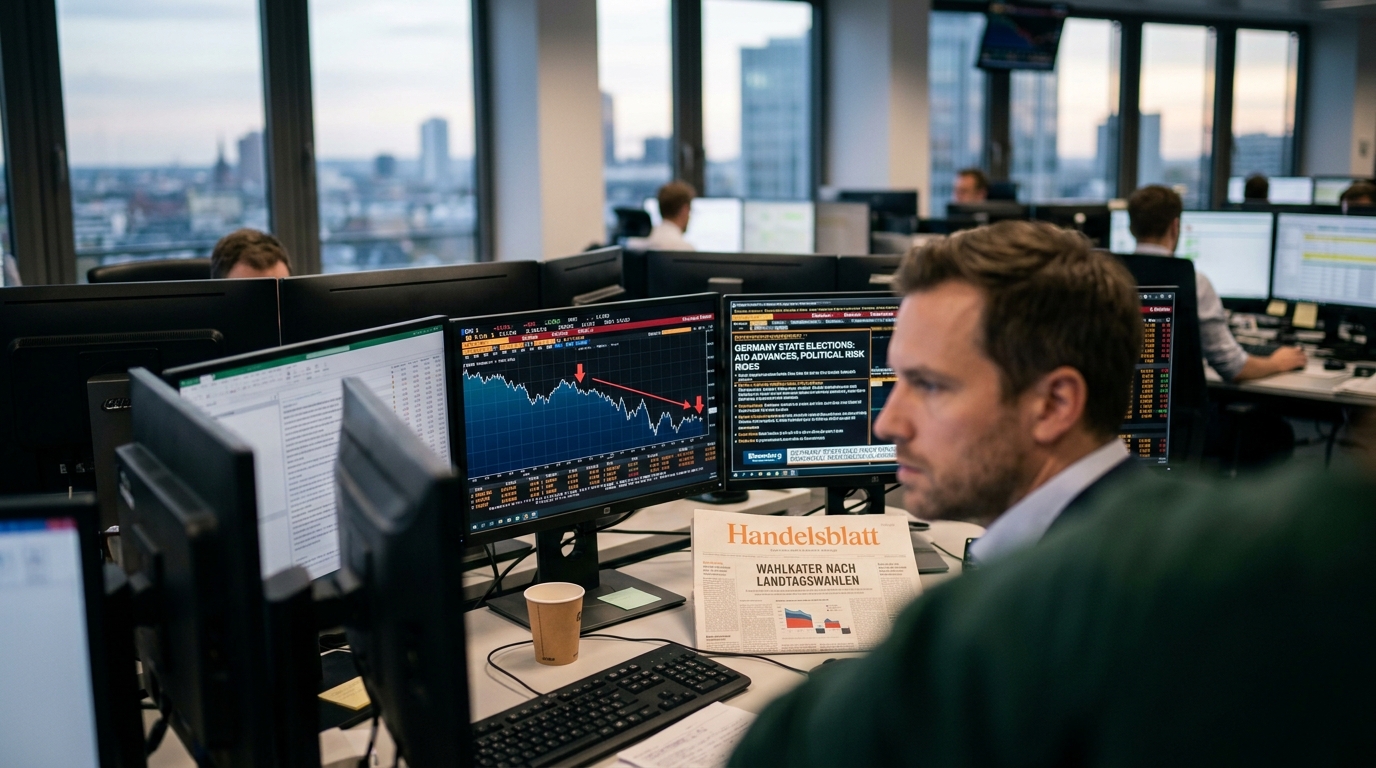
Three state elections in fifteen days. Two AfD victories. And a chancellor describing his own party’s result as a “disaster” on national television. The question for traders opening positions in DAX, EWG, VWAGY, SIEGY, or DBK this week is whether German equities have adequately priced any of it.
The answer, so far, is largely no.
What Sunday Produced
In Mecklenburg-Western Pomerania, the AfD secured its second state victory in just two weeks, earning 38.2 percent of the vote. The SPD came second at 35.5 percent, while Merz’s CDU fell to 4.9 percent, failing to clear the five percent threshold needed to win any seats at all. That would be, as public broadcaster ARD projected Sunday night and multiple German outlets noted, the CDU’s lowest result in any state since World War II.
Berlin delivered a separate blow. Die Linke took first place in the capital with 25.7 percent, comfortably ahead of Merz’s CDU, which finished with 18.8 percent.
Facing calls to resign after Sunday’s defeats, Merz is under pressure to deliver on his promised reforms. He refused Sunday night, vowing to press on. He struck a defiant tone, arguing that Germany’s economic and political problems make difficult reforms more urgent, not less so. Markets will decide whether they believe him.
How Fixed Income Is Responding
The Bund market is the most direct read on political risk. After the Sept. 6 Saxony-Anhalt result, the reaction was almost insultingly calm. Ten-year Bund yields moved higher around that election, even as the AfD won 43.8 percent in Saxony-Anhalt, and the DAX barely blinked.
Sunday’s results are materially worse for CDU credibility, and the fixed income response has sharpened. The ten-year Bund yield jumped in early trading, with the two-year climbing as well, a steepening that reflects investors demanding greater compensation for duration exposure during domestic political instability. German-periphery spread compression is reversing, with institutional portfolios now demanding higher risk premiums for core Eurozone debt as fiscal consensus appears fragile.
The DAX and EWG: Where the Discount Lives
The DAX closed Friday down 1.6 percent at 25,304, with Volkswagen off nearly six percent and Mercedes-Benz down 4.8 percent among the biggest drags. The index enters the week already at its lowest level since late July, and analysts suggest the DAX could stabilize even as political pressure on Merz rises. That stabilization call deserves scrutiny.
The practical problem for bulls is that Merz’s economic credibility is the scaffolding under his reform program, and that scaffolding has cracked. CDU voters have flocked to the AfD, increasingly doubtful the 70-year-old can revive Germany’s economy and bring down the cost of living. A cordon sanitaire has existed within Germany’s political mainstream for years, under which the CDU, SPD, Greens, and Liberals have refused to enter into coalitions with the AfD. If that firewall strains further, coalition arithmetic for any future federal government gets harder, not easier.
For traders, the highest-conviction hedges remain in the autos, which sit at the intersection of German political risk and Chinese competitive pressure. VWAGY has now lost nearly six percent in a single session. A weakened Merz government is less able to negotiate trade relief from Beijing and less able to fund domestic industrial support. German government bond yields were moving higher after Sunday’s results, with the ten-year Bund sensitive to political developments. DBK and other domestic financial names tend to underperform in periods of elevated Bund yield volatility.
Trader’s Action Plan
The base case is that markets absorb this result without a sustained breakdown. The AfD wins state parliaments; it does not govern federally, and the 2029 federal election remains distant. Merz stays. His reform program, however diluted, continues. The DAX holds above 25,000. EWG stabilizes near current levels.
The risk case is more interesting. Delivery on the 500 billion euro infrastructure fund and the 108.2 billion euro 2026 defense budget risks slipping quietly, because slow implementation is a planning problem rather than the kind of headline that moves a bond desk, until suddenly it does. That slow bleed in reform execution is the scenario worth watching, particularly for SIEGY and other industrial names whose earnings assumptions depend on government procurement following through.
Watch the Bund spread to BTPs this week. A meaningful widening beyond 90 basis points signals that this is no longer just a domestic story. At that point, the Stoxx 600 target of 670 requires a discount, and the cheapest hedge is not a put on the DAX but on EWG, where U.S.-listed options carry less embedded volatility than the domestic market currently implies.