Editor’s Note: With the market in turmoil, one of America’s best connected financial insiders (who called the 2000 and 2008 crises) is stepping forward with a warning everyone in our country needs to hear. Click here to get it or read more below.
Dear Reader,
A millionaire Wall Street insider just issued a dramatic new warning – and every American with money in the stock market needs to hear it today.
After running his own $200 million hedge fund firm, this Wall Street legend saw the Twin Towers fall on 9/11… the banks collapse in 2008… and the economy grind to a halt in 2020…
But now, he’s warning:
Whitney Tilson, who famously called the Tech Wreck in 2000, has a long history of eerily accurate predictions – CNBC even gave him a nickname he never asked for: “The Prophet.”
His appearance on 60 Minutes exposing the 2008 financial crisis even won an Emmy.
But he says what’s happening in America today is more dangerous than anything he’s seen before.
He’s warning millions of Americans could soon be blindsided by a permanent change coming to our country, which will be far more wide-reaching than a stock market crash or banking collapse.
Just look at what’s happening inside Gartner. For decades, it’s been at the heart of America’s white-collar economy – full of staff from top-tier Ivy League schools.
It should be one of our country’s most stable firms…
And yet, in the last year, it’s collapsed by more than 60%.
That’s why Tilson says it’s now critical you move your money today – because the next part of this story is going to make America unrecognizable.
In fact, he’s just agreed to reveal exactly where to put your money today – a new investment research vehicle his team spent years developing, ready for this moment.
Get the full details right here, while you still can.
Regards,
Matt Weinschenk
Publisher and Director of Research, Stansberry Research
P.S. Gartner isn’t the only white-collar firm in trouble. The world’s most powerful “knowledge” work firms are getting destroyed. Consulting firms. Insurance analytics. Software stocks.
Morningstar. Duolingo. Verisk. Accenture. They’re all in freefall. Duolingo has already collapsed as much as 75% in a year.
These aren’t just random examples. They’re connected. They’re warning signs. And ignoring them will be catastrophic.
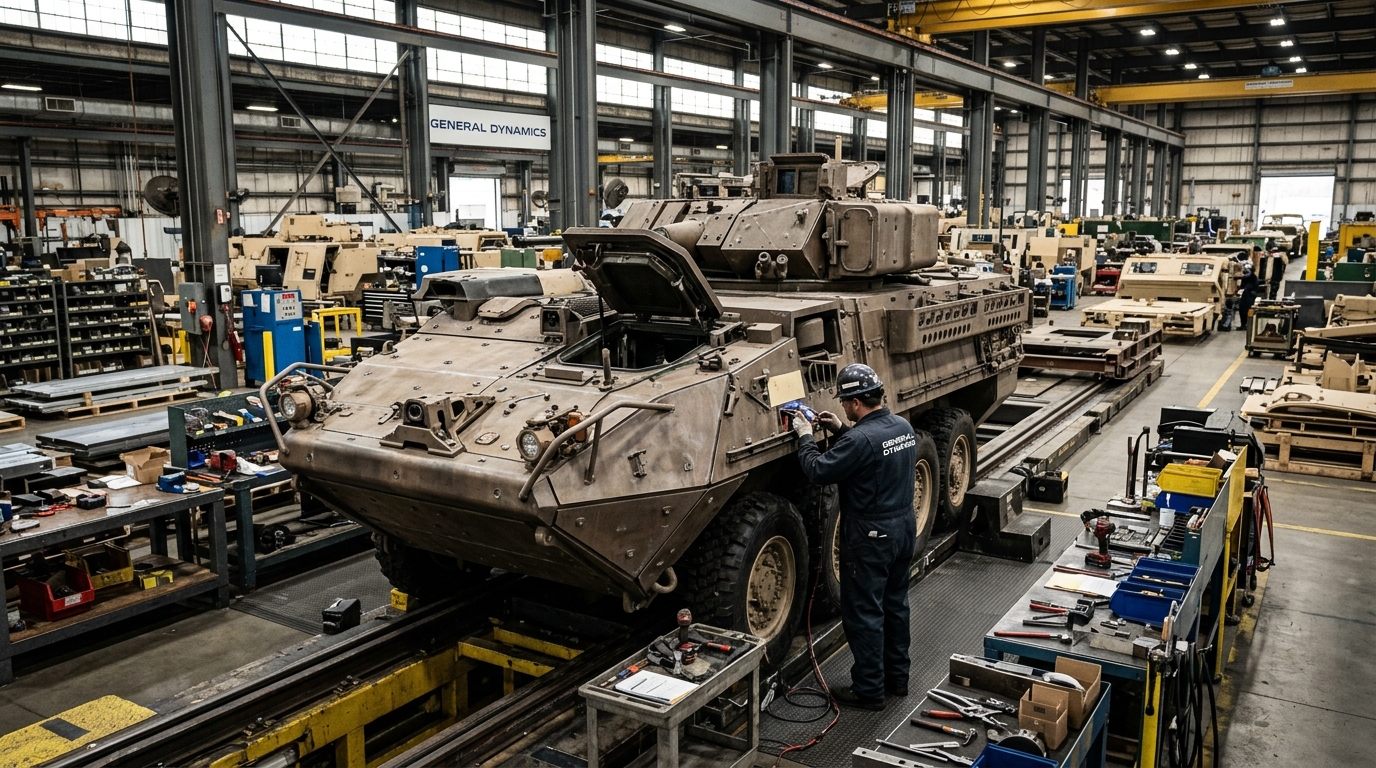
GD’s $136.5B Backlog Is Doing the Work the Stock Is Not
General Dynamics closed at $343.39 on September 22, down 2.97% on the day and sitting roughly 14% below its 52-week high of $400 (set July 29, 2026). The price action looks bearish. The contract book tells a different story.
Total backlog reached $136.5 billion at the end of Q2 2026, a record level representing 32% year-over-year growth. That number is not a projection. It is locked work. Defense segment backlog alone stood at $112.5 billion, with a book-to-bill ratio of 1.4-to-1 in Q2 and 1.8-to-1 across the first half of the year. The company is winning contracts faster than it can execute them, which is precisely the dynamic that protects margins when the broader equity cycle turns defensive.
The margin trajectory backs that up. Revenue rose 8.1% year over year in Q2, operating earnings climbed 11.9%, and the operating margin expanded 40 basis points to 10.4%. That expansion is coming from two specific divisions. Aerospace operating earnings hit $510 million, a 26.6% increase driven by a 130-basis-point improvement in operating margin. Marine Systems revenue reached $4.7 billion, up 10.4% year over year, led by volume on the Columbia and Virginia-class submarine programs.
The submarine work is the structural anchor. In May 2026, General Dynamics Electric Boat was awarded a contract modification not to exceed $2.30553 billion for Virginia-class Block VI submarines, covering long-lead materials and initial manufacturing activities ahead of full construction slated for completion by September 2035. That is nine years of revenue visibility embedded in a single contract. Earlier this year, the Navy’s larger Block VI/Columbia award was announced on July 29, 2026, as part of a $76.6 billion package spanning both the Virginia-class Block VI and Columbia-class programs. Combined, these programs lock in production demand that no late-cycle equity rotation can touch.
The Gulfstream business adds a different layer of resilience. The Aerospace segment ended Q2 with a roughly $24.0 billion backlog, with orders reflecting very strong demand and a book-to-bill ratio of 1.5-to-1 in the quarter alone. Business jet demand is not immune to a slowdown, but a backlog that size absorbs several quarters of softening before revenue takes a real hit.
The current dislocation between the stock price and the contract book creates a specific opportunity. As of mid-September, the average analyst price target stands at $422.30, while the shares trade near $344. Full-year 2026 EPS guidance is set at $16.80 to $16.90, raised from prior estimates after two consecutive quarters of beats. Q3 results are due in late October; that is the next catalyst.
The risk is not the backlog. Single-source suppliers, seasonally lighter second-half cash flow due to higher capital expenditures, pension contributions, and back-half tax payments are the documented risks management flagged. None of those change the multi-year earnings trajectory. Traders who can look past six weeks of sector-wide pressure have a structurally defined entry here.