
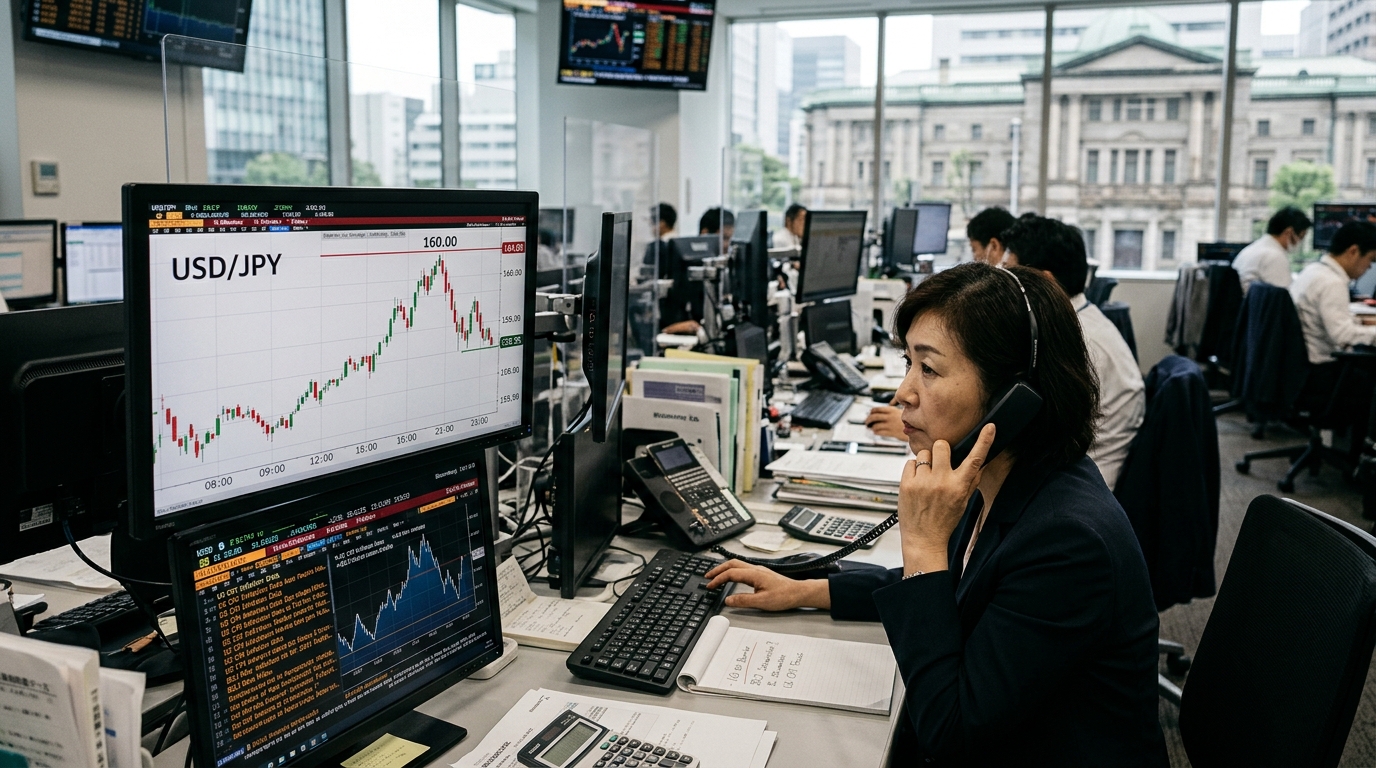
USD/JPY is trading near 158.95 this morning, having retreated from the 160.00 level that Tokyo has now defended twice this year. The pullback is not driven by optimism about Japan’s economy. It is driven by fear of what happens if the pair gets there again.
The yen edges higher as traders remain on high alert, recalling the joint US-Japan currency intervention executed in July and August. That precedent is real. Japan spent 11.73 trillion yen in late April and May and about 15.4 trillion yen in July and August defending the currency this year. At 160, the Ministry of Finance has a track record, and the market knows it.
What Adachi Said This Morning
Reuters published comments today from former central bank policymaker Seiji Adachi, who said the Bank of Japan will likely raise interest rates several more times to fight inflation, but its rate-hike plans may face political headwinds next year due to weak consumption. The numbers he attached to that view are significant. Adachi projected the policy rate will rise to 1.5% from 1.25% in December or January, with further increases to 1.75% or 2.0% next year to guard against inflation overshooting the BOJ’s 2% target.
That framing matters. Adachi is not calling for one more hike and a pause. He is describing a tightening cycle with real distance left to run. With stubbornly high energy costs and rising import prices from a weak yen adding to inflationary pressures, the BOJ raised its policy rate to 1.25% in September after delivering a hike in June, a shorter interval than the roughly twice-a-year hikes seen in 2024 and 2025. The acceleration itself is the signal.
A majority of analysts polled by Reuters expect the BOJ to raise rates in December and follow up with another hike by end-March, with many seeing the terminal rate at around 1.75% or 2.0%. In a November 11-18 survey, 86% of economists, 61 of 71, expected the central bank to raise the overnight call rate by 25 basis points to 1.50% at its December 17-18 meeting, which would be the first time in 37 years the bank raised rates three times in one calendar year.
The Complication Traders Cannot Ignore
The bullish BOJ case has a hole in it. Adachi warned that weakening consumption could make steady rate hikes harder to justify and prompt Prime Minister Sanae Takaichi’s administration and its reflationist aides to push back. A board reshuffle next year gives Takaichi an opportunity to replace two departing hawks with her preferred candidates, which may also reshape the debate over the terminal rate.
The BOJ is not the only central bank where political and positioning dynamics are distorting the rate signal. Extreme speculative short positioning in the euro has created a parallel setup where a central bank surprise could trigger a violent unwind.
BOJ staff estimates put Japan’s nominal neutral rate in a range of 1.1% to 2.5%, but the board has no consensus on where within that band the neutral rate lies. That ambiguity is the reason 160 keeps coming back into play. When the BOJ signals without committing, yen bears fill the vacuum.
Wednesday’s PCE Is the Swing Factor
Core PCE is forecast at 3.2% year-on-year versus 3.1% previously, a stronger reading could reinforce expectations for tighter Fed policy. That is the scenario where USD/JPY recovers toward resistance and intervention risk spikes again. The main risk to any bearish USD/JPY view remains a strong US PCE report, which could revive expectations of a more hawkish Federal Reserve and support the dollar.
The asymmetry here skews toward caution on USD/JPY longs. If the PCE reading comes in hot and USD/JPY runs at 160.00, intervention risk rises sharply, making it dangerous to chase longs at 159.50-160.00. On the other side, a cool PCE reading extends the correction, with a potential downside target near 158.24 if the pair breaks below 158.80.
The trade is not to be long or short JPY directionally into Wednesday. It is to understand that 160.00 is not a level the market trades through cleanly. Tokyo has demonstrated that twice this year at considerable cost. With a former BOJ insider now talking about 2% as a destination, the yen’s floor is firmer than the spot rate near 158.95 suggests. But the ceiling at 160 is where real risk concentrates. Position accordingly before the data lands.