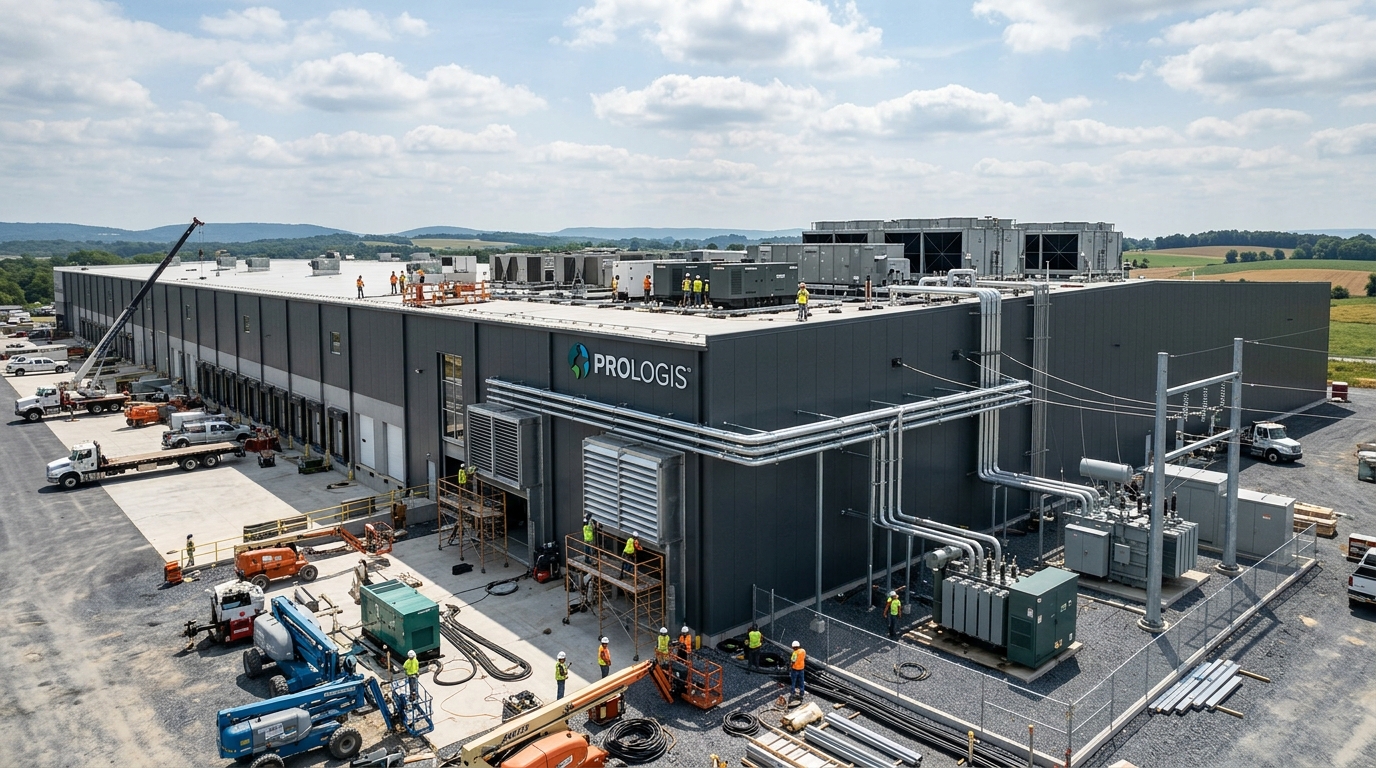
The building at 2500 Liberty Drive in Allen Township, Pennsylvania tells the story plainly. The 1-million-square-foot warehouse will be used as a data center, after the Allen Township Board of Supervisors unanimously approved amended land development plans to convert the facility. It was completed as a logistics hub in 2023. By mid-2026 it was headed in an entirely different direction.
This is not a one-off pivot. It is a capital allocation thesis playing out across millions of square feet of industrial real estate, and the investment case behind it is more compelling than most logistics-focused investors have priced in.
The Conversion Math
Data center projects are more capital-intensive than warehouses, but development yields are also higher. Prologis has said it targets 7.5% to 10% yields on data center developments, versus mid-single-digit stabilized cap rates on its operating portfolio.
Converting a warehouse or industrial building into a data center is often described as modestly cheaper than greenfield, but the real advantage is speed. In 2026, time to power is worth more than the construction delta. Cushman & Wakefield’s 2026 development cost guide says critical equipment lead times, rising wages, and material cost inflation have pushed development costs up 21% per MW since the prior edition in late 2024. A landlord who already holds the entitlements, the slab, and the utility relationship is starting from a fundamentally different position than a greenfield developer.
Prologis and the Hidden Asset
Best known as a logistics REIT, Prologis is increasingly positioning itself as an AI infrastructure play, with years of assembling land and power near major population centers now paying off as hyperscalers race to build data centers.
As of Q2 2026, Prologis reported a 5.8-gigawatt data center power pipeline. The company has described that pipeline as 1.6 gigawatts of secured power and 4.2 gigawatts in advanced stages of procurement. The company has also framed its long-term ambition as building about 10 gigawatts of data center capacity over roughly the next decade, with management describing a potential $30 billion to $50 billion of investment tied to that scale.
Prologis leadership has pointed to the company’s roughly 5,500-plus buildings and 12,000-plus acres of land globally as a sourcing advantage for identifying higher-value conversion opportunities. In 2026 guidance commentary, management has also said it expects data centers to make up about 40% of its owned-and-managed development starts value for the year.
The Hidden Pressure Point
The second-order story is land value. In Northern Virginia, Amazon paid $427 million for a roughly 122-acre campus in Loudoun County in 2026, while Starwood Capital agreed to pay $166.8 million for about 42 acres of county-owned land in Fairfax County, a county-record deal at about $4 million per acre. Powered land commands significantly higher prices than non-powered land, with regional variability shaping the tradeoff between certainty and upside. A warehouse landlord sitting on a site with existing utility relationships and entitlements holds an asset that many data center developers would pay a substantial premium to acquire rather than build from scratch.
Prologis has repeatedly emphasized that power availability remains a key constraint in data center development, and that securing capacity represents a meaningful competitive advantage.
What the Market Is Missing
Data center component suppliers are absorbing standard warehouse space to regionalize distribution, a structural tailwind directly benefiting the core logistics business alongside the conversion strategy. The warehouse-to-data-center trade is not cannibalizing Prologis’s logistics revenue. It is running in parallel with it.
Local municipality pushback on zoning and power usage for hyperscale projects remains a tangible risk to capitalizing this multibillion-dollar pipeline. Allen Township’s vote was unanimous. Not every jurisdiction will be. Permitting friction and utility queue backlogs are the variables most likely to compress the timeline between pipeline and revenue, and they deserve closer attention than the gigawatt headline numbers suggest.