
September 27, 2026
Bonus Content: One Cloud Goes Down. Every Bank Follows. Regulators Are Done Waiting.

America’s Emergency Oil Reserve Just Hit A 44 Year Low
It is 40.6% full. Here is why that reaches your grocery bill and your retirement account.
284.6M
BARRELS REMAINING
Week ending September 18, 2026. EIA Weekly Petroleum Status Report, released September 21.
The Strategic Petroleum Reserve is the country’s emergency crude stockpile. Its job is to soak up a supply shock before that shock reaches the price you pay.
Federal data now puts it at 289.7 million barrels, roughly 40.6% of its 714 million barrel authorized capacity. That is the lowest level since 1982.
The short version of how it got there:
✔ Before February 28 of this year, the reserve held roughly 415 million barrels.
✔ After the Strait of Hormuz was disrupted, a chokepoint carrying close to 20% of global oil supply, President Trump authorized a 172 million barrel release in March.
✔ That release was part of a coordinated international effort, with IEA member nations collectively committing 400 million barrels. Reported as the largest emergency stock mobilization the agency has ever run.
✔ The reserve has kept draining since. It fell another 3.7 million barrels in the most recent reported week alone.
One analyst note circulated by CNBC put it bluntly, calling this another inflation impulse and saying the country effectively has no strategic reserve left to speak of.
That’s rhetoric. 289.7 million barrels is still a real stockpile, and it sits above the statutory minimum of 252.4 million barrels set under the Energy Policy and Conservation Act. Anyone telling you the tank is empty is overselling it.
But the cushion is thinner than it has been in more than four decades, and thin cushions matter for one reason.
Energy feeds into nearly everything you buy, from groceries and freight to utilities and building materials. When oil moves and there’s less reserve on hand to blunt it, more of that move ends up on the shelf. Gasoline has been running around $4.08 a gallon in recent reporting.
Inflation doesn’t arrive as an event. It works as a slow subtraction from every dollar you’ve already put away.
A retirement account does not need a crash to lose ground. It only needs prices to keep rising faster than the account grows.
This is the kind of stretch gold has historically been held for. It promises nothing about returns. It’s savings held outside the currency and outside the paper system.
Central banks seem to think so too. The World Gold Council reported they bought a net 288.9 tonnes of gold in the second quarter of this year, up 62% from a year earlier.
The tax code allows eligible IRA, 401(k), TSP, and 403(b) savings to be diversified into physical gold and silver through a properly structured self directed IRA, generally without triggering a taxable distribution when the transfer is handled correctly.
Send me the FREE Precious Metals Retirement Guide

Inside your free guide:
✔ How energy shocks have historically fed into consumer inflation, and how quickly.
✔ How gold has behaved during past inflationary stretches.
✔ How a Gold IRA generally works, and how you may be eligible to move a portion of an existing IRA, 401(k), TSP, or 403(b) into physical metals.
✔ How physical metals can help diversify savings outside the paper system.
✔ A simple, conservative way to get started.
Or call 1-888-691-8238 to speak with a precious metals specialist.
The reserve was the cushion. There’s a lot less of it now.
One Cloud Goes Down. Every Bank Follows. Regulators Are Done Waiting.
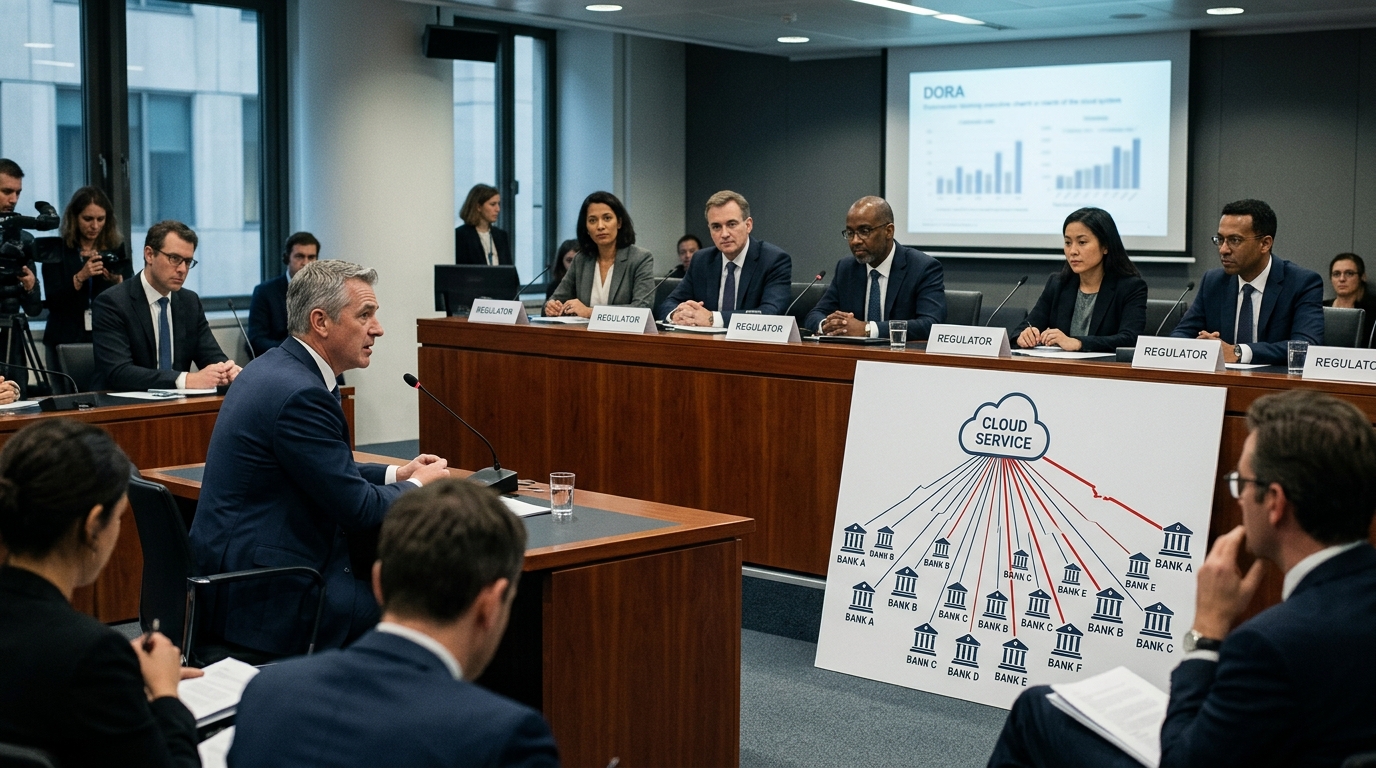
The argument for keeping all your banking infrastructure with a single hyperscaler used to be simple: cost, speed, simplicity. That argument is collapsing under the weight of the incident log.
Between August 2024 and August 2025, AWS, Azure, and Google Cloud together experienced more than 100 service outages. The October 2025 AWS event was the one that moved regulators from concerned to interventionist. That outage generated more than 17 million Downdetector reports and lasted more than 15 hours, with cascading failures that swept across Snapchat and thousands of enterprise services.
For financial institutions, the damage was direct. Banking apps, enterprise SaaS platforms, and fintech services that depended on AWS infrastructure experienced degradation, timeouts, and authentication failures.
That is the event regulators had been waiting to cite. DORA transforms cloud outages from third-party problems into your problems. It is no longer enough to secure your own perimeter. Financial institutions are now operationally responsible for managing the resilience risks of their critical vendors, from cloud infrastructure providers like AWS and Azure to platform dependencies. If your cloud provider experiences an outage, your firm faces potential regulatory consequences unless you can demonstrate a credible contingency plan.
DORA did not enter active enforcement in 2026. It became applicable on January 17, 2025, and supervisory scrutiny has been ramping since then. National Competent Authorities across EU member states are conducting active supervisory reviews, and enforcement tools are available.
The ESAs moved quickly after the October 2025 incident. In November 2025, the ESAs published their first list of 19 designated Critical ICT Third-Party Providers, including Amazon Web Services, Google Cloud, Microsoft, Oracle, SAP, and Deutsche Telekom. These providers are now subject to direct EU oversight under DORA’s oversight framework, including requests for information and the ability to conduct inspections. Financial institutions that depend on these providers must demonstrate they have assessed and mitigated the concentration risk arising from those dependencies.
The contract obligations are specific. Article 28 requires entities to assess concentration risk and ensure they can exit a provider without undue disruption. Article 30 requires the contract to include exit and transition provisions for critical-function arrangements. Supervisors are probing exit clauses that exist on paper but could not survive execution. Regulators now expect data-driven evidence of resilience. Policy documentation alone is not accepted as evidence of compliance.
The structural problem for traders watching bank stocks is cost. Smaller depository institutions face severe structural disadvantages when negotiating with dominant cloud providers. A community bank managing $800 million in assets completely lacks the financial leverage to demand customized contractual terms or independent security audits from a multi-billion-dollar hyperscaler. Running workloads across two or more independent cloud environments means duplicated licensing, duplicated engineering teams, and duplicated compliance overhead.
Forrester predicts at least two major multi-day hyperscaler outages will hit in 2026 as AWS, Azure, and Google Cloud prioritize AI infrastructure upgrades over aging legacy systems. Every outage adds another data point to the regulatory file. The banks that have already split their critical workloads across independent networks will absorb the next incident. The ones still negotiating their exit plans will answer for it.