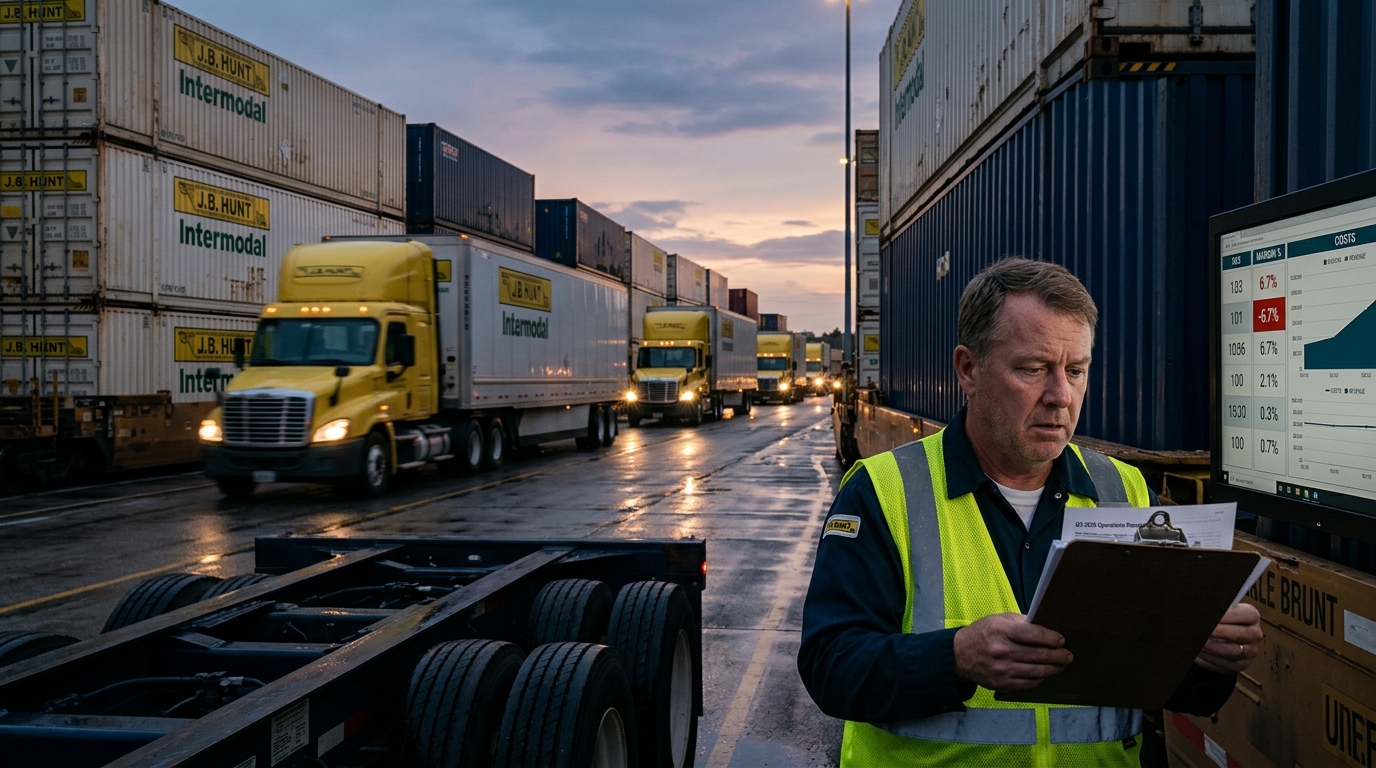
Here is the number freight investors should be staring at this morning: 20 versus 2. J.B. Hunt posted total operating revenue of $3.68 billion in the third quarter of 2026, up 20% from a year earlier, while operating income rose just 2%, to $247.1 million. A business generating that kind of volume growth and converting almost none of it to incremental profit has a pricing problem, not a demand problem.
Revenue growth of 20% was flattered by fuel surcharge revenue, which swelled to $670.8 million from $385.6 million a year ago. Strip that out and operating revenue rose 13%. Still healthy. Still not the headline. The headline is that operating margin came in at 6.7% of gross revenue, down from 7.9% in the prior-year period.
What the Quarter Actually Shows
Key cost headwinds included driver-related investments, volatile fuel prices, and higher claims and medical costs, which impacted operating income by over $50 million. That sequential drag explains why operating income fell 5% from Q2 even as year-over-year revenue roared higher. Driver-related investments accounted for slightly more than half of those headwinds, while claims and medical costs added more than $16 million, concentrated in September.
Intermodal is where the real story lives. Segment revenue rose 20% to $1.83 billion and operating income climbed 18% to $147.5 million, with volumes up 8% overall. That sounds better, and it is, but the intermodal segment is also where the pricing gap sits. Segment gross revenue growth of 20% reflected an 11% increase in gross revenue per load, largely from higher fuel surcharge revenue and mix changes. Revenue per load excluding fuel surcharge increased only 2% year over year. Volume is moving. Underlying price is not moving fast enough.
Dedicated contract services revenue rose 11% to $960 million, but operating income fell 22% to $81.7 million on driver pay, medical claims, insurance, and new-business onboarding costs. That is a segment supposed to deliver steady, contractual earnings. A 22% drop in operating income on an 11% revenue gain is the kind of result that will keep CFO Brad Delco busy well into 2027.
The One Catalyst That Changes Everything
Management opened the earnings call by noting that the 2027 intermodal bid season has already started. While the volume of activity remains relatively small this early in the season, Darren Field, president of Intermodal, said the early results on the oldest rates in the system were encouraging. He framed the 2027 season explicitly as an effort to repair margins after four challenging years of freight recession and inflationary cost pressure.
The mechanics matter here. Field said J.B. Hunt typically implements new pricing on about 10% of intermodal volume in the fourth quarter and roughly 30% in each of the first three quarters of the following year. He said the company is seeking larger increases than in prior pricing cycles to offset inflation and improve margins. That schedule means the bulk of any pricing win will not show up in earnings until mid-2027 at the earliest.
The spread between truckload and intermodal pricing is unusually wide. In eastern markets, where the historical gap runs roughly 10% to 15%, Delco estimated the current difference is above 30%. That asymmetry is the bull case in one sentence: intermodal is deeply underpriced relative to the truck alternative, and customers who cannot find drivers know it.
What the C.H. Robinson Deal Adds
J.B. Hunt’s results arrive as the brokerage sector is consolidating around it. C.H. Robinson and RXO announced on October 5 that they have entered a definitive merger agreement under which Robinson will acquire RXO in a stock-and-cash transaction valued at roughly $5.8 billion, creating a combined company with an enterprise value above $25 billion. Robinson has said it intends to target $300 million in cost savings within two years. A larger, leaner brokerage rival sharpens the urgency of J.B. Hunt’s own margin repair: asset-light brokers are getting more efficient while JBHT’s asset-heavy intermodal network still needs pricing to catch up to its cost base.
Bull and Bear
The bull case rests on the pricing lag closing. Intermodal pricing historically lags truckload pricing by two to three quarters, and truckload rates have been rising for most of 2026. If that lag resolves in Hunt’s favor through 2027 bid negotiations, the earnings leverage on an already-built cost structure could be considerable. Field said he believes the company can achieve its margin target coming out of next year, citing the current environment as providing the opportunity to do so.
The bear case is simpler. Insurance and medical claims have now pressured results across multiple segments, and there is no guarantee customers accept the larger rate increases management is seeking. The 2026 bid season delivered only low-single-digit pricing increases across the overall network. Asking for more in 2027 requires shippers to agree that their alternatives are worse.
What to Watch
Three things will determine whether this thesis holds. First, the pace of intermodal contract renewals through Q1 2027, when roughly 30% of the book reprices. Second, whether driver-related costs stabilize or keep climbing as drayage capacity stays tight. Third, the early pricing signals from Q4’s bid activity. Margin repair is the company’s stated leading priority entering 2027, though management acknowledged that intermodal repricing will phase in gradually through the bid cycle. Gradual is the word investors should hold onto. This story does not resolve in a single quarter.