For years, the luxury sector’s defense against every bearish argument came down to one name: Hermès. LVMH stumbled, Kering cratered, Burberry turned into a restructuring story. But Hermès kept growing, kept expanding margins, kept making the bears look wrong. That logic held a premium valuation together. On Thursday, it cracked.
Hermès posted slightly weaker third-quarter revenues than analysts expected as sales in its ready-to-wear and accessories division turned negative for the first time in years, a result that lands with more weight than the headline number alone suggests. Revenue rose 4.3% at constant currency to €4.1 billion, below the 5.2% growth expected by analysts polled by Visible Alpha. It was the weakest quarterly growth rate since early 2020, when Hermès had to shut down boutiques globally due to the pandemic.
Why This Quarter Is Different
Ready-to-wear and accessories, which account for over a quarter of quarterly sales, declined 2% from a year earlier. CFO Eric du Halgouet said the contraction was chiefly due to sluggish Chinese demand for high-volume accessories, while the division kept growing in every other region. That framing is important: China is not a peripheral problem for Hermès. Du Halgouet told journalists that the Chinese market, Hermès’ single largest, was “very difficult.”
Du Halgouet elaborated on the call that the softer demand was showing up in “volume” categories such as fashion accessories, and also watches and shoes. Watches were the weakest category of all, falling 6% in the quarter. Leather goods held up: that division grew 10.8% at constant exchange rates, and management sounded relatively confident about the Americas, where the region rose 13% at constant exchange rates, with Japan up about 11% and Europe excluding France up 9% over the first nine months.
The Thesis Under Pressure
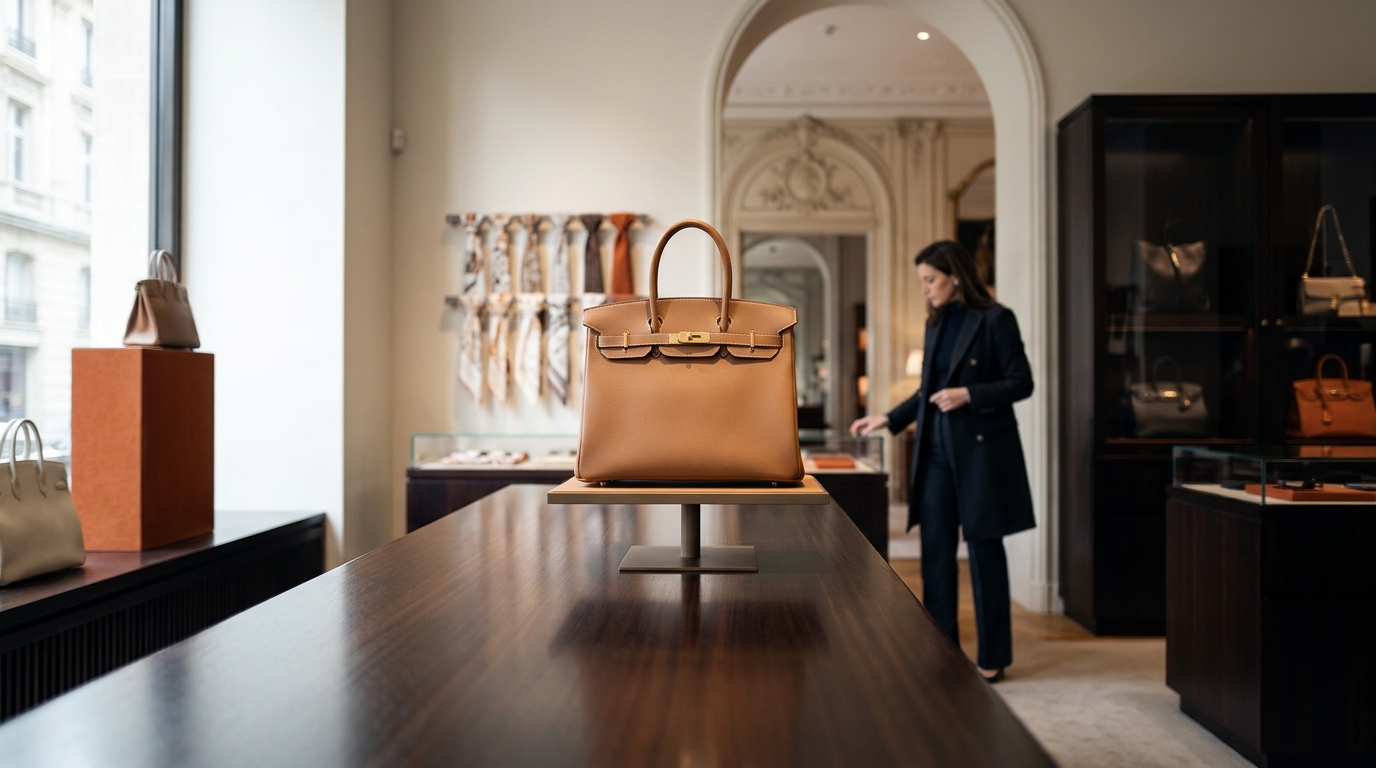
The investment case for Hermès has always rested on two pillars: exceptional brand scarcity and near-immunity to macro cycles. Both are now under serious scrutiny. The Birkin resale premium has already fallen from roughly 2.6 times retail at its 2022 peak to about 1.7 times in the third quarter, according to Bernstein. UBS recently downgraded Hermès to “sell,” warning that rising secondary-market supply of Birkins and Kellys could weaken the scarcity-based business model.
Hermès’ miss, which follows LVMH’s downbeat quarterly update earlier this month, looked likely to further unsettle investors about the company’s resilience in the face of a wider luxury sector slowdown. The shares fell sharply on the Paris exchange, down about 5% in early trade. That comes on top of a brutal year: Hermès has been among the sector’s notable laggards in 2026 as luxury demand weakened, particularly with China in focus.
Bull Case and Bear Case
The bull case is not gone. Leather goods drove the French house forward, and management reiterated its medium-term goal for revenue growth at constant exchange rates despite the deteriorating macroeconomic and geopolitical environment. Last year, Hermès posted a recurring operating margin of 41%. That structural superiority does not vanish in one quarter.
The bear case is harder to dismiss now. Hermès has traded at a hefty premium to its peers for years, and when sentiment sours across a sector, the priciest stocks often have the furthest to fall. A stock built on the premise that it never misses has now missed, in the category, China, and growth rate that investors most closely watched.
What to Watch Next
Three things will determine whether this quarter is a blip or the beginning of a rerating. First, Chinese consumer demand into the fourth quarter, specifically whether the “volume” categories du Halgouet flagged continue contracting or stabilize. Second, Birkin resale premiums: if they keep falling, the scarcity argument weakens further and the case for a premium multiple over peers weakens with it. Third, whether the ready-to-wear and accessories division stabilizes after the China-driven softness that management emphasized on the call.
The leather goods business remains the strongest in global luxury. But Hermès was not priced as a leather goods company. It was priced as an untouchable. Thursday’s numbers say it is not.