
October 26, 2026
T 401(k) is a promise
Bonus Content: Japan’s Yen Is at 157. BOJ Meets Oct. 29-30. Here Is the Trade.

Patriots’ Most Trusted Gold Company
Everything in Your 401(k) Is Somebody Else’s Promise.
For U.S. savers age 55+ with $50,000 or more in an IRA, 401(k) or savings. Free of charge, no obligation to buy anything.
Open your retirement statement and read it as a list of promises rather than a list of assets. The shift is uncomfortable, and it is accurate.
Every line is somebody else’s obligation
A stock is a claim on a company’s future. A bond is a promise from a borrower. Cash in the account is a liability of a bank. An annuity is a contract with an insurer. A fund share is a claim on a sponsor who holds claims on other people. At every level, somebody else has to perform.
In normal years that is invisible and nobody should lose sleep over it. In 2008 it was not invisible. Firms that had stood for a century needed rescuing in a weekend, and holders of paper spent that weekend finding out exactly whose promise they were relying on.
Physical gold is the exception in a retirement account. There is no issuer behind it and no earnings to miss. Inside a self-directed IRA the metal is titled to your account and held in an IRS-approved depository, insured and audited.2 It is not a position on a screen that references something elsewhere. It is a specific quantity of metal, allocated to you.
It also behaves differently from the rest of the statement, which is the point of holding any of it. Central banks have been adding more than a thousand tons a year1 – institutions with every tool of modern finance available to them, choosing the one asset that predates all of it.
Nobody sensible puts everything in metal. The question worth answering is whether 100% of your retirement should depend on counterparties performing. The free 2026 Gold IRA Guide walks through exactly how a rollover from an IRA, 401(k) or TSP works, which metals the IRS allows, how insured depository storage works, and the mistakes that cost retirees the most. It is free and it takes about thirty seconds to request.
Claim Your Free 2026 Gold IRA Guide →


Rock legend Ted Nugent and former White House Press Secretary Sean Spicer are official endorsers and clients of Bishop Gold Group. 10 years in business – 5-star rated on Trustpilot and Google – Mint Authorized Dealer
Prefer to speak to someone? U.S. – based specialists, no pressure, no jargon.
Mon-Fri – 7am-5pm PT
Sources
1 World Gold Council, Gold Demand Trends, annual central bank net purchases 2022-2024.
2 Self-directed IRA holdings are administered by an independent third-party custodian and stored at an IRS-approved depository; custody, insurance and audit arrangements vary by depository and fees apply.
Past performance is not a guarantee of future results. Precious metals are volatile and can decline in value. Figures here are historical and are not a prediction or a recommendation to buy or sell any asset.
Japan’s Yen Is at 157. BOJ Meets Oct. 29-30. Here Is the Trade.
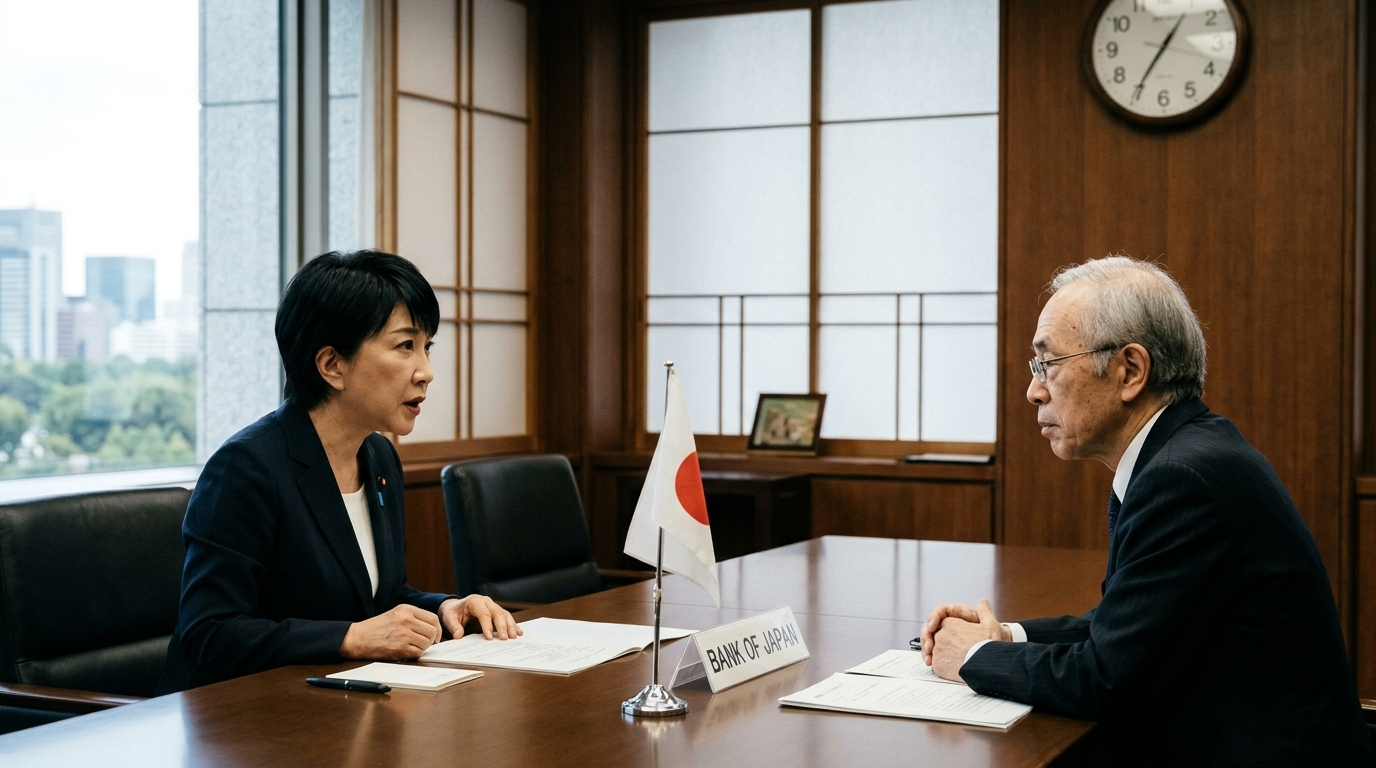
The yen is sitting at roughly 157 to the dollar this morning. The Bank of Japan decides Thursday and Friday, Oct. 29-30. And Prime Minister Sanae Takaichi has publicly leaned on Governor Kazuo Ueda to increase government bond purchases, a move that puts the two on a collision course just as yield and currency levels make the stakes unusually high.
Takaichi reportedly urged the BOJ to increase government bond purchases to contain long-term interest rates, exposing a widening policy divide between the prime minister and Governor Ueda. The BOJ has raised interest rates multiple times since Takaichi took office and has continued reducing its bond purchases. She wants the exact opposite: more buying, capped long yields, easier conditions for her fiscal agenda.
The fiscal pressure is real. Japan’s government has rebooted a DOGE-style spending review targeting 201 special-purpose funds holding around ¥7 trillion, with proceeds aimed at funding a food consumption tax cut from April 2027 alongside defence and industrial policy demands. Record budget requests of ¥143 trillion underline how wide the funding gap is. The spending review is partly a message to bond investors: concern over how Takaichi’s pledges will be funded has pushed 10-year JGB yields to multi-decade highs.
The 10-year JGB yield is sitting just under 3%. That is a world away from the near-zero rates Japan lived with for a generation. The 30-year JGB hit 4.235% on Oct. 6. These are not marginal moves. Japan’s 10-year yield has moved sharply higher during Takaichi’s first year in office.
Now consider what the BOJ actually does this week. The BOJ is widely expected to keep its policy rate at 1.25% at its Oct. 29-30 meeting, after hiking from 1% in a 7-2 vote in September. A hold is the base case. But a hawkish framing that keeps a December move in play would change the currency calculus fast.
That framing matters enormously for the yen. With a hold widely expected, yen and JGB moves are likely to hinge on the vote and Ueda’s guidance. Hawkish dissent from board members, or language pointing toward the next meeting, would probably bring December pricing forward and offer the yen some support. A unanimous hold paired with cautious messaging could see hike expectations drift later, keeping the yen soft.
Currency pressure from diverging central bank paths is not unique to Japan. The Reserve Bank of India faced the same bind, where a weakening currency forced a rate decision the inflation data alone could not justify.
This is the crux of the trade. Takaichi wants Ueda to buy bonds and hold yields down. Ueda is trying to convince markets policy is normalising, not sliding back into suppression. Those two positions cannot coexist without one side blinking. The front end is already pricing a BOJ that is not done tightening.
The Trade
The yen at 157 with a hawkish-leaning BOJ due in four days is a credible long yen opportunity, with the risk defined by Ueda’s post-meeting guidance. Front-end JGB yields remain the most sensitive gauge of shifts in timing, and the Tokyo CPI reading lands the same day as the decision, adding to the potential for volatility. Any signal pointing toward December tightening shortens the timeline for carry trade unwinds.
The risk to the long yen thesis is political override. If Takaichi extracts a public commitment from Ueda to slow bond purchase reductions, yields would fall and the yen would weaken further. Credible fiscal savings that cap new debt issuance near ¥40 trillion could ease some of the risk premium in long-dated JGBs, but markets are likely to wait for concrete numbers before giving the government credit.
Watch the vote count and the exact language on price risk in Thursday’s statement. A split board or any reference to overshoot risk is your confirmation. A clean unanimous hold with dovish language sends USD/JPY back toward 158-159. Four days is a short window. The signal arrives Friday morning Tokyo time.