
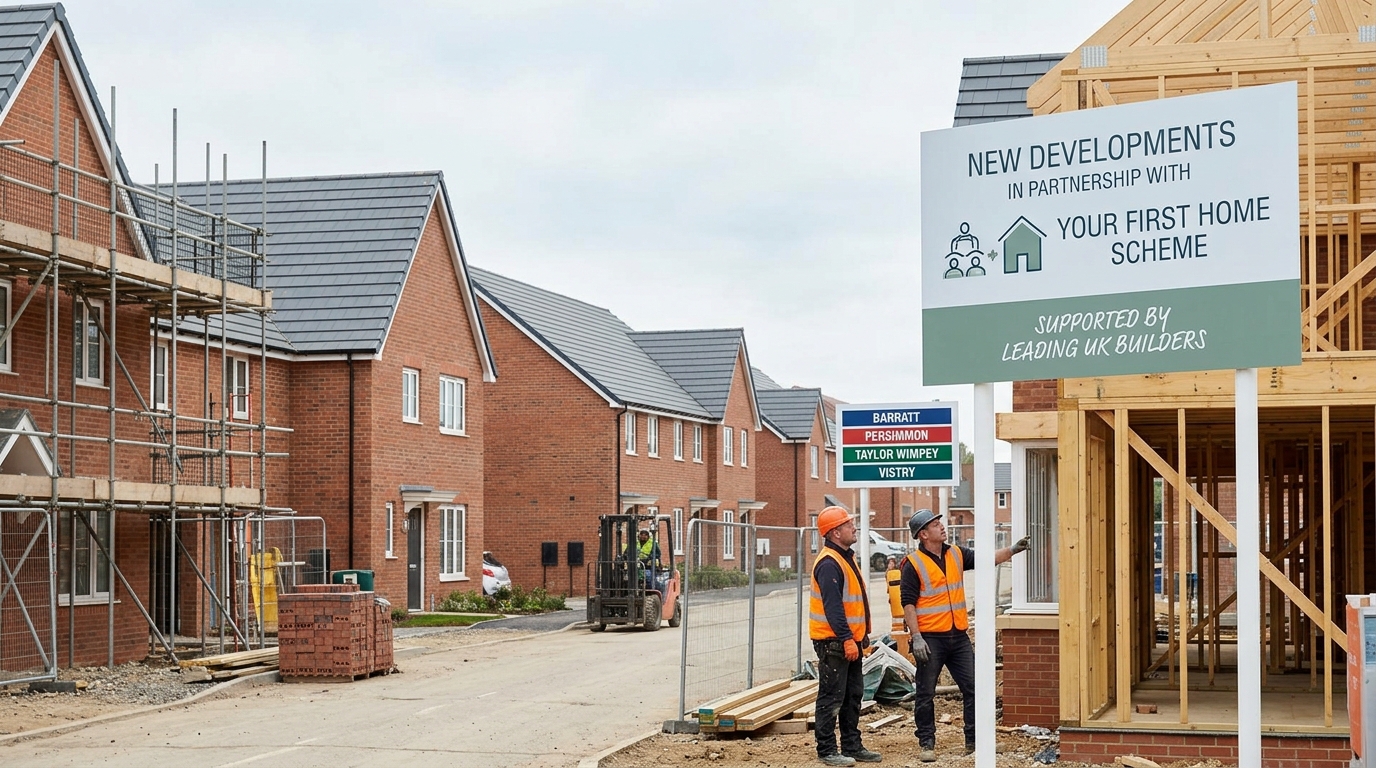
Shares in Barratt Redrow, Persimmon, Taylor Wimpey, and Vistry surged between 13% and 16% on Saturday after Prime Minister Andy Burnham announced the “Your First Home” scheme on the eve of Labour’s party conference. The FTSE 100 rose about 0.26% and the more domestically focused FTSE 250 gained 0.4%, even as mining stocks dragged and oil pushed above $106 a barrel. JPMorgan analysts called the plan a potential “game changer” for the sector.
Before buying those shares, investors should spend five minutes with the record of the last scheme.
What the Scheme Does
“Your First Home” allows qualifying first-time buyers in England to purchase a new-build home with a deposit of just 2.5%, backed by a government equity loan covering 20% of the property’s value. The loan carries an initial interest-free period. Household income caps and local property price caps narrow eligibility. Chancellor John Healey will formally confirm details in the October 28 Budget, with pre-registration expected before the end of 2026. Broker Panmure Liberum described it as “the younger sibling of Help to Buy.”
That description is accurate almost to the decimal place. The original Help to Buy equity loan scheme began in April 2013 and was closed to new applications in England in March 2023. It offered up to 20% government loans against new builds (40% in London) and was interest-free for the first five years. The new scheme cuts the minimum deposit from 5% to 2.5%, which is why Peel Hunt analyst Sam Cullen expects roughly 20% of deals to be supported, and a 10% uplift in sales volumes by 2028.
What Help to Buy Actually Did
Here is what the record shows. The scheme supported several of the largest developers in England in growing their completions and profits. Persimmon reported profit before tax of about £1.09 billion for 2018 alone, with nearly half its sales flowing through Help to Buy. Research from the London School of Economics found that in London the scheme increased house prices by about 8% with no discernible effect on construction volumes in supply-constrained areas, while boosting developer revenues by about 57%.
For buyers who used it, the math turned hostile once the interest-free period ended. In year six, borrowers start paying interest on the equity loan, which is 1.75% in the first year of charges, and then rises annually thereafter. Buyers who eventually sold also repaid the loan as a percentage of the sale price, not the original amount borrowed: borrow 20% of a £200,000 home, sell at £300,000, and the repayment is £60,000 on a £40,000 loan.
The Investment Case Today
The equity picture for shareholders is cleaner. Housebuilder stocks spent much of 2026 dealing with weak demand, elevated mortgage costs, and a slower construction market. Policy relief is real, and Panmure Liberum names Persimmon as a probable key winner, citing its focus on lower-priced homes that fall squarely within the scheme’s price caps. Taylor Wimpey generated about £3.84 billion in group revenue in 2025 and focuses heavily on entry-level buyers, putting it directly in the path of the new demand. Berkeley, which caters to higher-price London buyers, was up a more modest 5%, consistent with its lesser direct exposure.
The meaningful unknown is the developer participation fee. Burnham’s government says builders will contribute to the scheme’s running costs through a fee tied to property values. Panmure Liberum warned that if that hurdle is set too high, take-up may be limited, and builders with stretched balance sheets could be shut out entirely.
Risks Before October 28
The Budget context matters. UK borrowing reached £77.3 billion in the first five months of 2026-27, running £8.1 billion above the OBR’s forecast. Economists expect Healey to need to find as much as £14 billion to restore the fiscal buffer, and further tax rises are widely anticipated. A scheme funded by reprioritising existing government spending during a Budget that may include new revenue measures is not the same as unlimited capacity. Scheme generosity can be dialed back between now and October 28, and the fine print on income caps, price caps, and developer fees will determine whether the demand boost is closer to Peel Hunt’s 10% or something more modest.
Wealth Takeaway
Government demand subsidies reliably lift housebuilder shares fast and lift buyers’ costs slowly. The trade for investors is to own the companies that capture the demand boost before the scheme details tighten it. The trade to avoid is buying a new-build home purely because the deposit looks smaller, without modelling what that equity loan costs in year six.